Reducing Livestock Manure Odor by 80-100%
Enhancing Productivity through ICT Technology Application
On the 28th, Anseong City in Gyeonggi Province announced the completion of pig farms No. 2 and No. 3, applying the 'Anseong Customized Odor Reduction Smart Windowless (無窓) Livestock Barn Standard Model,' jointly developed with the Industry-Academic Cooperation Foundation of Seoul National University, marking the first such initiative among local governments nationwide.
The newly completed windowless barns at Seungyang Farm in Juksan-myeon and Sinchon 1 Farm in Miyang-myeon come four months after the completion of the first farm in April. The city plans to complete three additional windowless barns within the year, including two pig farms and one broiler farm.
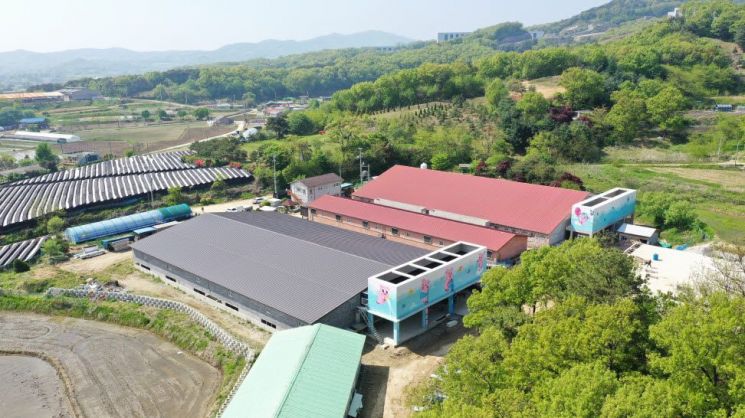 Sinchon 1 Farm in Miyang-myeon, Anseong, applying the standard model of the 'Smart Windowless Livestock Barn' that reduces odors using advanced ICT technology without windows.
 [Photo by Anseong City]
A 'windowless barn' is a livestock facility without windows, unlike traditional open barns, designed to reduce odor and enable efficient facility management by applying advanced ICT technology. The completion of these windowless barns is part of the city's five-year phased odor reduction plan for livestock, which has been underway since last year and will continue through 2027. The city aims to reconstruct or newly build at least 10% of existing old open barns into the windowless barn standard model during this period. Additionally, the city will apply odor reduction facility standards strengthened by more than 40% to barns and encourage closure through relocation and demolition for farms with frequent complaints.
The smart windowless barns feature ▲windowless centralized exhaust ▲washing towers (air washers, biofilters) ▲liquid manure circulation systems ▲CCTV ▲automatic feeding and watering systems ▲ICT odor measurement devices ▲and eight disinfection facilities. Through these, the city expects to reduce livestock odors by 80 to 100% compared to existing open barns.
Specifically, the newly completed smart windowless barn No. 2 farm simultaneously applies two models: side-wall entry for farrowing pens and underground channel entry for gestation pens, enabling automatic control of optimal temperature and humidity in pig houses via ICT. For smart windowless barn No. 3 farm, the city explained that a large-scale liquid manure storage tank with a capacity of 3,400 tons was installed, allowing effective liquid manure circulation and manure treatment.
The city anticipates that improving the breeding environment through windowless barns will increase the annual number of piglets born per sow by more than 30%, contributing to enhanced farm productivity. Furthermore, by eliminating windows, the barns block external risk factors, helping to prevent livestock diseases, the city added.
Kim Bora, Mayor of Anseong City, stated, "We will take the lead in smoothly implementing the five-year phased livestock odor reduction plan to not only solve the livestock odor problem but also enhance the competitiveness of farms."
© The Asia Business Daily(www.asiae.co.kr). All rights reserved.
![Clutching a Stolen Dior Bag, Saying "I Hate Being Poor but Real"... The Grotesque Con of a "Human Knockoff" [Slate]](https://cwcontent.asiae.co.kr/asiaresize/183/2026021902243444107_1771435474.jpg)















