Sixth Explosion Since Last December
Blue Lagoon Hot Springs Operations Suspended
Another volcano erupted after about two months on the Reykjanes Peninsula in the southwest of Iceland, a Nordic island nation.
On the 22nd (local time), major foreign media outlets reported, citing the Icelandic Meteorological Office, that the sixth volcanic eruption since last December occurred in the area south of the capital Reykjavik. The Meteorological Office stated, "After a series of earthquakes on the Reykjanes Peninsula in the afternoon, the eruption began," adding, "Hot lava was ejected into the air." The eruption occurred in the Sundhnukagigar volcanic area north of the fishing village Grindav?k on the Reykjanes Peninsula, according to the Meteorological Office.
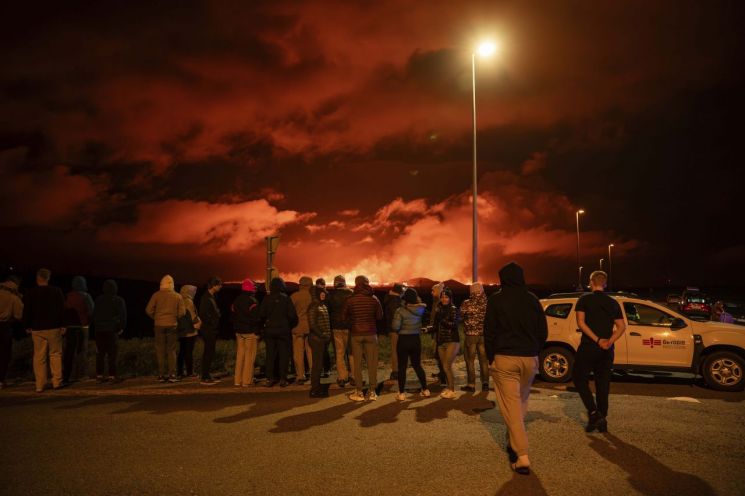
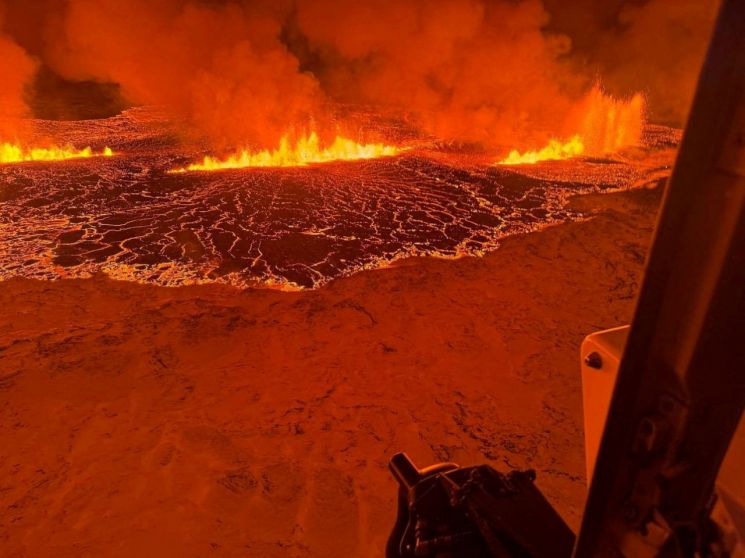 A helicopter is flying over the skies near Grindavik, Iceland, where bright red lava is erupting from a volcanic explosion last December.
 [Photo by Reuters Yonhap News]
The previous volcanic eruption started on May 29 and lasted for 24 days, ending on June 22. Iceland has 33 active volcanoes, but there had been no eruptions on the Reykjanes Peninsula for 800 years until March 2021. Since volcanic activity resumed on the Reykjanes Peninsula in 2021, there have been nine eruptions to date. In response, authorities installed artificial barriers to block lava flowing into the Svartsengi geothermal power plant, the famous Blue Lagoon hot springs, and the village of Grindav?k.
About 30,000 people, or 8% of Iceland's total population of approximately 400,000, live on the Reykjanes Peninsula. Local media reported that residents of Grindav?k are evacuating. When signs of volcanic activity such as earthquakes appeared in November last year, 4,000 residents of Grindav?k evacuated in advance according to evacuation orders and have not yet returned home. The Blue Lagoon hot springs also suspended operations at hotels and evacuated guests. Reykjavik Keflavik Airport reported that current flights are not affected.
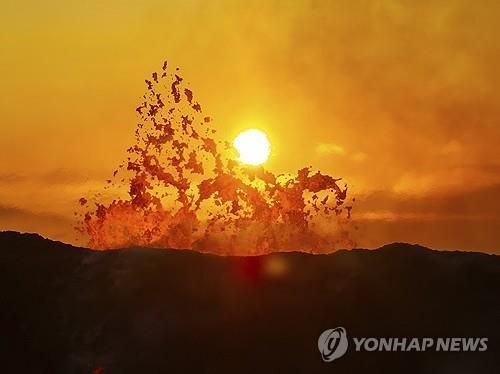 On June 10th, lava was erupting from a volcano on the Reykjanes Peninsula in Iceland.
 [Photo by AP Yonhap News]
Due to its geographical location on the boundary between the North American and Eurasian tectonic plates, Iceland frequently experiences earthquakes and volcanic eruptions. Scientists have warned that volcanic eruptions could repeat on the Reykjanes Peninsula over decades or even centuries. However, volcanic eruptions on the Reykjanes Peninsula are known as "fissure eruptions," which occur along cracks on the mountainside and generally do not involve widespread ash dispersion or large-scale explosions. When a volcano erupted in Iceland in 2010, southerly winds spread volcanic ash across Europe, causing an unprecedented aviation crisis that grounded about 100,000 flights.
© The Asia Business Daily(www.asiae.co.kr). All rights reserved.
![Clutching a Stolen Dior Bag, Saying "I Hate Being Poor but Real"... The Grotesque Con of a "Human Knockoff" [Slate]](https://cwcontent.asiae.co.kr/asiaresize/183/2026021902243444107_1771435474.jpg)

















