Interview with Seonkyung, Head of Korea-style ARPA-H Task Force
1.2 Trillion KRW Invested in Large-scale Project by 2032
"Pursuing R&D with Great Public Benefits Despite Low Success Rates"
"Focusing on Innovative Projects Often Questioned as 'Will It Really Work?'"
"With COVID-19 as a turning point, health issues have now become 'health security' beyond the economy. From vaccines to a super-aged society, we will boldly challenge the R&D projects that Korea needs right now."
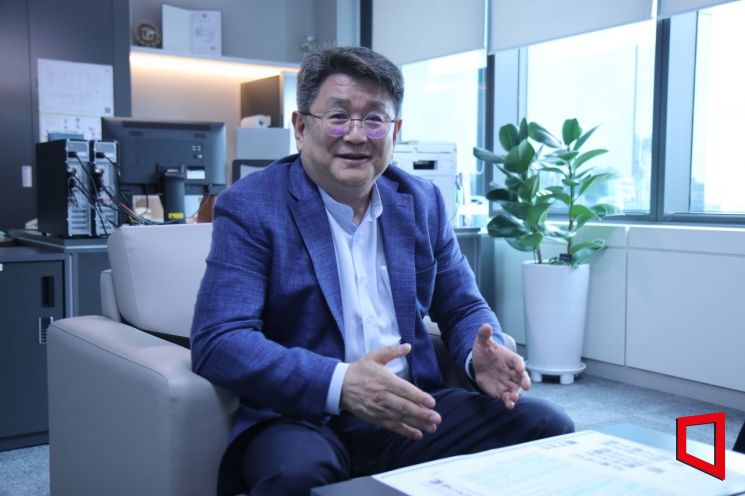 Seonkyung, head of the Korean ARPA-H project promotion team, is being interviewed by Asia Economy.
 [Photo by Lee Chunhee]
The Korean-style Advanced Research Project in Healthcare (KARPA-H), a large-scale government research and development (R&D) project with a budget of 1.1628 trillion won until 2032, recently set sail. It is a healthcare R&D support system benchmarked after the U.S. Defense Advanced Research Projects Agency (DARPA) and Advanced Research Projects Agency for Health (ARPA-H), which are known as places that "encourage failure."
Seon Kyung, head of the KARPA-H project team and professor at Kyung Hee University College of Medicine, said in an interview with Asia Economy on the 23rd, "We started from the awareness that we need to have R&D capabilities to respond to security elements threatening public health so that we can overcome the next pandemic. Even if the success rate is only 10-20%, we will undertake projects that, if successful, can bring tremendous benefits to all citizens."
The initial tasks announced at the project team's opening ceremony last month all focus on "innovation." In the health security field, the tasks include developing ultra-long-term vaccine stockpiling technology and establishing a decentralized vaccine production system. In the welfare and care sector, the task is to develop multimodal treatment technology for sarcopenia. Seon said, "All of these are 'high-risk, high-reward' projects that, despite having considerable competitiveness if developed successfully, also have a high chance of failure. Our goal this year is to add similar projects and decide on a total of 10 projects including the implementing institutions."

The emphasis on "challenges that can afford failure" stems from the awareness that domestic R&D is overly focused on success. Seon said, "Currently, the domestic R&D success rate reaches 98%, but abroad, the reaction is that 'they only choose projects that are sure to succeed.' Half of the people who hear about the project plan respond with 'Is this really possible?' which means it is truly innovative," emphasizing the need for bold challenges.
KARPA-H also promotes a "project manager (PM)-centered" project for the same reason. The PM is responsible for the entire cycle from problem identification, preliminary planning, project selection, to management, playing an integrated project management role. Seon explained, "Until now, PMs have only focused on distributing tasks and managing outcomes. In KARPA-H, PMs function not only as researchers and developers but also as investors and CEOs, and they must devise exit strategies in case of failure," highlighting its importance.
In fact, various systems that allow failure have been established. Unlike typical projects, the evaluation criteria abolish grading that distinguishes success or failure. Instead, qualitative indicators excluding success or failure are evaluated, so that even if a project fails but is conducted diligently, there will be no disadvantages. Seon emphasized, "KARPA-H is a 'process-oriented' R&D. Even if the final outcome is not achieved, if some results are obtained during the process, there will be no penalties, allowing learning from failure."
However, even though failure is tolerated, if nothing is ultimately successful, there is nothing to gain. Therefore, KARPA-H incorporates various efforts to increase the actual likelihood of success. The core is the "3P." Seon said, "Before project implementation, we quickly check all projects, publications, and patents worldwide," adding, "It is a system designed so that research can consider technology commercialization, including intellectual property rights, from the planning stage to overcome the 'valley of death' that must be crossed at the commercialization stage."
© The Asia Business Daily(www.asiae.co.kr). All rights reserved.
![Clutching a Stolen Dior Bag, Saying "I Hate Being Poor but Real"... The Grotesque Con of a "Human Knockoff" [Slate]](https://cwcontent.asiae.co.kr/asiaresize/183/2026021902243444107_1771435474.jpg)
















