Policy Debate on Abolishing 단통법 Held by Democratic Party on 22nd
Various Alternatives Proposed Including Complete Self-Sufficiency and Separate Notification
Ministry of Science and ICT & Korea Communications Commission: "Towards Enhancing Consumer Welfare"
Telecommunications experts and industry insiders unanimously agreed that alternatives should be considered to minimize side effects following the abolition of the Act on the Improvement of Distribution Structure of Mobile Communication Terminals (hereinafter referred to as the Terminal Distribution Act). Various alternatives such as a complete device subsidy system and transferring some provisions of the Terminal Distribution Act to the Telecommunications Business Act were discussed.
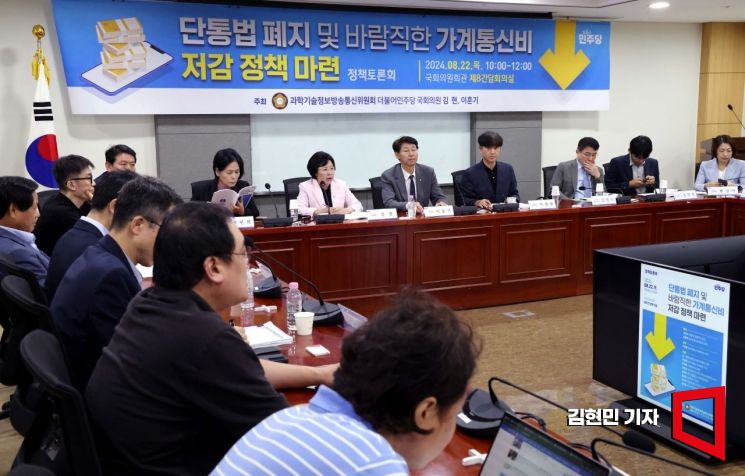 Kim Hyun, a member of the Democratic Party of Korea, is giving a greeting at the policy discussion on the abolition of the Mobile Device Distribution Act and the establishment of desirable household communication cost reduction policies held at the National Assembly Members' Office Building on the 22nd. Photo by Kim Hyun-min kimhyun81@
On the morning of the 22nd, at the 8th conference room of the National Assembly Members' Office Building, Professor Shin Min-su of Hanyang University's Department of Business Administration suggested that alternatives should be created by strengthening the positive aspects of the Terminal Distribution Act while reducing its negative parts during the "Discussion on the Abolition of the Terminal Distribution Act and the Establishment of Desirable Household Communication Cost Reduction Policies," hosted by Democratic Party lawmakers Kim Hyun and Lee Hoon-gi. Professor Shin was responsible for the first presentation titled "Evaluation and Tasks of the Terminal Distribution Act."
He introduced alternatives that could be discussed after the abolition of the Terminal Distribution Act, including ▲complete device subsidy system (separating the distribution of devices and mobile communication services) ▲compromise-type complete device subsidy system (similar to the complete device subsidy system but allowing communication service subscriptions at sales points subcontracted by telecom companies) ▲revision of the Terminal Distribution Act (separate disclosure and prohibition of subsidy payments) ▲abolition of the Terminal Distribution Act and amendment of the Telecommunications Business Act.
While emphasizing the need to consider the pros and cons of the proposed alternatives, Professor Shin stressed that the most important factor in reducing household communication costs is a policy to lower device prices. He said, "Statistics show that communication service fees are decreasing, so lowering device prices is important," adding, "Inducing device price reductions to enhance consumer welfare is key, so incentives for manufacturers are necessary." He also mentioned the need to provide a minimum two-year grace period for implementing alternatives after abolition, protect users due to the abolition of the law, and prevent damage to MVNO operators and small retailers.
Jung Kwang-jae, head of the Telecommunications Policy Research Office at the Korea Information Society Development Institute (KISDI), suggested that "institutional improvements to the selective discount system are necessary." The selective discount system mandates a 25% discount on fees equivalent to subsidies for subscribers who do not receive subsidies. Jung was responsible for the presentation on "Changes in the Telecommunications Market after the Introduction of the Terminal Distribution Act and Future Policy Directions" at the discussion.
Jung said, "Users' dependence on the selective discount is increasing," and added, "It is necessary to consider transferring this provision to the Telecommunications Business Act to maintain it after the abolition of the Terminal Distribution Act."
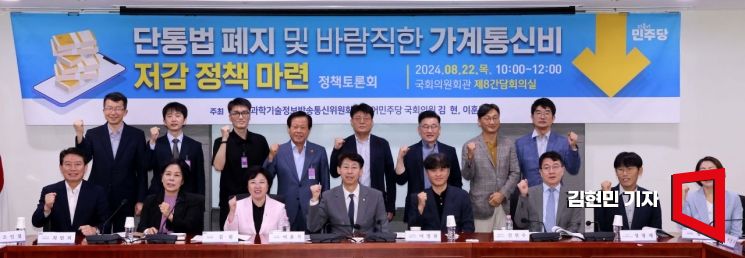 Chairperson Choi Min-hee of the National Assembly's Science, ICT, Broadcasting and Communications Committee and other attendees are taking a commemorative photo at the policy discussion on the abolition of the Mobile Device Distribution Improvement Act and the establishment of desirable household communication cost reduction policies held at the National Assembly Members' Office Building on the 22nd. Photo by Kim Hyun-min kimhyun81@
Lee Jong-cheon, director of the National Mobile Communication Distribution Association, emphasized the need to protect and improve small retailers and agencies during the discussion. He pointed out the necessity of ▲preventing discriminatory acts in telecom companies' direct rate plans ▲introducing a telecom distribution network reporting system ▲preventing incentive discrimination.
Device manufacturers expressed concerns about the complete device subsidy system, one of the proposed alternatives. Yoon Nam-ho, Executive Director of Samsung Electronics MX Marketing Group, said, "The ultimate goal of the complete device subsidy system should be to provide incentives to lower device prices, but I doubt whether it will achieve that," adding, "Consumer inconvenience may increase, and the distribution network may shrink, leading to a sharp decline in device demand." He further stated, "From the manufacturers' perspective, a sharp drop in device demand could reduce sales and create a vicious cycle for the business."
The relevant ministries, the Korea Communications Commission and the Ministry of Science and ICT, plan to design alternatives after the abolition of the Terminal Distribution Act that enhance consumer welfare. Cho Ju-yeon, head of the Telecommunications Market Survey Division at the Korea Communications Commission, said, "It is necessary to actively consider maintaining the selective discount system, providing notifications to prevent incomplete sales, and revitalizing the distribution of used phones," adding, "It is also necessary to strengthen post-regulation so that MVNO operators can grow healthily amid intensified competition after the abolition of the law."
Shim Ju-seop, head of the Telecommunications Usage System Division at the Ministry of Science and ICT, said, "Regulations that restrict competition among operators, such as disclosing or limiting subsidies, will be removed, and user protection provisions will be transferred to the Telecommunications Business Act for implementation," adding, "The selective discount system will maintain its legal basis and be properly operated to ensure that subsidy competition is not hindered."
© The Asia Business Daily(www.asiae.co.kr). All rights reserved.
![Clutching a Stolen Dior Bag, Saying "I Hate Being Poor but Real"... The Grotesque Con of a "Human Knockoff" [Slate]](https://cwcontent.asiae.co.kr/asiaresize/183/2026021902243444107_1771435474.jpg)
















