Consumer Sentiment Index at 100.8... Down 2.8p from Previous Month
Impacted by Timeff Unsettled Crisis and Black Monday
Expected Inflation at 2.9% for Second Consecutive Month
The consumer sentiment index, which had reached its highest level in 2 years and 3 months, declined again after 3 months. This was due to the aftermath of the large-scale unsettled payment incidents in e-commerce platforms such as TMON and WEMAKEPRICE (TMEP), as well as the Black Monday that recorded the largest stock price drop in history.
The expected inflation rate, which indicates the forecasted consumer price inflation over the next year, remained in the 2% range for the second consecutive month. Expectations for housing price increases were the highest in 2 years and 10 months.
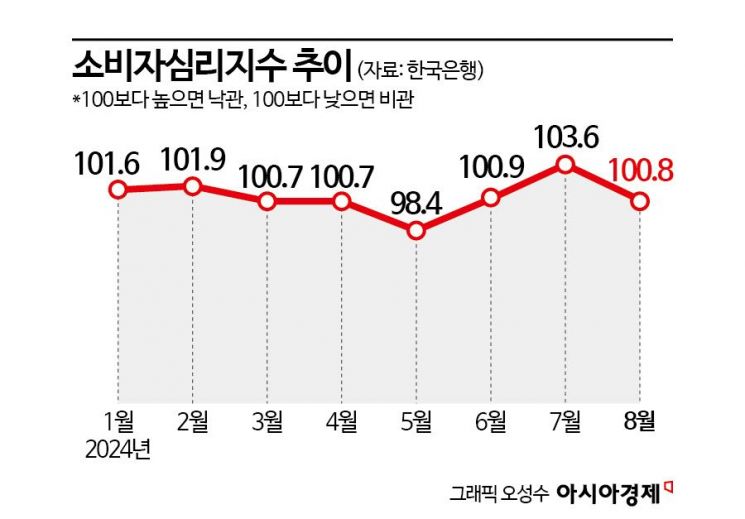
According to the 'August Consumer Sentiment Survey Results' released by the Bank of Korea on the 20th, the Consumer Confidence Index (CCSI) for this month was 100.8, down 2.8 points from the previous month. The consumer sentiment index had reached a peak of 103.6 last month, the highest in 2 years and 3 months, due to export growth and expectations of interest rate cuts, but it turned downward again after three months. This was caused by the recent global stock market plunge amid concerns about a U.S. economic recession and the large-scale unsettled payment situation in e-commerce.
The CCSI is a sentiment indicator calculated using six major indices that make up the Consumer Sentiment Index (CSI). A value above the long-term average (2003?2023) of 100 indicates optimistic consumer sentiment, while a value below 100 indicates pessimism.
Hwang Hee-jin, head of the Statistical Survey Team at the Bank of Korea’s Economic Statistics Bureau, said, "This month’s consumer sentiment index initially overreacted psychologically due to the sudden flood of U.S.-origin economic news following the sharp stock market drop on Black Monday, September 5th. However, the index gradually recovered during the survey period."
He added that the impact of the government’s real estate supply measures announced on the 8th might be somewhat limited. Hwang explained, "Since about 80% of responses are collected in the first three days of the survey (September 6th?8th), the reflection rate of the government’s August 8th real estate measures might be low."
The expected inflation rate for the next year remained unchanged at 2.9%, the same as the previous month. The expected inflation rate has stayed in the 2% range for two consecutive months since last month.
Hwang explained, "Recent news about rising agricultural product prices due to weather conditions such as heavy rain and heatwaves, along with remaining factors for public utility fee increases in the second half of the year, have kept expected inflation from falling further, maintaining it at the same level as last month."
Perceptions of household financial conditions and the economic situation both worsened. The Household Income Outlook CSI dropped 2 points to 98 from the previous month, and the Consumption Expenditure Outlook CSI fell 2 points to 109. The Current Economic Conditions CSI (73) decreased by 4 points, and the Future Economic Outlook CSI (81) declined by 3 points.
Housing Price Expectations Reach Highest in 2 Years and 10 Months
Following last month, expectations for housing price increases remained high. This month’s Housing Price Outlook CSI rose 3 points to 118 from the previous month. This is the highest level in 2 years and 10 months since October 2021 (125). The increase in apartment sales transactions in the Seoul metropolitan area and the continued upward trend in prices are interpreted as factors sustaining expectations for housing price increases.

Hwang said, "Although the Housing Price Outlook CSI is lower than the peak of 132 in December 2020, expectations for housing price increases are reflected similarly to the second half of 2020, when the sentiment of rising housing prices was strongly reflected."
The Price Level Outlook CSI (145) rose by 1 point from the previous month, due to rising petroleum prices despite a slowdown in agricultural product price increases.
The Interest Rate Outlook CSI (93) fell 2 points from the previous month as expectations for U.S. interest rate cuts increased and market interest rates declined.
The major items expected to influence consumer price increases over the next year were public utility fees (53.6%), agricultural, livestock, and fishery products (49.8%), and petroleum products (35.3%). Compared to the previous month, the share of responses for rent (up 1.8 percentage points) and petroleum products (up 0.3 percentage points) increased, while the share for public utility fees decreased by 0.7 percentage points.
This survey was conducted from the 6th to the 13th of the month, targeting 2,500 urban households nationwide (2,280 responses received).
© The Asia Business Daily(www.asiae.co.kr). All rights reserved.
![Clutching a Stolen Dior Bag, Saying "I Hate Being Poor but Real"... The Grotesque Con of a "Human Knockoff" [Slate]](https://cwcontent.asiae.co.kr/asiaresize/183/2026021902243444107_1771435474.jpg)


















