"Proceed with the 5 Plans Even If Immediate North Korean Response Is Absent"
"True Overcoming of Japan Is Driving Cooperation with Japan"
"US-Japan-South Korea Cooperation Will Continue Even After Prime Minister Kishida's Resignation"
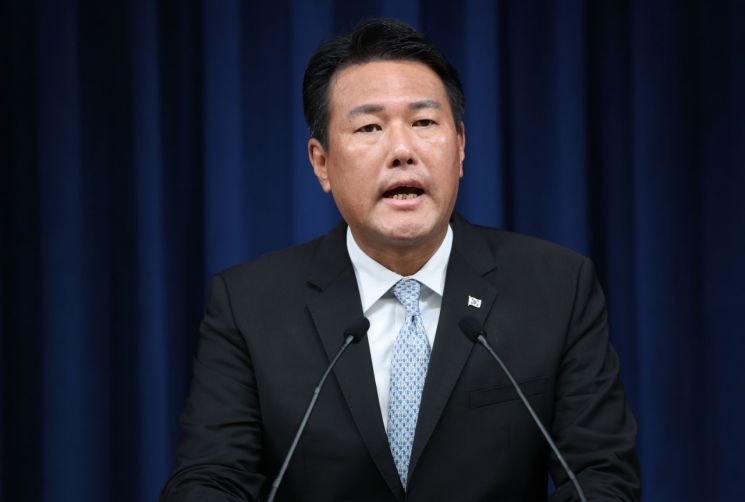 Kim Tae-hyo, the First Deputy Director of the National Security Office, is explaining President Yoon Suk-yeol's '8.15 Unification Doctrine' at the Presidential Office building in Yongsan, Seoul, on the 15th.
 [Image source=Yonhap News]
The Presidential Office stated on the 15th regarding President Yoon Suk-yeol's announcement of the '8.15 Unification Doctrine' on Liberation Day, "Humanitarian aid to North Korea and the inter-Korean dialogue consultative body require the North Korean authorities' response," adding, "We will wait."
Kim Tae-hyo, the First Deputy Director of the National Security Office, held a briefing at the Yongsan Presidential Office on the same day and said, "The last remaining task before us is unification, and when the freedom we currently enjoy expands to the northern land, the meaning of Liberation Day will be fully realized."
President Yoon announced the '8.15 Unification Doctrine' at the 79th Liberation Day celebration. This unification doctrine, which inherits and develops the 1994 National Community Unification Plan, is titled "Challenge and Response for Free Unification."
The unification doctrine includes three major unification visions, three unification promotion strategies, and seven unification promotion measures. The seven measures include proposals to establish a dialogue consultative body between the South and North authorities, promotion of humanitarian aid to North Korean residents, activation of unification programs, expansion of North Korean residents' "right to access information," and the establishment of an international Korean Peninsula forum.
Deputy Director Kim said, "Among the seven unification promotion measures, humanitarian aid to North Korea and the inter-Korean dialogue consultative body require the North Korean authorities' response. Even if there is no immediate response, the other five unification measures are plans we can independently devise and proactively pursue."
He explained that the 1994 National Community Unification Plan was about achieving national unification through voluntary negotiations and agreements between the South and North authorities, but it did not include the ultimate vision of unification we aim to reach or the strategies on what and how we should do to achieve it.
He emphasized that the Yoon Suk-yeol administration's unification doctrine is distinguished by clearly defining the goal of achieving a free unified Republic of Korea in accordance with the spirit of the Constitution of the Republic of Korea, clarifying the aspiration of unification where all members of the Korean Peninsula enjoy freedom, and presenting an action plan to strengthen our unification capabilities.
Deputy Director Kim said, "In three days, on August 18, it will be the first anniversary of the Camp David Declaration," adding, "Last year around this time, the leaders of South Korea, the United States, and Japan announced the Camp David Principles, declaring that the three countries support a free and peaceful unified Korean Peninsula."
He continued, "I hope that the unification doctrine announced today will serve as an opportunity to steadily prepare and foster the mindset for unification with our allies and friendly countries in the international community, assuring regional countries that unification also benefits their interests, thereby expanding the momentum for unification."
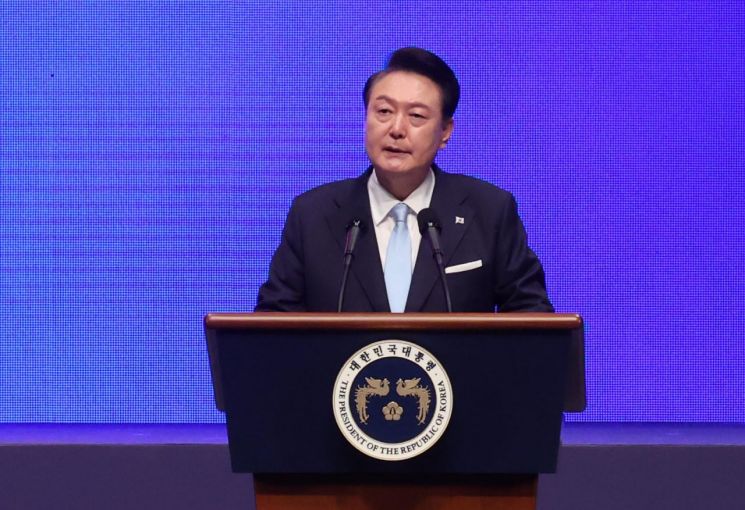 President Yoon Suk-yeol delivers a congratulatory speech and announces the '8.15 Unification Doctrine' at the 79th Liberation Day Celebration held at the Sejong Center for the Performing Arts in Jongno-gu, Seoul on the 15th.
 [Image source=Yonhap News]
Regarding the absence of any message related to Japan in President Yoon's Liberation Day speech, the Presidential Office said, "The speech implies that South Korea's trade and economic capabilities have grown enough to engage in fair competition with Japan," adding, "Although it did not explicitly mention South Korea-Japan relations, it showed confidence in those relations."
They added, "When we lead cooperation with Japan while being welcomed by the international community, I think that is the true path to overcoming Japan."
A Presidential Office official said about the plan to expand North Korean residents' access to information, "Loudspeakers or leaflets directed at North Korea may have some effect, but we do not intend to overly rely on analog methods that escalate tensions between the South and North," adding, "Various religious and civic groups are broadcasting content through diverse channels, and we hope such efforts become more vibrant and engaging."
Regarding President Yoon's proposal to establish a working-level dialogue consultative body between the South and North authorities, the official said, "Currently, the North Korean regime has locked official inter-Korean dialogue channels and is focused on regime consolidation," adding, "We cannot optimistically expect a response at this time."
However, the official said, "Sudden surprise events where the South and North leaders meet and shake hands do not help the development of inter-Korean relations," adding, "By discussing each issue concretely through the dialogue consultative body and finding clues, and building trust, the two leaders can meet anytime and expand on that."
The Presidential Office viewed that the recent announcement of Prime Minister Kishida Fumio's intention to step down would not pose significant problems for South Korea-Japan or South Korea-U.S.-Japan security cooperation.
A Presidential Office official said, "Among the main figures of Camp David, the Japanese prime minister is expected to change, and the U.S. will also have a new president after the November election," adding, "However, the trilateral cooperation among South Korea, the U.S., and Japan through Camp David, agreed upon last August and steadily implemented since, continues to be concretized."
© The Asia Business Daily(www.asiae.co.kr). All rights reserved.
![Clutching a Stolen Dior Bag, Saying "I Hate Being Poor but Real"... The Grotesque Con of a "Human Knockoff" [Slate]](https://cwcontent.asiae.co.kr/asiaresize/183/2026021902243444107_1771435474.jpg)
















