Supply of Non-Apartment Housing, Aiming to Improve Residential Environment
Relaxation of Building Standards Such as Floor Area Ratio, Financial Support, etc.
Application by Autonomous Districts → Selection Through City Review
Seoul City will support new construction and remodeling to increase housing supply in old low-rise residential areas where redevelopment is difficult.
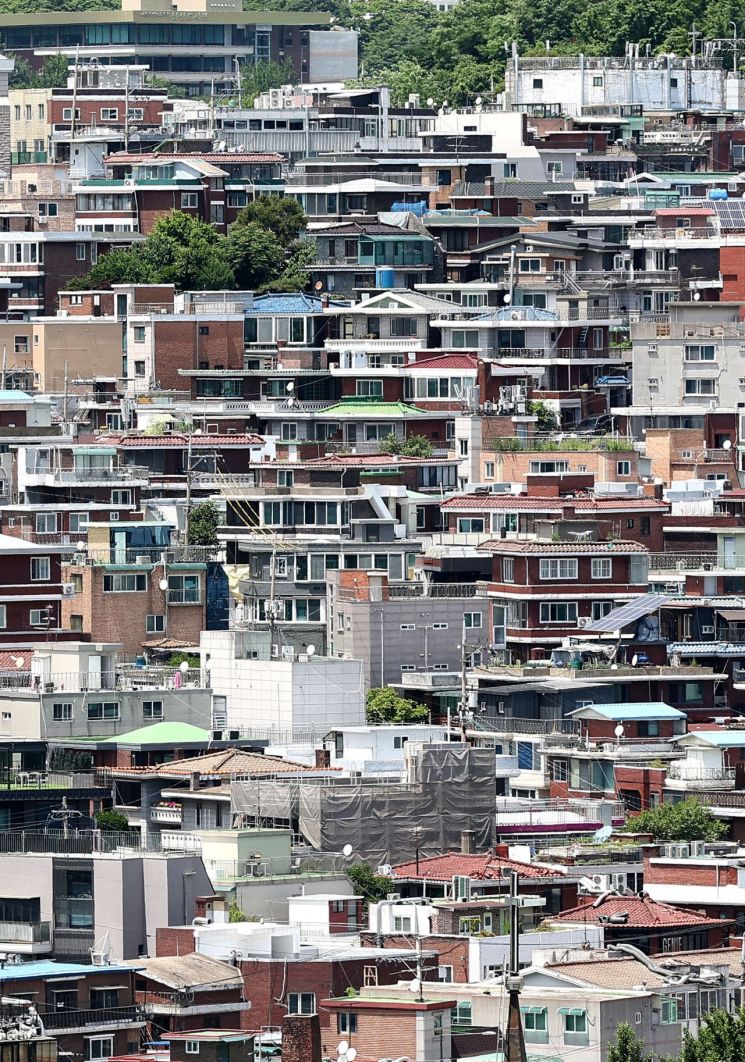
The city announced on the 15th that it will hold a public contest for the ‘Human Town 2.0 Project Sites’ targeting 25 autonomous districts from the 16th to the 30th of this month.
The ‘Human Town 2.0’ project supports individual building construction rather than full demolition reconstruction or redevelopment, providing housing stability measures such as new construction and remodeling of multi-family, multi-household, and row houses. The city explained, “The goal is to revitalize housing maintenance by easing building regulations in low-rise residential areas where maintenance was difficult due to legal and project funding issues, and to improve the residential environment by installing infrastructure and convenience facilities.”
If selected as a project site, the area will be designated as a special architectural zone, architectural agreement concentration zone, and remodeling activation zone, where building standards such as floor area ratio, building coverage ratio, landscaping area, and open space within the site will be relaxed. The city will also provide 200 million KRW in city funds for planning such as zone designation.
Additionally, to enable building owners to practically proceed with individual construction, the city will match them with humanators (experts in architecture and related fields) to provide advice and consulting. To reduce the financial burden on building owners, the city will support up to 3% of the loan interest on project costs up to 3 billion KRW and provide financial support such as tax reductions.
Along with this, the city will establish Moa Centers (village management offices) that comprehensively provide housing management services such as safety patrols, simple home repairs, unmanned parcel lockers, and safe zones for secondhand transactions, and support the creation of resident convenience facilities such as roads and public parking lots. For this, the city will provide up to 10 billion KRW in city funds.
In March, the city selected three sites as pilot projects for Human Town 2.0: 214 Sinyeong-dong, Jongno-gu; 85-29 Guro-dong, Guro-gu; and 422-1 Mangu-dong, Jungnang-gu, and held resident briefing sessions. Currently, humanator architectural consulting is underway and management plans are being established.
When autonomous districts discover and apply for sites that meet the contest requirements, the city will consult, conduct on-site inspections, and select sites through a selection committee review. The selection committee consists of the city’s residential environment improvement advisory group and experts in architecture and related fields. The evaluation criteria include project feasibility, willingness to proceed with the project, and project effectiveness. Additional points will be given to areas where participation in the New:Village project is possible or where buildings capable of establishing Moa Centers are secured.
The mandatory contest requirements are: an area of 20,000㎡ or more; a ratio of old and poor-quality housing of 50% or more; and a zoning district of second-class general residential area or lower with building regulations. However, areas smaller than 20,000㎡ may apply if project effects are expected. Also, the area must fall into one of the following: residential environment improvement project zone, urban regeneration activation area, or other non-maintenance project areas where infrastructure is relatively good but housing maintenance is urgent due to old or poor-quality buildings.
Among the selected areas, autonomous districts wishing to participate in the New:Village project promoted by the Ministry of Land, Infrastructure and Transport will also consider applying for the New:Village project site contest in consultation with the city.
Han Byung-yong, Director of the Seoul City Housing Office, said, “Human Town 2.0 is a practical non-apartment supply measure that can dramatically improve the residential environment of low-rise residential areas left out of development blind spots,” and added, “We will continue to expand the designation of Human Town project sites to promote housing supply for low-income residents.”
© The Asia Business Daily(www.asiae.co.kr). All rights reserved.
![Clutching a Stolen Dior Bag, Saying "I Hate Being Poor but Real"... The Grotesque Con of a "Human Knockoff" [Slate]](https://cwcontent.asiae.co.kr/asiaresize/183/2026021902243444107_1771435474.jpg)















