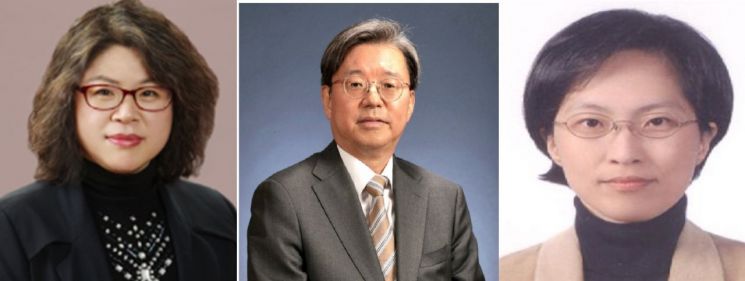
 From the left, Kim Bok-hyung, Chief Judge of the Seoul High Court (56, 24th class), Kim Jeong-won, Secretary General of the Constitutional Court (59, 19th class), and Yoon Seung-eun, Chief Judge of the Seoul High Court (57, 23rd class), who were recommended as new Constitutional Court Justice candidates on the 14th. Photo by the Supreme Court
Three candidates have been recommended as new Constitutional Court justices to succeed Justice Lee Eun-ae (58, Judicial Research and Training Institute class 19), who will retire on the 20th of next month: Kim Bok-hyung, Chief Judge of the Seoul High Court (56, class 24); Kim Jeong-won, Secretary General of the Constitutional Court (59, class 19); and Yoon Seung-eun, Chief Judge of the Seoul High Court (57, class 23).
The Constitutional Court Justice Candidate Recommendation Committee (Chairman Lee Kwang-hyung, President of the Korea Advanced Institute of Science and Technology) held a meeting on the afternoon of the 14th with all members present to review the qualifications of candidates nominated from both inside and outside the judiciary. After the evaluation, the committee decided to recommend these three individuals as candidates for nomination as Constitutional Court justices.
Chairman Lee Kwang-hyung delivered the list of the three candidates in writing to Chief Justice Cho Hee-dae immediately after the recommendation committee meeting concluded.
Chairman Lee stated, "In a rapidly changing society, the Constitutional Court plays a crucial role in safeguarding constitutional order by declaring constitutional values that our society must uphold and pursue, guaranteeing citizens' fundamental rights, resolving social conflicts, and achieving national unity. The recommendation committee kept these roles and responsibilities in mind and endeavored to recommend candidates who possess not only legal expertise such as legal knowledge and rational judgment ability but also a firm commitment to realizing constitutional values and protecting citizens' fundamental rights, a strong belief in protecting socially vulnerable and minority groups, the ability to embrace and insightfully understand diverse values in our society, and morality that aligns with the public's expectations."
Earlier, the Supreme Court disclosed a list of 36 candidates for successor justices on the 24th of last month. Among the candidates, 31 were incumbent judges.
The Supreme Court ensured that the recommendation committee could effectively review the candidates' qualifications as Constitutional Court justices by publicly releasing, well in advance of the committee meetings, the list of candidates who consented to the review along with information on their education, major career history, military service, assets, and any criminal records. The committee then gathered broad opinions on the candidates' suitability before presenting the results to the committee.
On the day of the meeting, the recommendation committee thoroughly examined the candidates' qualifications and morality as Constitutional Court justices based on nomination letters, opinion statements, and various review materials including major rulings, work records, asset status, criminal records, and military service. The committee also deeply discussed diverse opinions collected from various sectors of society regarding the desirable candidates for Constitutional Court justices, according to the Supreme Court.
The recommendation committee consists of ex officio members including Chairman Lee Kwang-hyung, Senior Justice Kim Sang-hwan, Director of the Court Administration Office Cheon Dae-yeop, President of the Korean Bar Association Kim Young-hoon, President of the Korean Law Professors Association Cho Hong-sik, and Chairman of the Law School Council Lee Sang-kyung. Non-ex officio members include Professor Kim Kyun-mi of Ewha Womans University, Professor Jeong Soon-seop of Seoul National University Law School, and Chief Judge Lee Sang-yeop of the Uijeongbu District Court Goyang Branch.
All nine Constitutional Court justices are appointed by the President. However, the Constitution stipulates that three justices are elected by the National Assembly, three are nominated by the Chief Justice of the Supreme Court, and the President appoints them accordingly.
The successor to Justice Lee Eun-ae is a nomination quota of Chief Justice Cho Hee-dae. Chief Justice Cho plans to disclose the list of candidates recommended by the committee along with their major rulings and work records on the official website of the Courts of the Republic of Korea. Respecting the committee's recommendations as much as possible, he intends to nominate one new Constitutional Court justice candidate around late this month and submit the appointment proposal to President Yoon Seok-yeol.
Kim Bok-hyung, Chief Judge of the Seoul High Court, graduated from Busan Seoyeon Girls' High School and Seoul National University Law School. He passed the 34th Judicial Examination and completed the Judicial Research and Training Institute as part of class 24. He began his judicial career in 1995 at the Seoul District Court.
He subsequently served as a judge at the Northern Branch of the Seoul District Court, Ulsan District Court, Suwon District Court, Seoul Central District Court, and Seoul High Court, and as a judicial research judge at the Supreme Court. He also served as Chief Judge at the Daegu District Court, judge at the Seoul High Court, Chief Judge of the Chuncheon Branch of the Seoul High Court, Senior Chief Judge at the Chuncheon District Court, and Chief Judge at the Suwon High Court. He currently serves as Chief Judge at the Seoul High Court.
Kim Jeong-won, Secretary General of the Constitutional Court, graduated from Yongsan High School in Seoul and Seoul National University Law School. He passed the 29th Judicial Examination and completed the Judicial Research and Training Institute as part of class 19. He served as a judge at Gunsan Branch of the Jeonju District Court, Jeonju District Court, Incheon District Court, Seoul Family Court, Seoul District Court, Seoul High Court, and Seoul Western District Court.
He later served as Chief Judge at the Gwangju District Court and Chuncheon District Court, was a professor at the Judicial Research and Training Institute, and then served as Chief Judge at the Seoul Central District Court and Seoul Northern District Court. In 2012, he moved to the Constitutional Court as a Senior Chief Research Judge, then served as Senior Chief Research Judge and Secretary General, and currently holds the position of Secretary General.
Yoon Seung-eun, Chief Judge of the Seoul High Court, graduated from Eunkwang Girls' High School in Seoul and Seoul National University Law School. He passed the 33rd Judicial Examination and completed the Judicial Research and Training Institute as part of class 23. He began his judicial career in 1994 at the Daejeon District Court.
He subsequently served at the Cheonan Branch of the Daejeon District Court, Suwon District Court, Seoul Western District Court, Seoul Central District Court, and Seoul High Court. In 2005, he served as Judicial Policy Advisor at the Court Administration Office, in 2006 as Judge of the Judicial Policy Office at the Court Administration Office, and in 2007 concurrently as Criminal Policy Advisor at the Court Administration Office.
He later served as a judge at the Seoul Southern District Court, Chief Judge at the Jeju District Court, professor at the Judicial Research and Training Institute, Chief Judge at the Anyang Branch of the Suwon District Court, and Chief Judge at the Seoul Central District Court. After serving as Chief Judge at the Daejeon High Court, he has been serving as Chief Judge at the Seoul High Court since 2018. Since 2022, he has also concurrently served as Director of the Court Library.
© The Asia Business Daily(www.asiae.co.kr). All rights reserved.
![Clutching a Stolen Dior Bag, Saying "I Hate Being Poor but Real"... The Grotesque Con of a "Human Knockoff" [Slate]](https://cwcontent.asiae.co.kr/asiaresize/183/2026021902243444107_1771435474.jpg)















