As the real estate market recovers in some areas such as Seoul and the metropolitan area, household loans have surged, prompting major banks to attempt to slow down by raising loan interest rates five times in a month. Meanwhile, bank deposit interest rates remain stagnant below the base rate (3.50%).
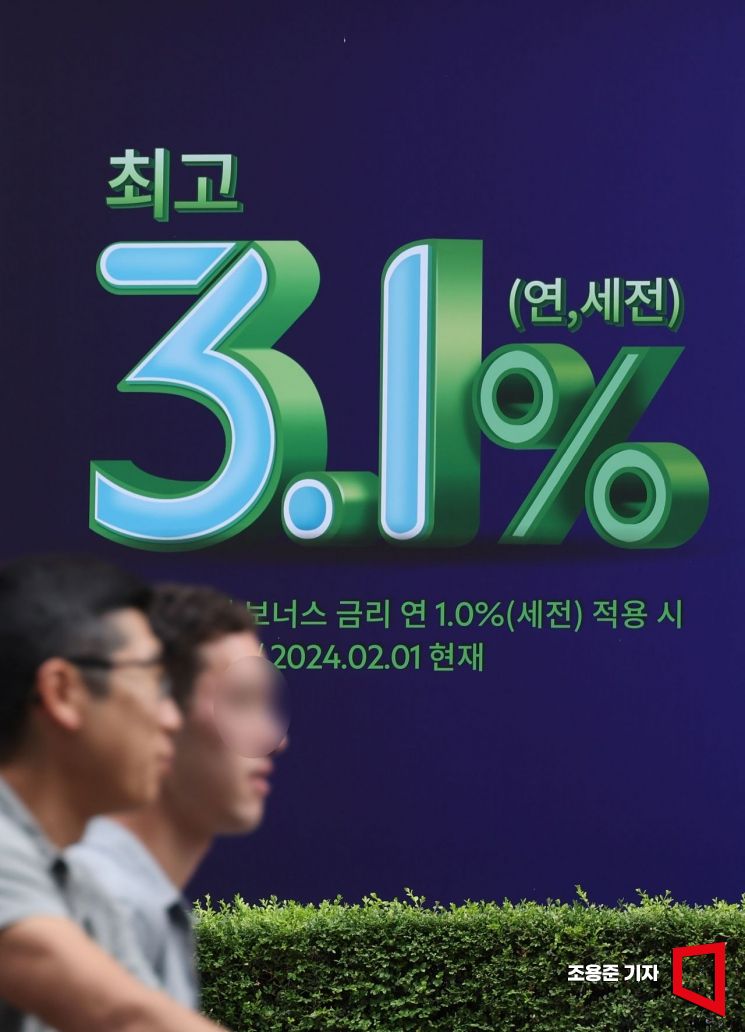 To slow down the pace of household loan growth, commercial banks are successively raising mortgage loan interest rates. On the 3rd, an interest rate notice was posted on the exterior wall of a bank in Namdaemun, Seoul. Photo by Jo Yongjun jun21@
According to the financial sector on the 16th, Shinhan Bank will raise mortgage loan interest rates (including jeonse deposit loans) by up to 0.05 percentage points starting today. For mortgage loans, rates will increase by 0.30 to 0.35 percentage points depending on the maturity of financial bonds, and jeonse deposit loans will also rise by 0.20 to 0.35 percentage points depending on the guarantee institution (Korea Housing Finance Corporation, Seoul Guarantee Insurance) and financial bond maturity. Notably, refinancing mortgage loans will see an increase of up to 0.50 percentage points.
This is the fifth time in nearly a month that Shinhan Bank has raised mortgage loan interest rates. On the 15th, 22nd, and 29th of last month, rates were raised by up to 0.05 and 0.30 percentage points respectively, and on the 7th of this month, rates were increased by 0.30 percentage points. Less than 10 days later, the bank has again raised loan interest rates repeatedly.
Shinhan Bank is not the only one implementing consecutive rate hikes. Woori Bank plans to raise mortgage loan interest rates by up to 0.30 percentage points starting on the 20th. Woori Bank has also raised rates five times in a month. Additionally, KB Kookmin Bank and NH Nonghyup Bank have raised rates two to three times within the same period.
The reason banks have raised interest rates up to five times in a month is due to the recent surge in household debt. As real estate prices recover or rise in some parts of Seoul and the metropolitan area, loan demand is increasing. Moreover, the government's implementation of the second phase of the Debt Service Ratio (DSR) regulation has been postponed to September, stimulating last-minute demand. According to the Bank of Korea, the increase in mortgage loans in July reached 5.6 trillion won. The increase has not decreased compared to April (5 trillion won), May (6 trillion won), and June (5.9 trillion won).
Furthermore, the effect of banks' interest rate hikes is repeatedly offset by falling market bond yields. Expectations are growing that the U.S. Federal Reserve (Fed) will cut the base rate in the second half of the year, even mentioning a 'big cut' (0.50 percentage points), causing bond yields to decline. According to the Korea Financial Investment Association, the 5-year bank bond yield fell to 3.101% on the 6th, marking the lowest point of the year.
A representative from a commercial bank said, "With increasing loan demand and falling market interest rates offsetting the effect of loan rate hikes, we have no choice but to continue raising rates to control the pace. Unless there are loan restrictions, it will be difficult to stop this trend."
On the other hand, deposit interest rates remain stagnant. The average interest rate for 12-month fixed deposits at the five major commercial banks (KB Kookmin, Shinhan, Hana, Woori, NH Nonghyup) remains steady at an annual high of 3.35 to 3.40%. The basic rate without preferential conditions is even lower, ranging from 2.50 to 3.40%. The 1-year bank bond yield, which serves as the benchmark for fixed deposit products, recorded 3.283% as of the 13th of last month, maintaining a low level.
As the gap between loan and deposit interest rates widens, secondary financial institutions such as mutual savings banks are actively targeting this gap. For example, savings banks have recently raised interest rates on demand deposit accounts (commonly called 'parking accounts') and launched high-interest special products to efficiently secure deposits. A savings bank official said, "With the possibility of interest rate cuts in the second half of the year, securing deposits, which serve as 'ammunition' for expanding loan assets again, is becoming increasingly important. The approaching maturity of high-interest deposits at year-end is another reason savings banks are focusing on deposit acquisition."
© The Asia Business Daily(www.asiae.co.kr). All rights reserved.
![Clutching a Stolen Dior Bag, Saying "I Hate Being Poor but Real"... The Grotesque Con of a "Human Knockoff" [Slate]](https://cwcontent.asiae.co.kr/asiaresize/183/2026021902243444107_1771435474.jpg)















