First Implementation of Kyowon University Support Project This Year
Selection of 20 Project Teams as Support Targets
4 Billion KRW per Consortium, 1.75 Billion KRW per Single Project
Presentation of Innovative Models Utilizing AI Textbooks
The Ministry of Education will support teachers from the teacher training stage to strengthen their ability to utilize 'AI (Artificial Intelligence) digital textbooks.' A budget of approximately 4.9 billion KRW will be invested targeting elementary and secondary teacher training universities that present innovative teaching models.
On the 13th, the Ministry of Education announced the results of the selection for the '2024 University Support Project for Improving Teacher Training Programs.' A total of 38 project teams submitted proposals for this project call, and after written and online face-to-face evaluations, 20 project teams were selected as support targets.
The University Support Project for Improving Teacher Training Programs is a project that supports curriculum innovation at teacher training universities (education universities, colleges of education, graduate schools of education) to cultivate teachers who lead instructional innovation in response to changes in the school field such as the high school credit system and the introduction of AI digital textbooks. This project is being promoted for the first time this year.
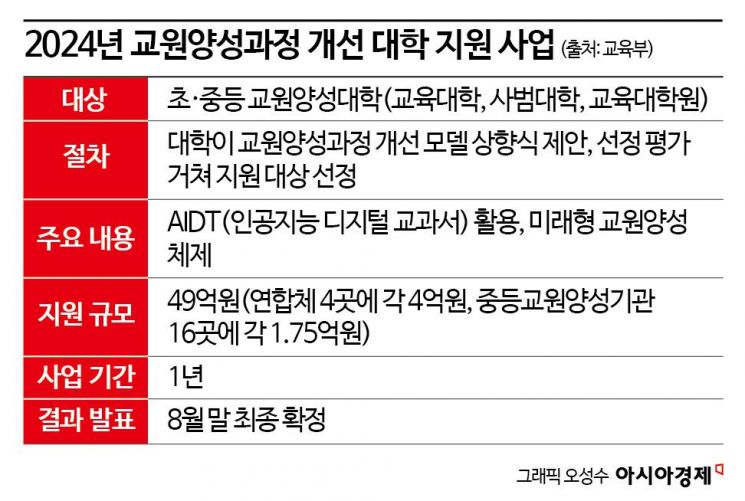
The Ministry of Education estimates the total support amount to be approximately 4.9 billion KRW. Four consortia will receive 400 million KRW each, and 16 secondary teacher training institutions will receive 175 million KRW each. The project period is one year in total.
Previously, the Ministry of Education announced that it would invest 381.8 billion KRW solely in teacher training for digital textbooks. Including various costs such as infrastructure construction, the total scale is estimated to be about 1.2 trillion KRW. The Ministry plans to introduce digital textbooks for English, mathematics, and information subjects in 3rd and 4th grades of elementary school, 1st grade of middle school, and 1st grade of high school starting next year, and to introduce digital textbooks for major subjects from 3rd grade of elementary school to 3rd grade of high school by 2028.
The universities selected as support targets in this project include four consortia and 16 standalone secondary institutions. The consortia include ▲Gyeongin National University of Education (Seoul National University of Education, Chuncheon National University of Education) ▲Daegu National University of Education (Busan National University of Education, Jinju National University of Education) ▲Cheongju National University of Education (Kongju National University of Education, Gwangju National University of Education, Jeonju National University of Education) ▲Korea National University of Education (Jeju National University). The standalone institutions include ▲Catholic Kwandong University ▲Kyung Hee University ▲Keimyung University ▲Kongju National University ▲Daegu University ▲Dongguk University ▲Mokwon University ▲Seowon University ▲Sungshin Women’s University ▲Soonchunhyang University ▲Ewha Womans University ▲Inha University ▲Jeonju University ▲Chosun University ▲Chung-Ang University ▲Hanyang University.
The schools participating in the project call proposed innovative models that include curriculum improvements supporting the strengthening of instructional innovation capabilities using AI digital textbooks. They also included the introduction of education expert training programs and major elective systems. Models that strengthen the field experience of prospective teachers by linking schools and education offices were also presented.
Universities with objections to the evaluation results can file an objection by the 23rd, and the results will be finalized at the end of this month. Based on the submitted proposals, an evaluation committee composed of experts in related fields will conduct written and face-to-face evaluations focusing on ▲boldness of innovation ▲field relevance ▲openness.
© The Asia Business Daily(www.asiae.co.kr). All rights reserved.
![Clutching a Stolen Dior Bag, Saying "I Hate Being Poor but Real"... The Grotesque Con of a "Human Knockoff" [Slate]](https://cwcontent.asiae.co.kr/asiaresize/183/2026021902243444107_1771435474.jpg)
















