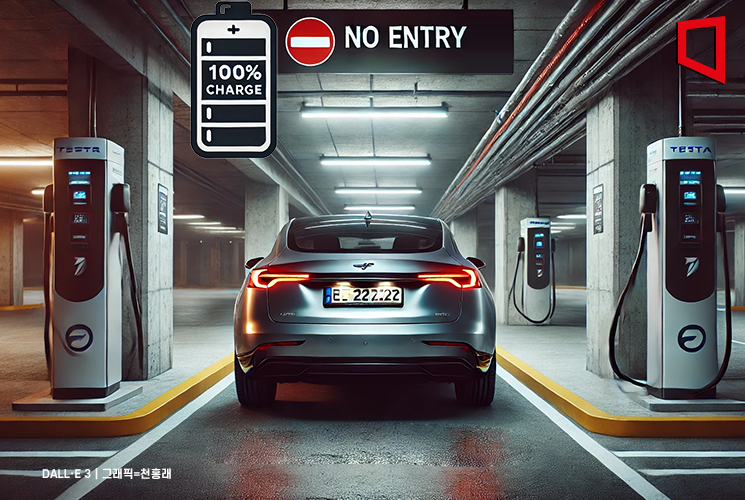
As a series of electric vehicle (EV) fires raises concerns about an emerging "EV phobia," discussions on introducing a so-called battery real-name system that discloses battery information are accelerating. Revealing battery information is expected to guarantee consumers' right to choose when purchasing EVs and alleviate vague anxieties about EV safety. Furthermore, it is analyzed that this could become a catalyst capable of reshaping the landscape of the EV and battery markets.
Within the automotive industry, there is concern that if the type of battery installed in EVs is disclosed, the leadership in the EV market could shift from automakers to battery companies. Automakers nominally resist disclosing battery information, citing the reason that "component information is not disclosed externally one by one." However, internally, they worry that revealing battery information?the core component of EVs?could result in losing their market dominance.
Batteries account for 30-40% of the cost of an EV. They determine key performance factors such as EV lifespan, driving range, and charging speed, which are critical criteria when purchasing an EV. With the introduction of a battery real-name system, consumers will examine not only the car brand but also the battery manufacturer and type when buying an EV. Consequently, the influence of battery manufacturers in the EV market is bound to grow stronger.
This could accelerate moves by automakers to enter the battery market directly and internalize production. For example, Hyundai Motor Company is developing next-generation batteries such as solid-state batteries. In June, Hyundai completed HLI Green Power, a battery factory in Indonesia jointly established with LG Energy Solution. The nickel-cobalt-manganese (NCM) batteries produced there are installed in the Casper Electric.
However, direct entry into the battery market by automakers faces many challenges and risks. Securing stable yield requires a considerable period of know-how accumulation. Although American and European companies have entered the battery market late, they have yet to catch up with Asian countries such as Korea, China, and Japan for this reason. Professor Moon Hak-hoon of Osan University said, "While automakers can secure technological capabilities through battery R&D, it is not easy to establish a large-scale production system directly due to a lack of manufacturing know-how."
Producing batteries directly may bring more disadvantages than advantages for automakers. Currently, when an EV fire occurs, the cause is analyzed, and responsibility is shared between automakers and battery manufacturers. For instance, when a fire occurred in the 2021 Bolt EV, GM recalled 140,000 units, and LG Electronics-LG Energy Solution bore 1.4 trillion won of the recall costs. Professor Lee Ho-geun of Daeduk College said, "If automakers internalize batteries and a safety accident such as a fire occurs, they would have to bear all responsibility alone, making it difficult to make such a decision easily."
The battery real-name system is likely to act as a positive factor for domestic battery companies. Due to negative perceptions of Chinese products, consumers are expected to prefer domestic batteries. This is also anticipated to have a positive effect in promoting technological development among domestic battery companies.
Until now, the choice of which battery to install in a car was entirely up to the automaker. Battery manufacturers would send developed samples to automakers, who would decide whether to install them after quality testing and price negotiations. If battery information is disclosed, an additional criterion of "consumer preference" will be added. Battery manufacturers, who have so far focused only on negotiations with automakers, may now need to strengthen marketing directly targeting consumers. If battery subscription services or battery leasing systems are introduced in the future, battery brands will become even more important.
However, if the quality of Chinese batteries is proven, the situation could be reversed in the long term. Professor Lee Ho-geun said, "For now, trust in domestic batteries is high, so Korean companies could benefit if battery information is disclosed," but added, "If fires occur in domestic batteries as well, the situation could change."
There are also many criticisms that disclosing battery information is not a fundamental measure to prevent EV phobia. Professor Moon Hak-hoon said, "While it is positive to disclose information to consumers, it is uncertain how effective it will be in alleviating fear or preventing EV fires," and added, "An EV battery certification system or evaluation is more urgent." Professor Kim Pil-soo of Daelim University said, "Disclosing battery information is better than not doing so, but it cannot be a fundamental measure to prevent EV fires," and emphasized, "Under the current circumstances, measures to prevent overcharging in underground parking lots should be prioritized."
© The Asia Business Daily(www.asiae.co.kr). All rights reserved.
![Clutching a Stolen Dior Bag, Saying "I Hate Being Poor but Real"... The Grotesque Con of a "Human Knockoff" [Slate]](https://cwcontent.asiae.co.kr/asiaresize/183/2026021902243444107_1771435474.jpg)















