Hominin Fossil with 1m Height Discovered on Indonesian Island
Smaller than Hobbit Fossil from 21 Years Ago... Suspected Dwarfism
The smallest hominin fossil in history has been discovered on Flores Island, Indonesia. Modern humans, Homo sapiens, are known to have originated from hominins. On the 6th (local time), the Associated Press reported, "A hominin fossil older and smaller than the 'hobbit' was found in Mata Menge, about 72 km away from Liang Bua Cave on Flores Island, where the first 'hobbit' fossil was discovered." An international research team from the University of Wollongong in Australia, the University of Tokyo in Japan, and the Indonesian Geological Research Center recently published these findings in the scientific journal Nature Communications.
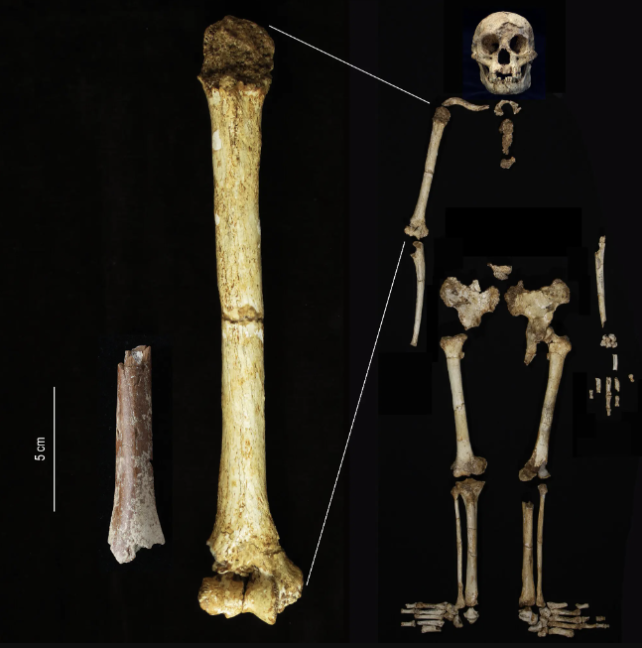 Hominin fossil found on Flores Island, Mata Menge (left), and Homo floresiensis specimen discovered in Liang Bua. [Image courtesy of the University of Tokyo research team]
Previously, in 2003, a fossil measuring 106 cm in height, weighing 25 kg, and with a brain capacity about one-third that of modern humans was found in Liang Bua Cave on Flores Island. This fossil was later named Homo floresiensis after the region, but it became widely known as the hobbit. The hobbit is a dwarf race featured in J.R.R. Tolkien's 1937 novel. When the fossil was discovered, it caused a sensation as it suggested that hobbits actually existed, but the evolutionary process remained a mystery. Some scientists speculated that Homo floresiensis might have been a hominin suffering from growth disorders.
Since 2013, hominin fossils such as jawbones and teeth have been found in Mata Menge on Flores Island, but due to the absence of the lower part of the skull, it was difficult to determine which human species they belonged to or estimate their body size.
The research team analyzed 10 newly excavated hominin fossils from the Mata Menge area, including jawbones and humeri (long bones of the arm). As a result, these fossils were dated to about 700,000 years ago and identified as remains of at least four individuals, including two children. Their height was estimated to be only about 1 meter, approximately 6 cm smaller than Homo floresiensis. Based on this, the team suggested that these hominins were likely ancestors of Homo floresiensis, which existed about 60,000 years ago.
Adam Brumm, a co-author of the paper and professor at the Griffith University Centre for Human Evolution in Australia, explained, "Considering the small proportions of these fossils, it is clear that the early ancestors of Homo floresiensis were much smaller than we previously thought." According to experts, the newly discovered hominins are believed to have evolved from Homo erectus. Due to the island's limited food resources, it is interpreted that they suffered from dwarfism.
© The Asia Business Daily(www.asiae.co.kr). All rights reserved.
![Clutching a Stolen Dior Bag, Saying "I Hate Being Poor but Real"... The Grotesque Con of a "Human Knockoff" [Slate]](https://cwcontent.asiae.co.kr/asiaresize/183/2026021902243444107_1771435474.jpg)















