BOJ "No Interest Rate Hike Amid Financial Market Turmoil" Clarification
"Concerns Over US Recession Are Excessive," Continuous Diagnosis
Tech Stocks Rally... US Treasury Yields Rise
The three major indices of the U.S. New York Stock Exchange were on the rise early in trading on the 7th (local time). Concerns about a U.S. economic recession have somewhat eased, and after rebounding the previous day, the New York Stock Exchange has been rising for two consecutive days as investor sentiment improved following the Bank of Japan's (BOJ) announcement that it would abandon plans to raise interest rates.
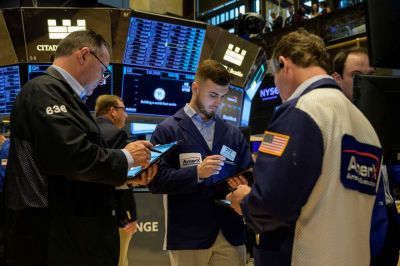
As of 9:31 a.m. in the New York stock market on that day, the Dow Jones Industrial Average, centered on blue-chip stocks, was trading at 39,203.83, up 0.53% from the previous trading day. The S&P 500 index, focused on large-cap stocks, rose 1.2% to 5,302.98, and the Nasdaq index, centered on technology stocks, was up 1.82% at 16,665.03.
The BOJ's dovish remarks brought a positive breeze to the New York stock market following Asian markets. BOJ Deputy Governor Shinichi Uchida stated, "We will not raise interest rates amid unstable financial markets," and added, "It is necessary to firmly continue financial easing at the current level for the time being." As concerns about a U.S. recession and the unwinding of the 'yen carry trade' were cited as major causes of the recent global stock market crash, the remarks helped calm market fears. Following Deputy Governor Uchida's comments, Japan's Nikkei 225 index rose 1.19% compared to the previous day, and the KOSPI index increased by 1.83%.
Among global investors, the yen carry trade?borrowing low-interest Japanese yen to invest in overseas assets?had been popular. However, after the BOJ raised its short-term policy rate from 0?0.1% to 0.25% on the 31st of last month, yen funds have been returning to Japan one after another. This has acted as a catalyst dragging down global stock markets.
Rah Shant, Managing Director at Jennison Associates, said, "We will not underestimate the importance of the BOJ's remarks. The halt in rate hikes is really helpful. The yen carry trade has persisted for years and will likely indirectly affect many asset markets worldwide."
Analyses that market fears of a U.S. recession are excessive have also contributed to the recovery of investor sentiment. U.S. investment bank Morgan Stanley diagnosed the previous day that "the U.S. economy is not in a recession." It maintained its forecast for a 75 basis point (1bp = 0.01 percentage point) rate cut by the Federal Reserve (Fed) this year. It also saw a low possibility of an emergency rate cut before the September Federal Open Market Committee (FOMC) meeting or a 'big cut' of 50bp at the September meeting. Austan Goolsbee, President of the Federal Reserve Bank of Chicago, also said in a CNBC interview on the 5th, "Although employment figures came out weaker than expected, it does not yet look like a recession," adding, "Economic growth is at a fairly stable level."
Additionally, there are forecasts that the U.S. will continue solid growth in the third quarter this year. According to the Atlanta Federal Reserve Bank's 'GDP Now' released the previous day, the U.S. GDP growth rate for the third quarter is projected at an annualized 2.9% quarter-on-quarter. This is an upward revision of 0.4 percentage points from the previous forecast of 2.5% released on the 1st. The U.S. GDP growth rates were 1.4% in the first quarter and 2.8% in the second quarter. Although GDP Now is not the official forecast of the Atlanta Fed, it is widely used as a reference for future economic trends.
However, there are observations that volatility may continue for the time being. The risk of yen carry trade unwinding remains. According to JP Morgan, the scale of yen carry trade unwinding is around 50?60%, and further unwinding movements may continue.
Quincy Crosby, Global Chief Strategist at LPL Financial, said, "The remaining question is whether the concerns that pushed the market into a waterfall sell-off have eased," adding, "Volatility is expected to continue during the calm seasonal period of August and September." He emphasized, "However, it is important to remember that there is always a pocket of opportunity on the other side of the storm."
Government bond yields are rising. The 10-year U.S. Treasury yield, a global bond yield benchmark, rose 5 basis points from the previous day to 3.93%, while the 2-year U.S. Treasury yield, sensitive to monetary policy, traded 1 basis point higher at 3.99%.
By stock, Nvidia is up 2.53%. Microsoft (MS) rose 1.98%, and Alphabet, Google's parent company, increased by 1.54%. Super Micro Computer and Airbnb plunged 14.66% and 14%, respectively, after reporting earnings below market expectations. Disney fell 3.41% despite reporting quarterly earnings that exceeded expectations. CVS Health dropped 0.58% after posting quarterly earnings above forecasts but lowering its annual profit outlook.
International oil prices are also rising amid easing recession fears. West Texas Intermediate (WTI) crude oil rose $1.48 (2.02%) from the previous trading day to $74.68 per barrel, and Brent crude, the global oil price benchmark, increased $1.50 (1.96%) to $77.98 per barrel.
© The Asia Business Daily(www.asiae.co.kr). All rights reserved.
![Clutching a Stolen Dior Bag, Saying "I Hate Being Poor but Real"... The Grotesque Con of a "Human Knockoff" [Slate]](https://cwcontent.asiae.co.kr/asiaresize/183/2026021902243444107_1771435474.jpg)















