August Economic Trends
Prolonged Negative Outlook on Domestic Demand
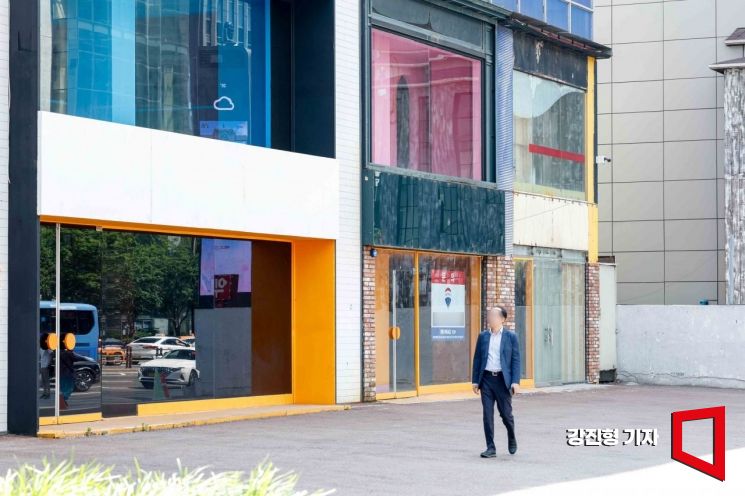 Last year, it was found that one out of five self-employed restaurant owners in Seoul closed their businesses, with Gangnam-gu (2,798 locations) having the highest number of closed stores. On the 5th, shops along the main street near Gangnam Station in Seoul were empty due to closures. Photo by Kang Jin-hyung aymsdream@
On the 7th, the Korea Development Institute (KDI), a government-funded research institute, diagnosed that "domestic demand is constraining economic improvement." It also assessed that external uncertainties have somewhat expanded due to heightened geopolitical risks in the Middle East and concerns about a recession in the United States.
In its August economic trends report, KDI stated, "Although strong export growth centered on semiconductors continues, domestic demand remains weak, limiting economic improvement." This is largely unchanged from last month's mention that "domestic demand is not showing signs of recovery," indicating a prolonged negative assessment of domestic demand.
KDI noted, "Service industry production remains at a low growth rate, and construction investment continues to decline, so the recovery of domestic demand has not become visible," particularly emphasizing that "service industry production sustained low growth mainly in wholesale and retail trade, accommodation, and food services."
It added, "With retail sales continuing to decline and loan delinquency rates rising, the accumulated sluggishness in construction orders has led to a contraction in construction investment, resulting in a gradual adjustment in employment conditions."
Indicators related to domestic demand continued to show weakness. Retail sales in June decreased by 3.6% compared to the same month last year, marking the fourth consecutive month of decline. Passenger cars (-21.4%) sharply decreased due to base effects, and declines continued mainly in clothing (-4.6%) and food and beverages (-2.8%). Domestic shipments of consumer goods (-6.1%) also fell significantly, indicating sluggish goods consumption.
Service consumption showed a slowing trend, centered on accommodation and food services. Service industry production recorded a low growth rate of 0.5% due to weakness in wholesale and retail trade (-3.7%) and accommodation and food services (-1.2%). However, sectors closely related to overseas travel and overseas consumption maintained high growth rates. Duty-free store retail sales (10.3%) continued to grow strongly, and in the second quarter, online overseas direct purchases (on a current account basis) also recorded a high growth rate of 25.6%, mainly driven by China (64.8%).
The semiconductor-driven economic recovery trend continued. KDI stated, "Semiconductor-related production indicators maintained a favorable trend, and exports continued to increase mainly in ICT items," adding, "With semiconductor production and shipments increasing and inventories decreasing, overall indicators improved, leading the manufacturing sector's recovery."
KDI added a mention of "heightened geopolitical risks" in this diagnosis. KDI assessed, "External uncertainties have somewhat expanded recently due to heightened geopolitical risks in the Middle East and concerns about a recession in the United States." The instability in the Middle East, heightened by the assassination of Hamas's top leader within Iranian territory, is spreading fears of a full-scale war between Iran and Israel.
KDI stated, "The global economy is expected to maintain a moderate growth trend centered on the United States and China, but downside risks to the economy remain due to escalating trade conflicts and concerns about a U.S. recession," adding, "Global merchandise trade is continuing a moderate recovery phase, and production growth is sustained mainly in emerging countries; however, leading indicators related to manufacturing and consumption remain weak," it evaluated.
© The Asia Business Daily(www.asiae.co.kr). All rights reserved.
![Clutching a Stolen Dior Bag, Saying "I Hate Being Poor but Real"... The Grotesque Con of a "Human Knockoff" [Slate]](https://cwcontent.asiae.co.kr/asiaresize/183/2026021902243444107_1771435474.jpg)















