Prosecutor Personnel Changes Replace Command Line
Investigation of Major Cases Accelerates
Han Dong-hoon's 'Elite' Prosecution Declines
Focus on Combat-Ready 'Field-Type' Prosecutors
The atmosphere within the prosecution has recently changed. Arrests and summonses of high-profile figures are continuing, and investigations that had been stagnant for years are gaining momentum.
On the 23rd of last month, the Seoul Southern District Prosecutors' Office arrested Kim Beom-su, the chairman of the management innovation committee and founder of Kakao, ranked within the top 15 in the business world. This marked the climax of the nearly two-year-long investigation into Kakao, which had passed through the Financial Supervisory Service.
About a year after forming the special investigation team for the ‘presidential election interference and public opinion manipulation case,’ the Seoul Central District Prosecutors' Office indicted Kim Man-bae, the major shareholder of Hwacheon Daeyu, and Shin Hak-rim, former chairman of the Korean Federation of Mediaworkers’ Unions, on the 8th of last month. Although there has been controversy over the investigation methods, they have completed a face-to-face investigation of First Lady Kim Kun-hee regarding allegations of receiving luxury handbags and the long-unsolved Deutsche Motors stock manipulation suspicions.
Hong Seon-geun, chairman of Money Today Media Group, and Kwon Soon-il, former Supreme Court justice, who are suspected of involvement in the ‘Daejang-dong 5 billion Club’ scandal, were also summoned and investigated as suspects.
Kim Myung-soo, former Chief Justice of the Supreme Court, who was accused of abuse of power and other charges, was notified of a summons for the first time in 3 years and 5 months since the case was assigned. A summons investigation is expected to take place within this month. During the Moon Jae-in administration, Kim was accused by the opposition party in March 2021 of abuse of power for not accepting the resignation of Im Seong-geun, then a high court chief judge, citing the Democratic Party’s push for ‘judge impeachment,’ but the investigation had not progressed for nearly three and a half years.
In addition, the anti-corruption divisions 1 to 3 and the Fair Trade Investigation Division of the Seoul Central District Prosecutors' Office are competitively conducting large-scale internal investigations behind the scenes, and rumors suggest these will soon materialize.
This turnaround in the prosecution’s atmosphere has been noticeable since the personnel reshuffle in May. Changes in the leadership of frontline district prosecutors’ offices and investigative departments have been prominent. In particular, it is said that this reversal occurred as non-mainstream prosecutors advanced to key positions, replacing the elite prosecutors who had traditionally formed the mainstream of the prosecution.
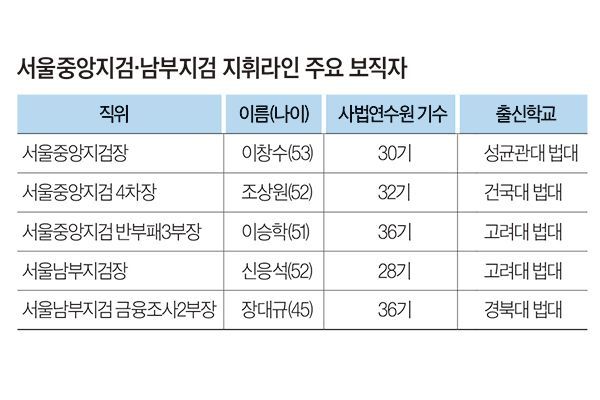
A representative figure is Lee Chang-soo, chief prosecutor of the Seoul Central District Prosecutors' Office. Chief Prosecutor Lee is a graduate of Sungkyunkwan University Law School, which is considered somewhat distant from the prosecution’s ‘traditional mainstream.’ Assisting him in leading anti-corruption investigations is Deputy Chief Jo Sang-won, a ‘field expert’ from Konkuk University Law School, who has no experience working at the Ministry of Justice or the Supreme Prosecutors’ Office, which are considered ‘noble prosecutor courses.’
Jang Dae-gyu, head of the Financial Investigation Division 2 at the Seoul Southern District Prosecutors' Office, who arrested Chairman Kim Beom-su, is a ‘minority’ graduate of Kimcheon High School and Kyungpook National University Law School. Shin Eung-seok, chief prosecutor of the Seoul Southern District Prosecutors' Office, graduated from Yeongdeungpo High School and Korea University Law School, was promoted to chief prosecutor almost at the last among his 2022 peers, and succeeded to his current position in May after serving as chief prosecutor of Uijeongbu and Daegu district prosecutors’ offices, following peers who had already passed through the position.
Those around the prosecution view this recent turnaround and investigative achievements as an ‘underdog reversal’ of the prosecution. Prosecutors who were relatively non-mainstream are said to be armed with a ‘hungry spirit,’ producing remarkable investigative results.
On the other hand, the reason these prosecutors could be appointed to key positions is partly due to the fallout from the conflict between President Yoon Seok-youl and then-People Power Party emergency committee chairman Han Dong-hoon before the general election, which led many elite prosecutors, who had been the mainstream, to move to non-core departments. Some see this as a new trend emerging alongside the decline of Han Dong-hoon’s influence within the prosecution, who was symbolic of ‘elite prosecutors.’
Inside and outside the prosecution, some also point to Kim Joo-hyun, senior secretary for civil affairs, as the background of this phenomenon. Kim, an ‘expert in prosecution personnel affairs’ who served as deputy minister of justice and director of the prosecution bureau, is said to have reshaped the prosecution landscape.
There is also interest in how this trend will affect the upcoming appointment of the next Prosecutor General, which is imminent.
Woo Bin, Legal Times Reporter
※This article is based on content supplied by Law Times.
© The Asia Business Daily(www.asiae.co.kr). All rights reserved.
![Clutching a Stolen Dior Bag, Saying "I Hate Being Poor but Real"... The Grotesque Con of a "Human Knockoff" [Slate]](https://cwcontent.asiae.co.kr/asiaresize/183/2026021902243444107_1771435474.jpg)















