Visit to Zhongguancun Startup Street that gave birth to Xiaomi and Baidu
Inspection of Humanoid Robot Innovation Center... Sharing Seoul Vision
Meeting with Chinese authorities in entertainment and fashion to plan content development
Seoul Mayor Oh Se-hoon visited 'Zhongguancun,' known as the Chinese version of Silicon Valley, to explore strategies for the global market entry of Korean-Chinese startups. Mayor Oh plans to actively support Seoul's innovative and startup companies in entering the Beijing market.
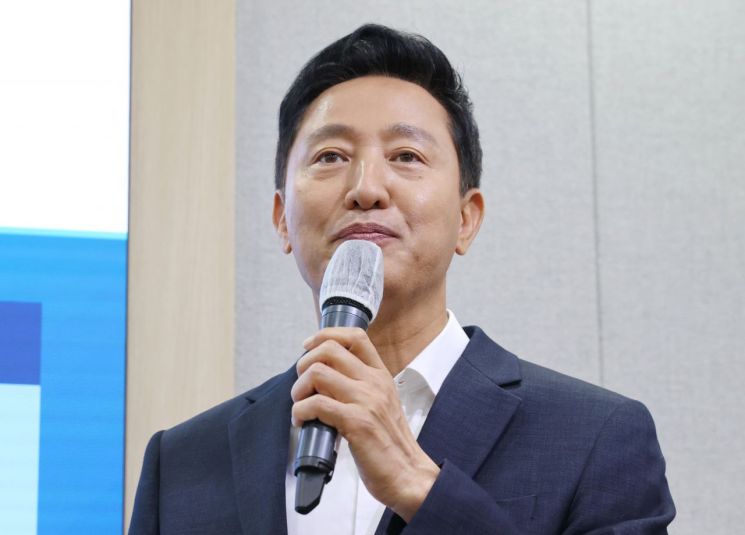
On the 31st of last month (local time), Mayor Oh visited the 'Zhongguancun' startup street located in the northwest of Beijing to tour major startup support facilities and discuss plans for fostering the domestic startup ecosystem and growth strategies.
'Zhongguancun' is a high-tech base and a hub of advanced technology, having produced many of China’s leading global companies such as Baidu, Lenovo, Tencent, and Xiaomi. The 'Startup Street' within Zhongguancun, established in June 2014, is China’s first innovation startup cluster with a length of 220 meters and a total floor area of 45,000 square meters. Currently, over 50 startup support service organizations are housed there, running more than 3,000 incubation programs.
On this day, Mayor Oh visited the 'Peking University Startup Training Camp,' a representative support center within Zhongguancun Startup Street, where he listened to local startups and KIC China Center officials about China’s startup support measures. He also exchanged opinions on the success strategies of resident companies and the entry of Seoul’s innovative and startup companies into Beijing. The 'Peking University Startup Training Camp' utilizes Peking University’s excellent research and human resources to provide startup education and mentoring. The startup center spans from the first floor above ground to two basement levels (5,000 square meters), offering tenants access to all necessary facilities for startups, including lecture rooms, youth exchange spaces, startup research labs, exhibition halls, and laboratories.
Mayor Oh also visited the 'Beijing Humanoid Robot Innovation Center,' the first provincial-level facility of its kind in China, located in the Beijing E-Zhuang Economic and Technological Development Zone. The center is jointly established by the Beijing Municipal Bureau of Economy and Information Technology, Beijing Jingcheng Machinery Electric, Xiaomi Robotics, Ubitac, and Beijing E-Zhuang Robot Technology Industry Development.
Currently, specialized companies in fields such as robot finished products, core components, and ultra-large models are housed there. Recently, the center unveiled the humanoid robot 'Tiangong (天工),' which operates solely on electric drive. At the center, Mayor Oh examined 'Tiangong' as well as robotic arms and robots capable of facial expressions, and exchanged views with officials on the development plans for the robotics industry in both countries.
Earlier, Seoul announced the 'Seoul Robot Industry Promotion Comprehensive Plan' to nurture the robot industry as a future strategic sector and to leap forward as a global robot city through the popularization of robot services. In this regard, Seoul is currently promoting various projects such as robot technology development, demonstration support, and the opening of the Robot Artificial Intelligence Science Museum. The city plans to create the 'Suseo Robot Cluster,' where robot companies and support facilities are concentrated, to attract advanced robot companies.
Mayor Oh also inspected Wangjing Soho and Daewangjing Central Park in the Chaoyang District and attended a session where experts briefed him on Beijing’s urban planning and green space creation strategies. Wangjing Soho, designed by architect Zaha Hadid who also designed Seoul’s landmark DDP, features curved buildings and a 50,000 square meter urban garden, serving as a landmark for Beijing.
Additionally, Mayor Oh held a meeting with about 30 companies including large, medium-sized, small businesses, and startups operating locally in Beijing to share insights on China’s industrial and economic status and to explore directions for Seoul’s economic policy development. He also met with representatives of China’s cultural and artistic sectors to share plans for Korea-China cultural exchange and strategies for spreading global cultural and artistic content.
© The Asia Business Daily(www.asiae.co.kr). All rights reserved.
![Clutching a Stolen Dior Bag, Saying "I Hate Being Poor but Real"... The Grotesque Con of a "Human Knockoff" [Slate]](https://cwcontent.asiae.co.kr/asiaresize/183/2026021902243444107_1771435474.jpg)















