Carbohydrates in Bananas Have Effects Equivalent to Sports Drinks
Magnesium and Potassium Help Achieve Stability
Shin Yubin eating a ‘banana’ and doing a ‘banana flick’.
Although she finished in 4th place, table tennis national team player Shin Yubin (20)’s cute ‘banana mukbang’ has become a hot topic during the 2024 Paris Olympics. A commentator broadcasting Shin Yubin’s table tennis match joked during the game, saying, “She’s adapting to the opponent’s banana flick while eating a banana.” The Banana Flick is a table tennis technique where the ball hit with the backhand curves quickly like a banana, hence the name.
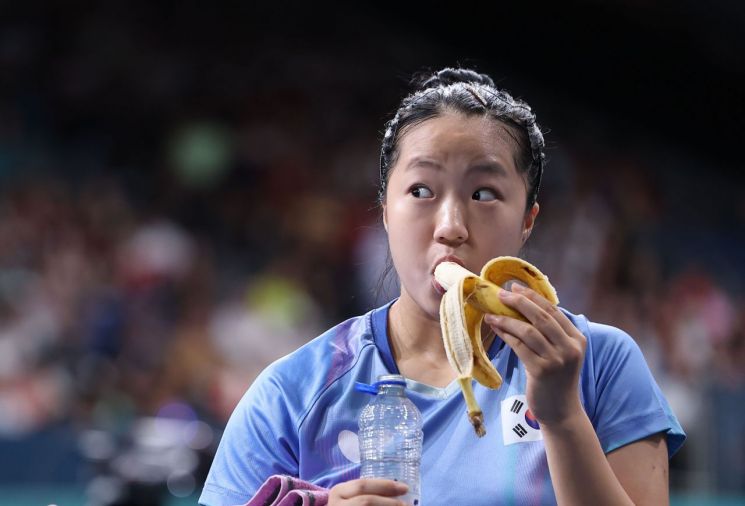
Why is Shin Yubin so obsessed with bananas? Besides their convenient size and ease of eating, there is a scientific reason behind it. According to the Food and Drug Safety Ministry’s food nutrition database, 100g of banana contains carbohydrates (20g), magnesium (32mg), and potassium (355mg).
Athletes expend a lot of energy during matches. Consuming bananas at this time provides carbohydrates that have effects similar to sports drinks. In 2018, a research team from Appalachian State University in the U.S. conducted an experiment with 20 male and female cycling athletes and revealed the effects of carbohydrates from bananas consumed during exercise. The study showed that bananas effectively supply energy to athletes, reduce inflammation markers after exercise to aid quick recovery, and improve endurance.
Dr. David Nieman, who led the experiment, said, “Consuming bananas with water during exercise offers several benefits to athletes and fitness enthusiasts,” adding, “There are more advantages than those associated with typical sports drinks, including stronger anti-inflammatory effects, better nutrient intake, and enhanced metabolic recovery.”
Magnesium helps achieve relaxation by calming the nervous system and relieving tension. A deficiency in magnesium can cause muscle spasms such as eyelid twitching and severe fatigue. Muscle cramps can be fatal to an athlete’s game flow. The potassium abundant in bananas helps regulate blood pressure by expelling sodium. It also helps stabilize heartbeats by effectively supplying oxygen to the brain.
When is a banana best to eat? Bananas are known to taste best and have the most benefits when 40-60% of their peel is covered with black spots called ‘Sugar Spots.’ Sugar Spots develop as bananas ripen over time. Bananas with Sugar Spots are known to contain more enzymes, antioxidants, and oligosaccharides than fully yellow bananas.
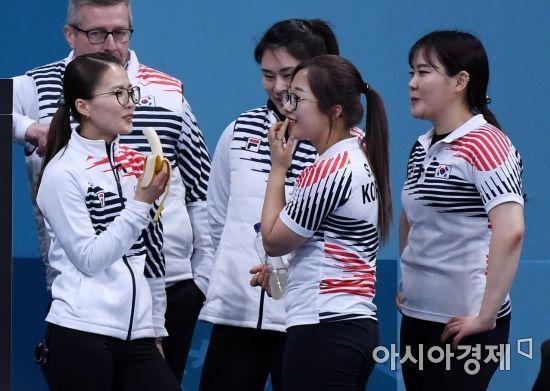 The women's curling preliminary match between South Korea (Kim Eun-jung, Kim Kyung-ae, Kim Sun-young, Kim Young-mi, Kim Cho-hee) and China at the 2018 Pyeongchang Winter Olympics was held on the 18th at the Gangneung Curling Center. Team representative Kim Eun-jung (left) is eating a banana.
 Gangneung ? Photo by Kim Hyun-min kimhyun81@
Scenes of athletes doing ‘banana mukbang’ are often caught on camera. Bananas are consumed not only in intense sports like table tennis and tennis but also in endurance-demanding sports such as marathons and golf. During the 2018 PyeongChang Winter Olympics, silver medalist curler Kim Eun-jung (33) was caught on camera eating a banana during a match, which became a topic of interest. Kim Eun-jung said, “I actually don’t like bananas,” adding, “I ate a lot because I heard bananas are good for replenishing energy. I ate them to win.”
Jung Hyun (28), who reached the first ‘Major semifinal’ in Korean tennis history, has a habit of eating a banana every five games, also for energy replenishment. During the 2018 ATP Tour BNP Paribas Open quarterfinals, he was seen eating a banana on the broadcast while playing against then world No. 1 Roger Federer (42). Soccer player Son Heung-min (32) was also photographed eating a banana during a break in national team training.
© The Asia Business Daily(www.asiae.co.kr). All rights reserved.
![Clutching a Stolen Dior Bag, Saying "I Hate Being Poor but Real"... The Grotesque Con of a "Human Knockoff" [Slate]](https://cwcontent.asiae.co.kr/asiaresize/183/2026021902243444107_1771435474.jpg)
















