Government Urges Institutional Reforms as Large Corporations Flood In
"Proposed Regulatory Improvements Only Benefit Large Corporations... SMEs Will Struggle"
The market for recycling and reusing used batteries from electric vehicles has opened, but small and medium-sized enterprises (SMEs) already in the market are uneasy due to the successive participation of large corporations.
According to the government and the used battery industry on the 2nd, the Ministry of Trade, Industry and Energy's National Institute of Technology and Standards will establish certification standards for excellent recycled products (GR·Good Recycled) for five key battery minerals?nickel sulfate, manganese sulfate, cobalt sulfate, lithium hydroxide, and lithium carbonate?within this month. In October last year, standards for recycling and reusing used batteries were also established and implemented.
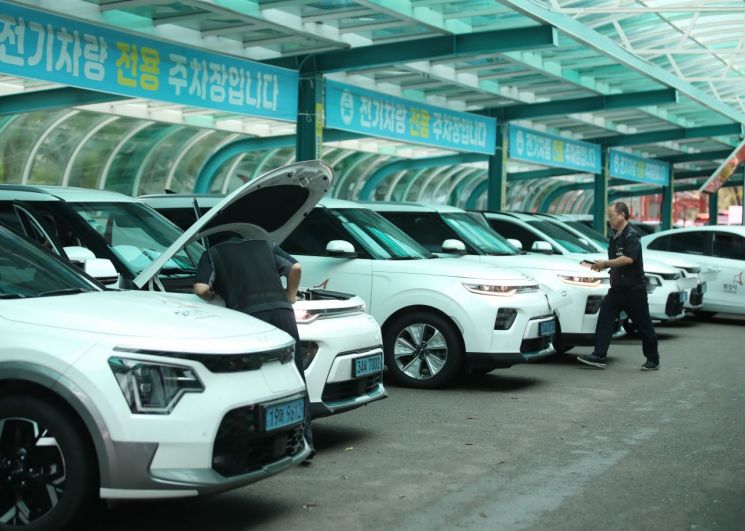 The Ministry of Environment estimates that more than 100,000 waste batteries will be generated domestically by 2030, five years from now. The photo shows an electric vehicle-only parking lot in a local government area.
 [Photo by Asia Economy DB]
Reuse refers to using batteries that are still usable as large-capacity energy storage systems (ESS), while recycling means extracting rare metals such as nickel and lithium contained in the batteries.
The Ministry of Environment estimates that more than 100,000 used batteries will be generated domestically by 2030. Accordingly, revisions to laws such as the Electrical Appliances and Consumer Products Safety Control Act, which mandates the use ratio of recycled materials from used electric vehicle batteries and battery integrated management systems, and the Act on Resource Circulation of Electrical and Electronic Products and Automobiles are underway.
The Small and Medium Business Ombudsman received complaints from SMEs in 2022 about insufficient government standards for recycling and reusing used batteries and concerns about environmental pollution caused by landfill and disposal of used batteries. They recommended that the Ministry of Trade, Industry and Energy and the Ministry of Environment establish standards and a circulation system to revitalize the used battery market. As a result, the two ministries have begun improvement work, leaving only the final legislative procedures.
The government's plan is to respond to global market expansion and secure competitiveness through standardization of the entire process from transportation to recycling and disposal of used batteries.
The government is hastening institutional arrangements because the global used battery market is expanding.
In May, the European Union (EU) enacted the Critical Raw Materials Act (CRMA), which includes mandatory use of recycled battery materials. According to energy market research firm SNE Research, the global used battery recycling market size will rapidly grow to 70 trillion won by 2030, 230 trillion won by 2040, and 600 trillion won by 2050. The number of electric vehicle scrappages is also predicted to increase from 410,000 units in 2030 to 42.27 million units by 2050.
Domestic large corporations are quickly responding to market trends. LG Energy Solution signed a joint venture agreement with China's Huayou Cobalt for used battery recycling in August last year, and in November, SK On announced a business cooperation with Germany's BASF. Samsung SDI established a partnership with Sungil Hightech, a used battery recycling specialist, and POSCO Group founded POSCO HY Clean Metal in a joint venture with GS Energy and Huayou Cobalt.
Hyundai Glovis and Kia, affiliates of Hyundai Motor Company, also entered the used battery market by signing an MOU in October last year with Gyeongsangbuk-do Province, Gyeongbuk Technopark, EcoPro, and EvaCycle to build an alliance for revitalizing the battery ecosystem.
Kim Seung-tae, head of policy support at the Korea Battery Industry Association, explained, "The domestic market is expected to become active after 2027. From now on, infrastructure such as traceability management systems must be established to respond appropriately to the market."
However, about 600 SMEs nationwide, including vehicle dismantling companies and those with used battery processing technology, remain uneasy about the moves of large corporations.
Mr. H, a representative of a non-ferrous metal smelting company in a provincial area, expressed concern, saying, "After proposing regulatory improvements, there has been no change that SMEs can feel, and it only benefits large corporations. If large corporations enter the market, SMEs will inevitably perish." Mr. K, a representative of an electrical and electronic equipment service company in the metropolitan area, said, "Since we are entangled with the interests of automakers, we cannot simply oppose and are watching the situation. We hope the government will make decisions so that SMEs can survive."
In this regard, the Fair Trade Commission advised applying for designation as a medium-sized business suitable industry. A Fair Trade Commission official said, "Applying for designation as a medium-sized business suitable industry through related associations is one solution. If the issue is raised to the commission after industry surveys, the possibility of designation increases."
© The Asia Business Daily(www.asiae.co.kr). All rights reserved.
![Clutching a Stolen Dior Bag, Saying "I Hate Being Poor but Real"... The Grotesque Con of a "Human Knockoff" [Slate]](https://cwcontent.asiae.co.kr/asiaresize/183/2026021902243444107_1771435474.jpg)
















