Hamas Supreme Leader Assassinated, Middle East Situation Shaken
Presidential Office Reviews Evacuation Plans for Korean Nationals in Emergencies
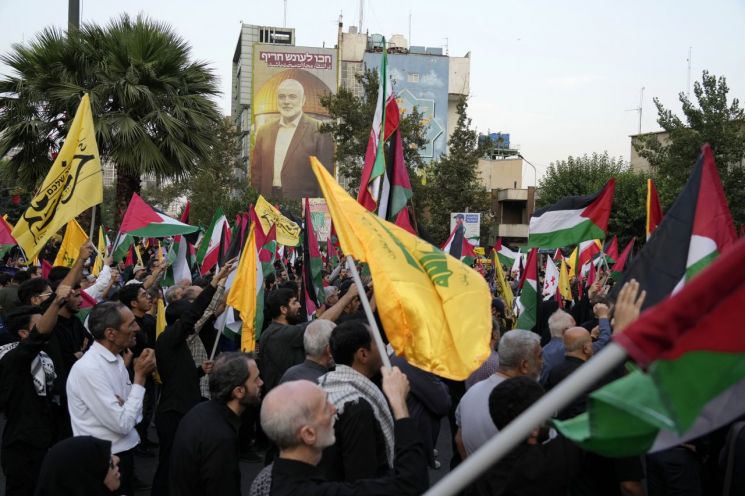 On the 31st of last month (local time), local protesters in Palestine Square, Tehran, Iran, waved the Iranian and Palestinian flags while condemning the assassination of Hamas supreme leader Ismail Haniyeh. [Image source=Yonhap News]
On the morning of the 1st, the Presidential Office held a 'Joint Security and Economic Inspection Meeting on the Middle East Situation' and checked the impact of the recent Middle East situation involving Israel, Hezbollah, Hamas, and others on our security and economy.
Recently in the Middle East, the situation has been greatly shaken as Ismail Haniya, the top political leader of the Palestinian armed faction Hamas, was assassinated in Tehran, the capital of Iran. Iran and Hamas stated that Haniya was killed by an Israeli attack.
In response, Iran's Supreme Leader Ayatollah Ali Khamenei reportedly ordered a direct attack on Israel, according to The New York Times (NYT). This indicates a stance to retaliate as Israel directly attacked Iranian mainland.
If the war between Israel and Hamas actually expands to Iran, it is expected that the global economy and security situation, including international oil prices, will be greatly shaken.
The meeting participants analyzed the positions of related countries on the current situation and prospects for future developments. Afterwards, they reviewed diplomatic countermeasures, safety measures for local Korean residents, and evacuation plans for residents in case of emergency.
It is planned to take necessary measures by each ministry according to the development of the situation.
Regarding economic impact, although international oil prices have risen due to the Middle East situation, it was explained that there is no impact on domestic supply and demand such as crude oil, gas supply, and tanker operations. The domestic and international financial markets are also generally stable, being more influenced by expectations of changes in U.S. monetary policy.
However, participants agreed to maintain a high level of vigilance and continue monitoring domestic and international markets closely, given the possibility of rapid changes in the Middle East situation. They also agreed to closely coordinate so that necessary measures can be taken immediately according to a step-by-step response manual in case of any abnormal signs.
Attendees of the meeting included Jang Hojin, Director of the National Security Office; Sung Taeyoon, Director of the Presidential Office Policy Office; Kim Beomseok, First Vice Minister of the Ministry of Economy and Finance; Kim Honggyun, First Vice Minister of the Ministry of Foreign Affairs; Kim Seonho, Vice Minister of the Ministry of National Defense; Choi Namho, Second Vice Minister of the Ministry of Trade, Industry and Energy; Hong Jangwon, First Deputy Director of the National Intelligence Service; Kim Taehyo, First Deputy Director of the National Security Office; and Wang Yunjong, Third Deputy Director of the National Security Office.
© The Asia Business Daily(www.asiae.co.kr). All rights reserved.
![Clutching a Stolen Dior Bag, Saying "I Hate Being Poor but Real"... The Grotesque Con of a "Human Knockoff" [Slate]](https://cwcontent.asiae.co.kr/asiaresize/183/2026021902243444107_1771435474.jpg)















