Board of Audit and Inspection Predicts Labor Shortage of 1,748 in Cheonan Rural Areas
Public Seasonal Worker Program to Launch in November
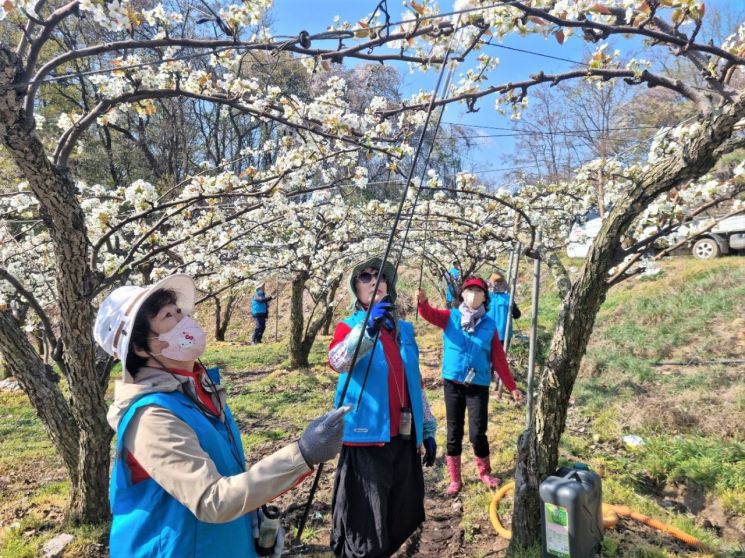 Chungnam Cheonan City, struggling with a chronic labor shortage in rural areas, has been confirmed to be preparing a public seasonal labor project in collaboration with local agricultural cooperatives.
A scene from last year's pear pollination volunteer activity held in the Seonghwan area.
Cheonan City in Chungnam Province, which has been struggling with a chronic labor shortage in rural areas, is partnering with local agricultural cooperatives to promote a public seasonal worker program.
According to Cheonan City on the 31st, Cheonan Nonghyup and Seonghwan Nonghyup are preparing to apply for the public seasonal worker program for agricultural products this November.
The public seasonal worker program is operated by the local government or an agricultural cooperative designated by the local government. The local government signs an MOU with a foreign local government according to the Ministry of Justice's basic plan for seasonal workers to bring in labor.
The workers brought in through this process are employed by the agricultural cooperative selected by the local government, which signs labor contracts with the seasonal workers and then provides their labor to the farms in need. However, the costs associated with employing these workers are borne by the requesting farms.
Currently, seasonal workers are supplied either through MOUs between domestic and foreign local governments or by inviting relatives within the fourth degree of kinship of marriage immigrants residing in Korea.
However, in the field, individual farms face difficulties operating seasonal workers due to mandatory employment periods of over five months and the need to provide accommodation.
In fact, in Cheonan City, only seven seasonal workers were brought in through MOUs in the first half of this year, and only 18 through invitations of marriage immigrants, indicating the system's lack of effectiveness.
Above all, as the shortage of rural labor in the region is expected to worsen in the future, hiring seasonal workers to support farms is becoming increasingly important.
According to an audit report on the introduction and management of foreign labor released by the Board of Audit and Inspection in June, the annual rural labor shortage in Cheonan was 85 people in 2022, but is projected to surge to 1,748 by 2032.
As a result, the public seasonal worker program, in which agricultural cooperatives employ and supply workers to farms, is emerging as an alternative. Given that many local farms require concentrated short-term labor of less than a month rather than continuous employment for over five months, a system in which the cooperative employs seasonal workers in bulk and supplies them as needed is seen as more effective.
In particular, since each cooperative can employ up to 100 workers, if selected for the program, it is expected to greatly help resolve the rural labor shortage.
A Cheonan City official said, "The existing seasonal worker recruitment was not suitable for our city due to issues such as the length of the employment period," adding, "With public seasonal workers, farms can use labor only when needed, so it will help solve the rural labor shortage."
© The Asia Business Daily(www.asiae.co.kr). All rights reserved.
![Clutching a Stolen Dior Bag, Saying "I Hate Being Poor but Real"... The Grotesque Con of a "Human Knockoff" [Slate]](https://cwcontent.asiae.co.kr/asiaresize/183/2026021902243444107_1771435474.jpg)
















