June Industrial Activity Trends
Overall Industrial Production Declines for Second Consecutive Month
Although semiconductor production achieved a record high, total industrial production continued to decline for the second consecutive month. Retail sales (consumption) and facility investment increased slightly compared to the previous month but showed sluggish performance compared to the same month last year.
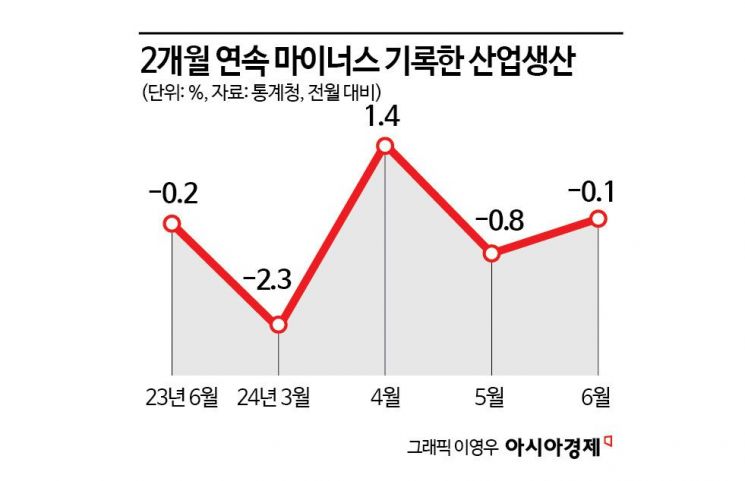
According to the 'June 2024 Industrial Activity Trends' released by Statistics Korea on the 31st, total industrial production decreased by 0.1% compared to the previous month. This marked a negative trend for two consecutive months following May's -0.8%. However, semiconductor production (8.1%) increased at the largest rate in seven months since November last year (9.8%), leading to a 0.5% rise in manufacturing production compared to the previous month. Manufacturing, which accounts for most of manufacturing production, also increased by 0.6%. Chemical products (1.2%) and machinery equipment (1.0%) also led the growth trend.
Gong Mi-sook, Director of Economic Trend Statistics at Statistics Korea, explained, “The semiconductor sector is benefiting from strong front-end demand for IT devices and increased demand in the high value-added artificial intelligence (AI) industry,” adding, “Although total industrial production has been negative for two consecutive months, both manufacturing and service sectors have turned positive, so this appears to be a temporary phenomenon.”
In fact, semiconductor exports are proceeding smoothly. Exports increased by 28.1% compared to the previous month, and shipments also rose by 23.7%. As exports improved, inventory decreased by 14.6% compared to the previous month and by 33.5% compared to the same month last year. Accordingly, the semiconductor production index reached 163.4 (2020=100), marking the highest level since related statistics began in January 1980.
Nevertheless, public administration production fell by 5.1% last month, pulling down the total industrial production index. Statistics Korea attributed this to increased operating expenses beyond normal levels in June, a month when public administration execution is high, due to early budget execution. The Ministry of Economy and Finance also explained this as a seasonal factor related to rapid fiscal execution in the first half of the year. A ministry official said, “Specifically, expenses such as reserve forces meal costs for the central government and riot police meal costs for the National Police Agency decreased,” adding, “This is not a meaningful factor for economic assessment.”
However, shadows of domestic demand sluggishness still persist in this month's industrial activity trends. Service sector production increased by 0.2%, but accommodation and food services, representing the domestic demand sector, decreased by 0.2% in June following declines of -1.9% in both April and May. Wholesale and retail trade increased by only 0.2% compared to the previous month. While overseas semiconductor exports surged, export shipments increased by 7.4% compared to the previous month, but domestic shipments decreased by 1.4%. This marked a negative trend for two consecutive months following May's -1.7%, and a 6.4% decrease compared to the same month last year. Domestic semiconductor shipments also fell by 7.0% compared to the previous month.
Retail sales, representing goods consumption, rose by 1.0% compared to the previous month but decreased by 3.6% compared to the same month last year, marking four consecutive months of decline. A Ministry of Economy and Finance official said, “Goods consumption itself is not showing a strong trend,” but added, “However, looking at the overall trend, attention should be paid to indicators based on the previous month.” He further explained, “The trend itself is improving, and we expect a trickle-down effect on consumption from exports.”
Facility investment rebounded by 4.3% one month after a 3.6% decline in May but decreased by 2.7% compared to the same month last year. In particular, construction output (constant prices) fell by 0.3%, marking a decline for two consecutive months. While civil engineering (6.1%) construction performance increased, building construction (-2.3%) decreased.
Looking at the entire second quarter, signs of domestic demand stagnation are clearly evident. Manufacturing production increased by 1.1% compared to the previous quarter due to increased semiconductor exports, but total industrial production decreased by 0.35% as production in construction and service sectors declined. Service sector production also turned negative, decreasing by 0.3% compared to the previous quarter. Retail sales in the second quarter decreased by 0.8% compared to the previous quarter, marking two consecutive months of decline following the first quarter. Compared to last year, it decreased by 2.9%, the largest drop since the first quarter of 2009 (-4.5%).
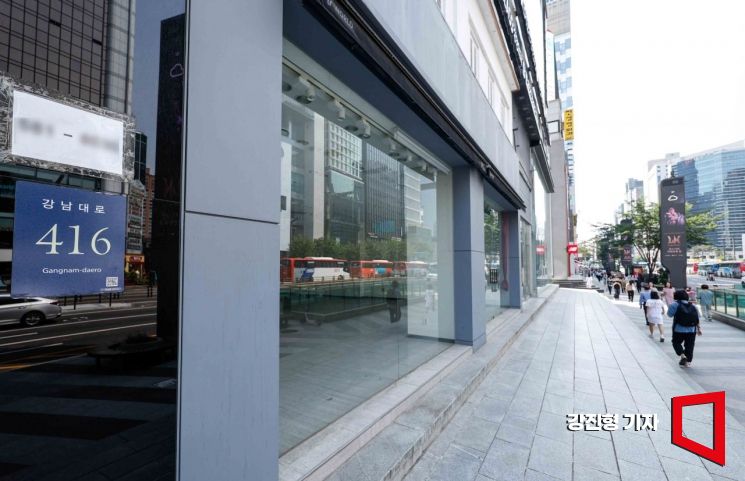 The first floor of a commercial building on a main street near Gangnam Station in Seoul is closed and empty. Photo by Jinhyung Kang aymsdream@
© The Asia Business Daily(www.asiae.co.kr). All rights reserved.
![Clutching a Stolen Dior Bag, Saying "I Hate Being Poor but Real"... The Grotesque Con of a "Human Knockoff" [Slate]](https://cwcontent.asiae.co.kr/asiaresize/183/2026021902243444107_1771435474.jpg)
















