Survival After Cockpit Crashes Into Container
No Threat to Life... Investigation Participation Planned Upon Recovery
The reason why the only surviving pilot in the Nepal Kathmandu plane crash was able to live has been revealed. It was confirmed that he survived by being trapped between containers that the cockpit collided with.
On the 25th (local time), the British daily The Independent reported the words of Badri Pandey, Nepal's Minister of Culture, Tourism, and Civil Aviation, who said that the cockpit of the plane that crashed at Tribhuvan International Airport in Kathmandu, Nepal, the previous day was found embedded in a container.
The Sauria Airlines passenger plane, Bombardier CRJ 200, was carrying two pilots and 17 airline staff when it suddenly flipped while departing from Kathmandu at 11:11 a.m. the previous day, heading to the resort city of Pokhara.
The fuselage first collided with containers located at the edge of the airport and then fell into a gorge east of the runway. During this process, other parts of the plane shattered after the crash, but Captain Manish Ratna Shakya was found trapped in the cockpit wedged in the container and was rescued five minutes after the crash.
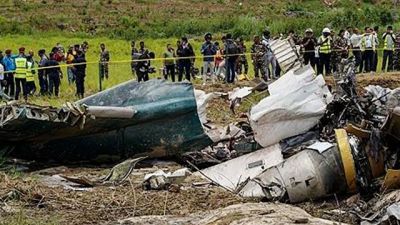 The site of the travelogue crash accident in Kathmandu, Nepal on the 24th [Image source=Yonhap News]
The pilot, who was in respiratory distress when found, sustained injuries to his head and face and suffered a fractured spine, requiring surgery, but his life is not in danger. A local police official said, "It is a miracle that the pilot survived." The local Civil Aviation Authority stated, "Captain Shakya's condition is improving," and "He will participate in the investigation of the cause of the accident after recovering his health."
The cause of the accident has not yet been clearly determined. The Independent cited local media, reporting that "experts say the accident may have occurred due to a failed takeoff where the plane could not gain altitude when attempting to take off."
The bereaved families claim negligence on the part of the company operating the defective aircraft. It was reported that the passenger plane involved in the accident was scheduled to undergo maintenance after arriving in Pokhara.
In Nepal, home to the Himalaya mountain range, aircraft accidents frequently occur due to rugged mountainous terrain, unpredictable weather, challenging runways for takeoff and landing, aging aircraft, and poor maintenance. Since 2000, 360 people have died in plane and helicopter crashes in Nepal, and in January last year, a passenger plane crashed near the resort city of Pokhara while preparing to land, killing all 72 passengers on board.
According to local media, this accident is the 105th since Nepal began aviation operations in the 1950s.
© The Asia Business Daily(www.asiae.co.kr). All rights reserved.
![Clutching a Stolen Dior Bag, Saying "I Hate Being Poor but Real"... The Grotesque Con of a "Human Knockoff" [Slate]](https://cwcontent.asiae.co.kr/asiaresize/183/2026021902243444107_1771435474.jpg)
















