First of the 'Broadcasting 4 Laws,' the Korea Communications Commission Act Passes National Assembly
Ruling Party Begins 2nd Filibuster on Broadcasting Act
Democratic Party's Convention Schedule Likely to End on the 28th
Among the 'Broadcasting Four Acts' promoted by the Democratic Party of Korea, the amendment to the Act on the Establishment and Operation of the Korea Communications Commission (KCC Act) passed the National Assembly on the 26th with opposition parties alone. The People Power Party immediately launched a second filibuster against the Broadcasting Act, which was subsequently tabled.
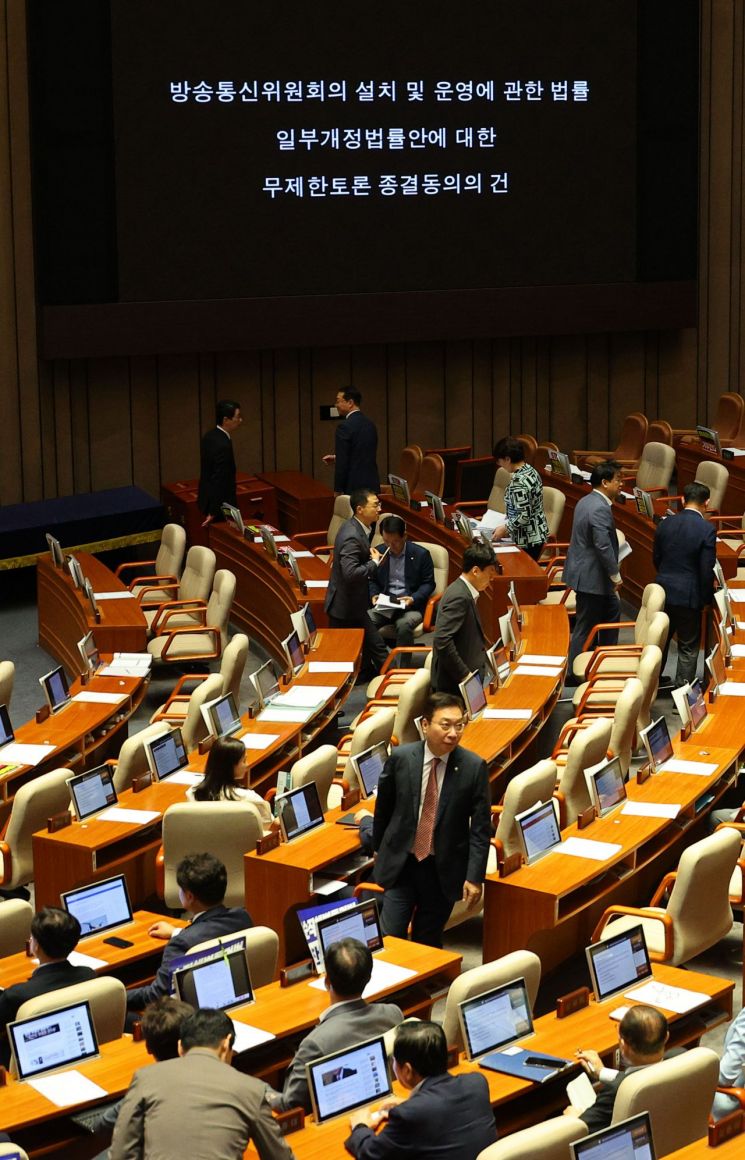 On the afternoon of the 26th, as the vote began on the motion to end unlimited debate on the partial amendment bill concerning the establishment and operation of the Korea Communications Commission at the National Assembly plenary session, members of the People Power Party were leaving.
 [Photo by Yonhap News]
On the same day, the Democratic Party forcibly ended the People Power Party's filibuster (unlimited debate), which had started the previous afternoon, after 24 hours and 7 minutes.
Immediately after the debate was ended, the KCC Act was put to a vote in the plenary session and passed unanimously with all 183 members present voting in favor. Only opposition party members participated in the vote, while People Power Party members protested the end of the filibuster and walked out.
The KCC Act amendment increases the quorum for KCC resolutions from the current two standing commissioners to four. The Democratic Party proposed the amendment as party policy on the 13th of last month to prevent the KCC, which has five standing commissioners, from being operated by only two commissioners appointed by the president.
The Democratic Party plans to sequentially push through the remaining three bills among the Broadcasting Four Acts (amendments to the Broadcasting Act, the Korea Broadcasting Culture Promotion Foundation Act, and the Korea Educational Broadcasting System Act) in the plenary session. The main points include significantly increasing the number of directors for public broadcasters KBS, MBC, and EBS, and granting the right to recommend directors to media and broadcasting academic societies and related professional organizations.
Speaker Woo Won-shik tabled the Broadcasting Act immediately after the KCC Act was passed in the plenary session, as requested by the Democratic Party. The People Power Party launched a second filibuster against the Broadcasting Act, with Shin Dong-wook, the party’s chief floor spokesperson, taking the lead.
Like the KCC Act, the Democratic Party could forcibly end the filibuster on the Broadcasting Act through a vote after 24 hours of debate on the afternoon of the 27th, but Democratic Party members are expected not to attend the plenary session on the 27th due to the party convention schedule.
Therefore, the forced termination of the filibuster and the vote on the Broadcasting Act are expected to take place on the 28th, when Democratic Party members attend the plenary session. The remaining two bills are also expected to follow the sequence of bill tabling → ruling party filibuster → opposition party filibuster forced termination → unilateral passage, with the votes on the Broadcasting Four Acts expected to be completed by the 30th.
© The Asia Business Daily(www.asiae.co.kr). All rights reserved.
![Clutching a Stolen Dior Bag, Saying "I Hate Being Poor but Real"... The Grotesque Con of a "Human Knockoff" [Slate]](https://cwcontent.asiae.co.kr/asiaresize/183/2026021902243444107_1771435474.jpg)
















