Increased Burden on Job Seekers Due to 'Kkamkkami' Transition
Recruitment-Type Intern Job Postings Up 23% in 5 Years
Experts Call for Systems to Support Job Seekers
In his twenties, Mr. A was hired as a recruitment-linked intern at a major telecommunications company early last year. He endured an intense three-month period but ultimately failed to pass the final selection. Even after going through three stages in the internship screening, he had to undergo more than four additional stages for regular employee conversion, including weekly reports, evaluations by current department members, PT presentations, and executive interviews. Each branch office had 3 to 4 interns assigned, but only one was converted to a regular employee, or sometimes none were selected at all. At the branch where Mr. A worked, only one person survived.
 A office worker is walking through an alleyway in Seoul, bathed in the afternoon sunlight. Photo by Heo Young-han
Mr. A said, "We heard rumors that not all interns pass, so although we didn’t show it, there was competition, jealousy, and envy among the peers," adding, "It was very frustrating and mentally exhausting because the conversion criteria and the number of hires were not clearly defined." He also added, "After gathering opinions from acquaintances, those who failed the regular employee conversion were not even allowed to pass the document screening for several years when reapplying."
Recruitment-linked internships refer to a system where interns can be converted to regular employees after a short period of 2 weeks to as long as 6 months. Although companies have been using this system for over a decade, they rarely disclose conversion rates or criteria. Because of this, job seekers say they cannot let go of the tension and pressure that is "blood-curdling."
Even those who pass the final selection after going through the recruitment-linked internship process view the system negatively. Mr. Kim (24), who succeeded in converting to a regular employee after a one-month internship at a cosmetics manufacturing company last April, said, "I was told that if there were no problems, I would be converted, but I was always anxious, wondering if I made any mistakes every day and when the results would come out." His company requires all applicants to go through the internship process to become regular employees, without open recruitment. The recent conversion rate is known to be about 50%.
Companies say they need to work together to determine if the candidate is suitable for the job. A representative from a major IT company that selects recruitment-linked interns every year explained, "We do not provide job seekers with the conversion rate or criteria for recruitment-linked interns," adding, "The conversion rate is not particularly low, but since we select people who work well together, it is difficult to set specific plans."
Although the scale of new hires has recently decreased, corporate demand for recruitment-linked interns is on the rise. According to the career platform Saramin, recruitment-linked internship postings increased by 23% last year to 19,266 compared to 15,611 five years ago.
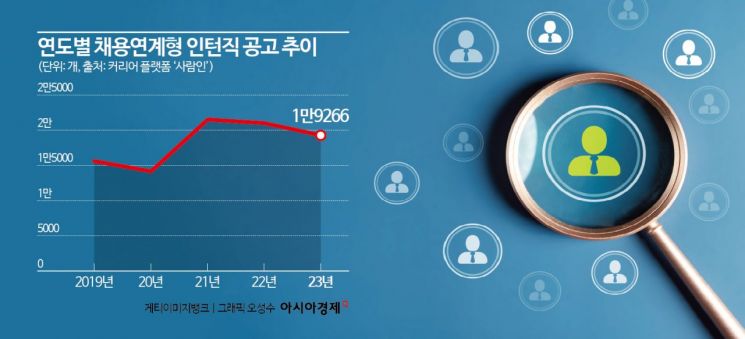
Especially in 2021, during the COVID-19 period, recruitment-linked internship postings increased by 52% compared to the previous year. Senior Researcher Kim Yubin of the Korea Labor Institute explained, "Due to the high uncertainty in society during COVID-19, it was probably difficult for companies to hire regular employees," adding, "Therefore, they likely used internships as a conservative employment strategy that made restructuring easier."
Experts emphasize the need to establish a safety net for job seekers in a job market where the power imbalance is clear. They argue that it is necessary to reduce the uncertainty faced by job seekers who cannot gain an upper hand in their relationship with companies. Professor Lee Byung-hoon, Emeritus Professor of Sociology at Chung-Ang University, pointed out, "Companies are using labor cheaply and easily while shifting responsibility onto job seekers, who are in a subordinate position," adding, "There is no problem even if companies operate as they please."
Professor Kim Seong-hee of Korea University Graduate School of Labor Studies also criticized, "There are companies that only pretend to hire but have a low actual conversion rate to regular employees," adding, "There is no system that requires them to disclose their criteria and how many they hire." Professor Kim said, "The employment disclosure system should be well organized so that recruitment-linked internships do not become a form of false hope that extends probation and selection processes longer than experiential internships," adding, "We need to properly organize the employment disclosure system and ultimately consider whether the practice of relying on internships is an appropriate employment policy in Korea."
© The Asia Business Daily(www.asiae.co.kr). All rights reserved.
![Clutching a Stolen Dior Bag, Saying "I Hate Being Poor but Real"... The Grotesque Con of a "Human Knockoff" [Slate]](https://cwcontent.asiae.co.kr/asiaresize/183/2026021902243444107_1771435474.jpg)
















