Resolution of the "Improper Solicitation and Graft Act Enforcement Decree" on the 23rd
Wreaths and artificial flowers, agricultural and fishery product values frozen
"Macroeconomic impact expected to be minimal"
Eight years after the implementation of the Improper Solicitation and Graft Act (Kim Young-ran Act), the meal expense limit has been raised, prompting voices of relief from small business owners and the dining industry. However, the revised bill excludes the increase in the value limits for wreaths, artificial flowers, and agricultural, livestock, and marine product gifts, creating a mixed atmosphere of joy and disappointment across different sectors.

The Anti-Corruption and Civil Rights Commission (ACRC) announced on the 23rd that it has approved a revision to the Enforcement Decree of the Improper Solicitation and Graft Act to raise the value limit for food items from 30,000 won to 50,000 won. Under the current Kim Young-ran Act, exceptions allow the acceptance of food items valued at 30,000 won or less provided to public officials and others for smooth job performance, social, or ceremonial purposes. The value limits are 50,000 won for congratulatory and condolence money, 100,000 won for wreaths and artificial flowers, and 50,000 won for gifts (150,000 won for agricultural, livestock, and marine products).
The food item value limit under the Kim Young-ran Act has remained unchanged at 30,000 won since its enforcement in 2016. In response, merchants operating restaurants near government offices in areas such as Gwacheon and Daejeon launched set meals priced under 30,000 won. However, as prices surged rapidly, even this became difficult, leading some restaurants to engage in the side effect of splitting payments multiple times to stay within the meal expense limit.
Lee Gil-rye (67), who runs a Korean restaurant near the Gwacheon government complex, said, "In the past, even if we composed lunch sets under 30,000 won, they didn’t look sparse, but nowadays, just adding a few side dishes makes it impossible to turn a profit." She added, "While ingredient costs have risen over the past eight years, the meal expense limit has never been adjusted. Although 50,000 won is still tight, it provides much-needed breathing room."
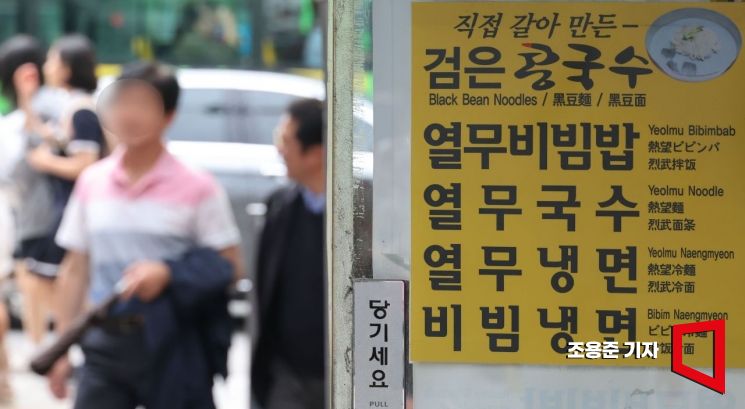 A notice about naengmyeon is posted on the door of a restaurant in a food alley in Seoul. Photo by Jo Yongjun jun21@
However, there are also reactions that the revised bill has caused mixed feelings across industries because it excludes wreath and artificial flower expenses, as well as agricultural, livestock, and marine product gift expenses. The wreath and artificial flower limit has been frozen at 100,000 won for six years since it was raised from 50,000 won in 2018, and although the gift limit for agricultural, livestock, and marine products was raised from 100,000 won to 150,000 won last year, it is still criticized for not reflecting current market prices.
Kim (37), who runs a flower shop in Jongno-gu, Seoul, said, "Wreaths and artificial flowers were raised once since the law’s enforcement, so they seem to have been excluded this time, but flower prices have also risen absurdly due to the domestic distribution structure." He added, "It’s disappointing that they were excluded this time, but I think there is a need for adjustment next time."
A representative from the Korea Federation of Micro Enterprise also said, "Overall, small business owners welcome this increase," but added, "The difficulties faced by small business owners are not limited to the dining industry. We hope that this opportunity will lead to adjustments in the value limits for other sectors to reflect actual market prices."
Experts predict that the economic impact of this revision will not be significant. Professor Kim Jin-il of Korea University’s Department of Economics said, "People who usually ordered menus priced around 60,000 won might now order 50,000 won menus to fit the limit. While the impact on individual merchants may be significant, the macroeconomic effect is expected to be minimal." He added, "If the reason for raising the food item value is to reflect actual market prices, adjustments should also be made for other sectors."
© The Asia Business Daily(www.asiae.co.kr). All rights reserved.
![Clutching a Stolen Dior Bag, Saying "I Hate Being Poor but Real"... The Grotesque Con of a "Human Knockoff" [Slate]](https://cwcontent.asiae.co.kr/asiaresize/183/2026021902243444107_1771435474.jpg)
















