Q2 Economic Growth Rate -0.2%, Lower Than Expected
Private Consumption -0.2%, Facility Investment -2.1%...Both Consumption and Investment Contracting
Calls for Base Rate Cut in Q4 Likely to Grow
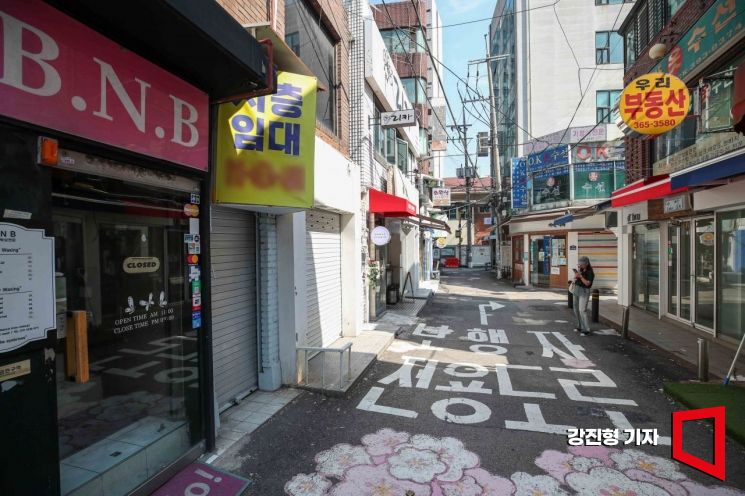 Empty storefronts are located throughout the commercial area near Ewha Womans University in Seodaemun-gu, Seoul. Photo by Jinhyung Kang aymsdream@
As domestic demand continues to slump, South Korea's economic growth rate in the second quarter sharply retreated compared to the previous quarter. Even considering the base effect from the surprise growth in the first quarter, the weakness in domestic consumption and investment in the second quarter was evident. The export growth trend also showed signs of slowing, increasing expectations for a base interest rate cut.
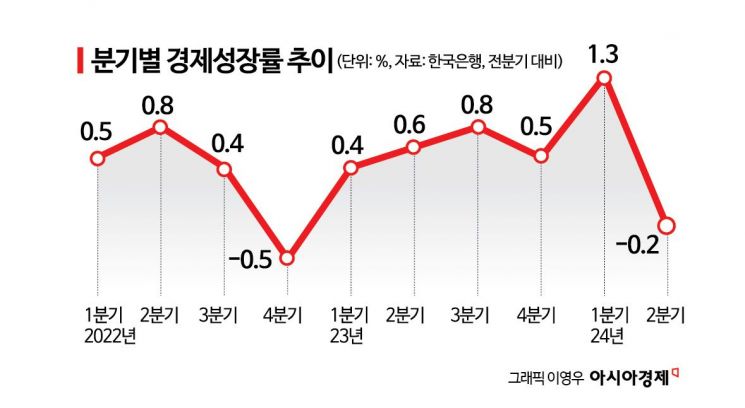
The Bank of Korea announced on the 25th that the real gross domestic product (GDP) growth rate for the second quarter (preliminary figure) recorded a negative (-) 0.2% compared to the previous quarter. This marks a significant slowdown from the 1.3% growth recorded in the previous quarter. Quarterly contraction is the first in one year and six months since the fourth quarter of 2022 (-0.5%).
The second quarter growth rate of -0.2% is lower than both the Bank of Korea's and market expectations. The Bank and the market had predicted a range of 0.0 to 0.1%. The growth rate for the first half of the year also came in at 2.8% year-on-year, slightly below the Bank of Korea's initial forecast of 2.9%.
Export Growth Continued but Domestic Consumption and Investment Clearly Sluggish
Breaking down the second quarter growth rate by sector, exports increased by 0.9% quarter-on-quarter, led by automobiles and chemical products, while imports rose by 1.2%, driven by crude oil and petroleum products.
On the other hand, domestic demand was weak. Private consumption decreased by 0.2% quarter-on-quarter due to sluggish consumption of goods such as passenger cars and clothing. Facility investment also shrank by 2.1%, as machinery including semiconductor manufacturing equipment declined. Construction investment, which had driven surprise growth with a 3.3% increase in the first quarter, fell by 1.1% as both residential building construction and civil engineering decreased.
Shin Seung-chul, Director of Economic Statistics at the Bank of Korea, explained, "Domestic demand has shown a poor trend since last year, briefly rebounded in the first quarter of this year, but returned to a sluggish trend in the second quarter."
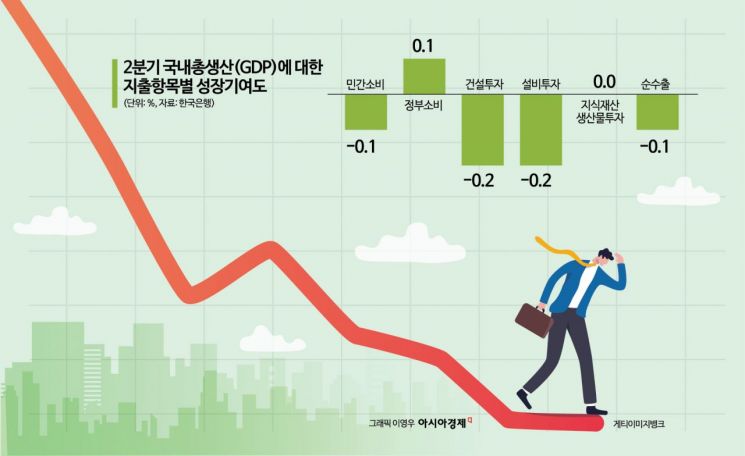
Looking at the contribution to growth by expenditure items, both net exports and domestic demand turned negative. The contribution of domestic demand to the second quarter economic growth rate was -0.1 percentage points, turning negative from 0.5 percentage points in the first quarter. Major domestic demand components such as construction investment (-0.2 percentage points), facility investment (-0.2 percentage points), and private consumption (-0.1 percentage points) all recorded negative contributions. Only government consumption (0.1 percentage points) showed a positive contribution.
The contribution of net exports (exports minus imports) also turned negative at -0.1 percentage points, the first negative reading in five quarters since the first quarter of last year (-0.2 percentage points). This is interpreted as net exports turning negative due to a higher import growth rate than export growth in the second quarter.
By industry, manufacturing grew by 0.7%, centered on transportation equipment. The electricity, gas, and water supply sector declined by 0.8% due to decreases in water supply, sewage and waste treatment, and raw material recycling industries.
The construction industry fell by 5.4% as both building construction and civil engineering decreased. The service sector maintained the previous quarter's level, with increases in transportation but declines in information and communication, wholesale and retail, and accommodation and food services.
The real gross domestic income (GDI) in the second quarter decreased by 1.3%, underperforming the real GDP growth rate (-0.2%).
Domestic Demand Slump Expected to Continue into Second Half
The domestic demand slump is expected to continue into the second half of the year, as private consumption and construction activity remain weak.
Kim Jeong-sik, Emeritus Professor of Economics at Yonsei University, said, "Although exports are showing strong performance, domestic demand is likely to deepen its slump. I expect the economic growth rate in the second half will not be as high as in the first quarter."
Director Shin Seung-chul said, "It is difficult to expect a complete recovery from the domestic demand slump in the second half," but added, "As factors that constrained domestic demand, such as high inflation and high interest rates, ease, a gradual improvement is anticipated."
Professor Kim Young-ik of Sogang University Graduate School of Economics explained, "The private consumption and facility investment sectors performed better than expected in the first quarter, so the second quarter declined due to the base effect." However, Professor Kim added, "Although domestic demand was weak, the recent improvement in consumer sentiment index suggests there is room for improvement in the second half."
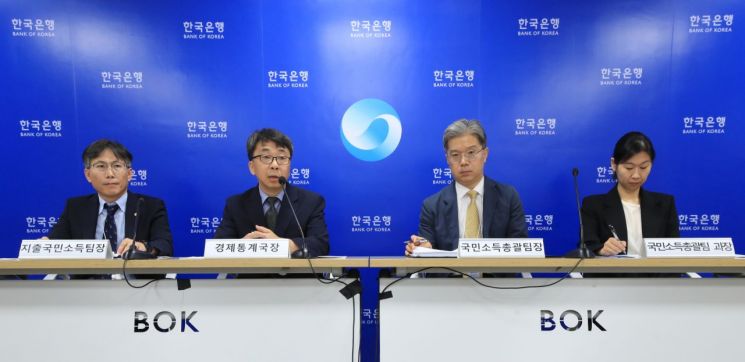 On the morning of the 25th, the Bank of Korea in Jung-gu, Seoul held a briefing on the real Gross Domestic Product (preliminary) for the second quarter of 2024.
- From the left in the photo: In-gyu Lee, Head of the National Income Expenditure Team; Seung-cheol Shin, Director of the Economic Statistics Bureau; Chang-gu Kang, Head of the National Income General Team; Nam-young Ha, Manager of the National Income General Team (Photo by Bank of Korea)
With the second quarter economic growth rate coming in lower than expected, pressure for the Bank of Korea to cut the base interest rate is expected to increase. The need for a rate cut to stimulate domestic demand and boost the economy is growing.
Heo Moon-jong, Senior Researcher at Woori Financial Research Institute, forecasted, "Concerns over the domestic demand slump are growing, so there may be minority opinions for a rate cut at the Bank of Korea's Monetary Policy Committee meeting next month."
Professor Kim Jin-il of Korea University’s Department of Economics said, "A rate cut is indeed necessary from an economic perspective," but added, "Concerns over financial stability and the timing of the U.S. Federal Reserve's rate cuts remain variables."
© The Asia Business Daily(www.asiae.co.kr). All rights reserved.
![Clutching a Stolen Dior Bag, Saying "I Hate Being Poor but Real"... The Grotesque Con of a "Human Knockoff" [Slate]](https://cwcontent.asiae.co.kr/asiaresize/183/2026021902243444107_1771435474.jpg)


















