"Development of New Domain Power, Strengthening Traditional Combat Power"
China has declared its intention to accelerate the development of nuclear weapons.
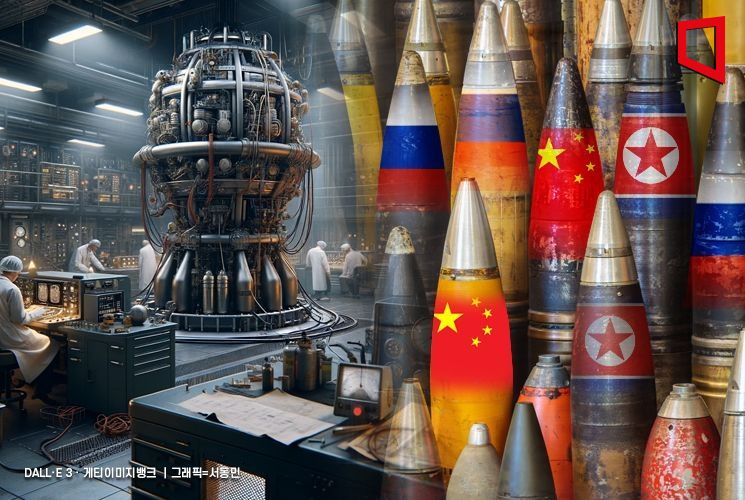
According to the South China Morning Post (SCMP) in Hong Kong on the 24th, the Chinese Communist Party pledged to "accelerate the development of strategic deterrence" in the resolution of the 3rd Plenary Session of the 20th Central Committee announced on the 21st. The term 'strategic deterrence' is used by China when referring to its nuclear capabilities.
The resolution stated, "To develop new frameworks for military services and weapons, China will speed up strategic deterrence, develop new domain forces equipped with new combat capabilities, and strengthen traditional combat power."
Zhao Tong, a senior researcher at the Carnegie Endowment for International Peace, told SCMP, "The reappearance of this language (strategic deterrence) in the recent 3rd Plenary Session resolution shows that China will continue to prioritize its nuclear and non-nuclear strategic capabilities," adding, "The rapid quantitative and qualitative enhancement of China's nuclear weapons systems, including nuclear warheads, missiles, launchers, silos, and strategic submarines, is expected to continue over the next few years." He viewed this as aimed at getting the United States to accept China's rise and respect China's core interests.
There is also analysis that Russia's invasion of Ukraine served as a catalyst. Military commentator Song Zhongping said, "The Ukraine conflict showed the international community that the United States is reluctant to intervene due to fear of Russia's nuclear weapons," adding, "Even if the U.S. has the will to intervene (in Taiwan), it will inevitably exercise restraint if China possesses powerful nuclear weapons capable of retaliatory strikes on the U.S. mainland."
Ryle Goldstein of the U.S. think tank Defence Priorities identified Taiwan as the only issue that could trigger a nuclear war between the U.S. and China. He stated, "The only way to avoid the consequences of a nuclear conflict and the enormously costly and wasteful competition associated with it is for the U.S., Taiwan, and Beijing to engage in a series of concrete compromises."
According to the Stockholm International Peace Research Institute (SIPRI), the U.S. possesses about 3,700 nuclear warheads, second only to Russia's approximately 4,500, while China has 410. Earlier, the U.S. Department of Defense stated that as of May last year, China had over 500 operational nuclear warheads and is rapidly increasing its stockpile, expecting to exceed 1,000 by 2030.
© The Asia Business Daily(www.asiae.co.kr). All rights reserved.
![Clutching a Stolen Dior Bag, Saying "I Hate Being Poor but Real"... The Grotesque Con of a "Human Knockoff" [Slate]](https://cwcontent.asiae.co.kr/asiaresize/183/2026021902243444107_1771435474.jpg)















