Problems Arise When Only Specific Direct Translation Rights and Interests Are Represented
Discussion Needed on Support Direction for All Healthcare Workers
As the National Assembly begins serious discussions on the Nursing Act, medical associations have argued that the direction should be one where all healthcare professionals can coexist, rather than representing the rights and interests of a specific occupation.
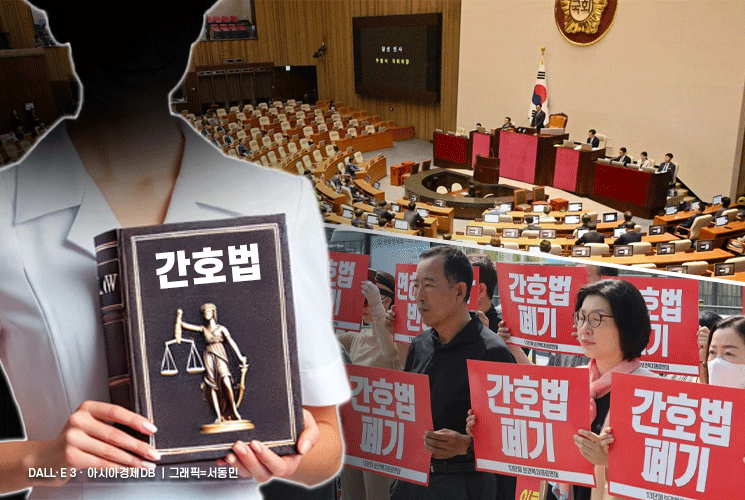
The National Assembly's Health and Welfare Committee held a subcommittee meeting on the 22nd to discuss the Nursing Act. The bills on the table included the "Act on Nurses, etc." proposed by Chu Kyung-ho, the floor leader of the People Power Party, and the "Nursing Act" proposed separately by Kang Seon-woo and Lee Soo-jin of the Democratic Party of Korea. Both ruling and opposition parties have adopted the act as their party stance, raising expectations for the passage of the Nursing Act. The subcommittee discussion focused not on the existence of the Nursing Act but on specific issues such as the "PA nurse qualification" and "educational restrictions for nursing assistants."
Previously, the Nursing Act had passed the plenary session last April during the 21st National Assembly by a Democratic Party resolution but was nullified due to President Yoon Seok-yeol's veto power.
The medical community has opposed the current bills, stating that they contain virtually the same content as the Nursing Act that was vetoed by President Yoon last year. For example, in last year's bill, the clause "to regulate necessary matters so that high-quality nursing benefits can be received in the community" was changed to specify "schools, industrial sites, home care, and various social welfare facilities" as the community. The Korea Medical Association (KMA) pointed out, "Although the wording was revised in an open and illustrative manner, it still contains essentially the same content, which means the problems have not been resolved. This is merely a trick to circumvent criticism of the discarded Nursing Act."
The KMA also claimed that the renewed discussion of the Nursing Act is a retaliatory move against the medical community's opposition to increasing medical school quotas. A KMA official said, "Despite the unresolved issues such as excessive conflicts between occupations raised when the government exercised its veto power, the ruling and opposition parties, along with the government, have reversed their stance 180 degrees and are pushing for the enactment of the Nursing Act. This is a retaliatory act against doctors and a political act that forgets their duties."
Concerns were also raised that the Nursing Act would cause various problems by representing only the rights and interests of a specific occupation. If the bill passes, it is expected to cause issues such as unlimited expansion of nurses' scope of practice, promotion of illegal medical acts by nurses, violation of the constitutional principle of prohibition of broad delegation, legal conflicts, allowance of unlicensed medical acts by advanced practice nurses, encouragement of illegal medical institution establishment by nurses, and sudden distortion of nursing workforce supply and demand.
It was also pointed out that expanding nursing duties to overlap with other healthcare occupations would increase confusion in medical settings. In fact, the KMA was not the only organization opposing the Nursing Act last year. Fourteen healthcare organizations representing various occupations united with the KMA to call for the repeal of the Nursing Act.
A KMA official explained, "If independent laws are enacted for each healthcare occupation to define the scope of work and authority individually, there will be an increase in legislative initiatives aimed at including favorable content and excluding unfavorable content for each occupation based on these individual laws. This will lead to overlapping scopes of work or deletion of restricted conditions, resulting in independent work performance and causing divergent interpretations and conflicts between individual laws among healthcare professionals and technicians, thereby increasing confusion in medical settings."
The KMA emphasized that, while most healthcare occupations oppose the Nursing Act, policies should be pursued that allow healthcare professionals to coexist. A KMA official stressed, "It would be desirable not only to support and improve the treatment of nurses but also to improve the support and treatment of the entire healthcare workforce through amendments to the Medical Service Act and the Healthcare Workforce Support Act."
© The Asia Business Daily(www.asiae.co.kr). All rights reserved.
![Clutching a Stolen Dior Bag, Saying "I Hate Being Poor but Real"... The Grotesque Con of a "Human Knockoff" [Slate]](https://cwcontent.asiae.co.kr/asiaresize/183/2026021902243444107_1771435474.jpg)















