Meeting of Gwangju Party Election Commission Scheduled After Candidate Registration Deadline at 6 PM on the 23rd
Discussion on Candidate Eligibility... May Request Interpretation from Central Party Election Commission
Candidate Kang Wiwon: "Past Controversies Are Not Grounds for Disqualification... Fairness Must Be Maintained"
As the curtain rises on the election for the Democratic Party Gwangju Metropolitan City Party Chairperson, which is attracting more attention than the party convention to elect the party leader and supreme council members, the results of the meeting of the Gwangju City Party Election Commission are drawing attention.
According to the Democratic Party Gwangju City Party on the 23rd, the registration for the city party chairperson candidates will close at 6 p.m. that day. As of 11 a.m., Kang Wiwon, co-representative of the Democratic Party National Innovation Council, and Yang Bunam, National Assembly member (Seo-gu Eul), had completed their candidate registration. Kang emphasized "innovation," while Yang stressed "stable management," and both began their election campaigns after registering as candidates the previous day.
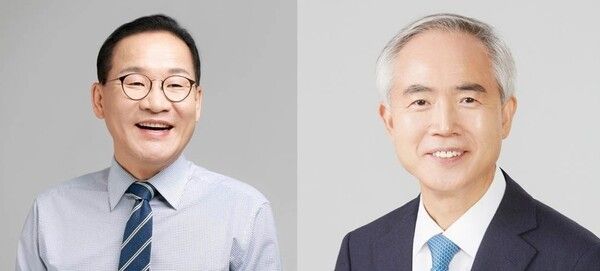 Kang Wiwon, Standing Representative of the Democratic Party of Korea National Innovation Council (left in photo), and Congressman Yang Bunam, candidates for the Chairman of the Democratic Party of Korea Gwangju Metropolitan City Party. (in alphabetical order)
The Gwangju City Party Election Commission is known to hold a meeting immediately after the candidate registration deadline to discuss the eligibility of the candidates. However, due to political sensitivities, there is a possibility that the Gwangju City Party Election Commission may not make a decision and instead request an interpretation from the central party election commission.
The Democratic Party restricts the eligibility to run for office for those who have been convicted with a confirmed sentence of imprisonment or probation or higher for criminal offenses that have drawn public condemnation, such as bribery, solicitation, embezzlement of public funds, violations of the Political Funds Act, sexual crimes, and personal misconduct, as well as those who are clearly deemed unsuitable to be recommended as public office candidates.
Kang withdrew from candidacy twice?once in the 2018 Gwangju Gwangsan District Mayor election and again in this year's National Assembly election?without undergoing candidate verification due to allegations of sexual harassment that occurred over 20 years ago.
At the time, the party's position was that there was no problem according to party regulations, but Kang said, "I judged that I could not let the leadership of Lee Jae-myung and the Democratic Party's general election victory strategy be shaken because of me." He also carries risks related to drunk driving and unlicensed driving incidents from over 20 years ago.
Yang Bunam was also embroiled in controversy over allegations of receiving high legal fees under the pretext of settling a case (violation of the Attorney-at-Law Act).
Although neither candidate has a confirmed sentence of imprisonment or probation or higher, the Gwangju City Party Election Commission is expected to examine whether they fall under the category of being clearly unsuitable to be recommended as public office candidates.
Kang stated, "There is a saying that 'there is no drunk driving without a story,' but the 2003 drunk driving incident occurred while I was undergoing treatment for depression and attempting an extreme act, and the 2006 incident happened while moving an institutional vehicle about 1 meter due to parking. Since these incidents happened nearly 20 years ago, they do not constitute 'unconditionally disqualifying' reasons."
He added, "The term 'secondary victimization' was legally defined at the end of 2019, but the defamation lawsuit loss was in 2018. Moreover, secondary victimization is not an unconditionally disqualifying reason. In the last general election, I did not withdraw because I feared failing candidate qualification verification, but as a close aide to Lee Jae-myung, it was an act of putting the party's interests first to block malicious attacks from the People Power Party."
He also said, "I expected at least minimal fairness from the Gwangju City Party Election Commission, but I doubt whether neutrality can be expected from an election commission composed of members recommended by eight regional chairpersons (National Assembly members). The collective and public endorsement by incumbent National Assembly members is a campaign method prohibited by 'Party Regulation No. 4 on Party Position Elections.' I want to ask whether the Gwangju City Party Election Commission has ever discussed the fact that eight National Assembly members jointly nominated a candidate."
On the other hand, there is a political view that this candidate eligibility verification is a golden opportunity for Kang to shed the stigma that has held back his political career so far.
There is an opinion that if he passes this verification, it could instantly resolve the regret of not being able to remove the controversy tags after voluntarily withdrawing without verification in both the 2018 local elections and the 2024 general election.
An official from the local political circles said, "The results of the candidate eligibility verification for the Gwangju City Party Chairperson are one of the biggest interests in the Gwangju political scene," adding, "Both candidates are likely to be on high alert."
© The Asia Business Daily(www.asiae.co.kr). All rights reserved.
![Clutching a Stolen Dior Bag, Saying "I Hate Being Poor but Real"... The Grotesque Con of a "Human Knockoff" [Slate]](https://cwcontent.asiae.co.kr/asiaresize/183/2026021902243444107_1771435474.jpg)















