Focus on North America Sales Share Over 3 Years
Samsung Bio 27.8%
HD Hyundai Construction Equipment 22.0%
CJ CheilJedang 24.1%
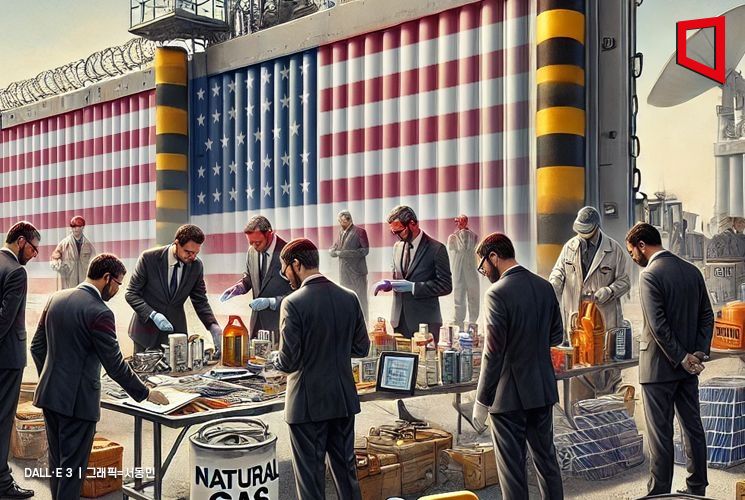
Daishin Securities identified domestic sectors to watch in relation to U.S. President Joe Biden's withdrawal from the Democratic presidential nomination during the past night (local time), highlighting industrial sectors such as oil & gas, electrical equipment, shipbuilding, aerospace, shipping, machinery, and construction. They also advised paying attention to the food & beverage and pharmaceutical & bio sectors.
On the 22nd, Lee Jaeman, a researcher at Daishin Securities, stated, "The investment strategy for the domestic stock market to prepare for the 'Trump era' should focus on sectors where direct investment in the U.S. has increased and where sales could rise with expanded investment in U.S. industrial and energy sectors."
Lee explained, "Domestic food & beverage and pharmaceutical & bio sectors also fall under industries with significant increases in direct investment in the U.S. Considering the steady growth in import demand within the U.S. for these two categories, it is necessary to pay attention to them."
He added, "Among these sectors, companies with high exposure to the U.S. (high North American or U.S. sales ratios) include Samsung Biologics, Doosan Enerbility, HD Hyundai Construction Equipment, CJ CheilJedang, and Samsung E&A. Expanding the weight of these companies is a strategy to prepare for the Trump era."
This analysis is based on the fact that former President Donald Trump maintains similar core policies in his 2024 campaign as in 2016, including strengthening protectionism, reviving traditional energy, and prioritizing nationalism. Trump fundamentally prefers a weak dollar and low interest rates. Lee emphasized, "To avoid Trump's strengthened protectionism, it is necessary to focus on industries with substantial direct investment in the U.S."
However, he cautioned, "Since Trump has mentioned repealing the IRA, caution is needed for overseas companies related to eco-friendly materials (such as semiconductors and secondary batteries), transportation, and electric vehicles that have competed with U.S. companies supported by subsidies. In the U.S. stock market, old semiconductors (Intel, Micron) and automobiles (GM, Ford) may be highlighted instead of new semiconductors and cars."
Considering the preference for low interest rates and corporate tax cuts (→ expansion of fiscal deficits), Lee predicted a high likelihood of a rebound in the U.S. long- and short-term interest rate spread. He views increasing exposure to U.S. bank stocks as necessary.
He analyzed, "Considering corporate investment tax deductions on interest expenses, new city construction, and expanded investment pledges in businesses like UAM, the potential for increased corporate investment could be a growth driver for the U.S. Although sales are near all-time highs, there is a high possibility of expanded investment in industrial and energy sectors where capital expenditures (CAPEX) are at peak or below average."
© The Asia Business Daily(www.asiae.co.kr). All rights reserved.
![Clutching a Stolen Dior Bag, Saying "I Hate Being Poor but Real"... The Grotesque Con of a "Human Knockoff" [Slate]](https://cwcontent.asiae.co.kr/asiaresize/183/2026021902243444107_1771435474.jpg)
















