Market Outlook at 0~0.1% Range... Q1 Base Effect Impact
Some Forecast Negative Growth Due to Domestic Demand Slump
Possibility of Minority Opinion for Rate Cut in August
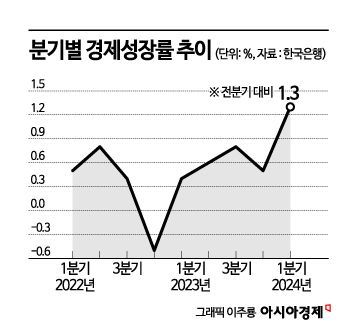
South Korea's economic growth rate in the second quarter is expected to slow significantly compared to the first quarter. In addition to the base effect from the surprise growth in the first quarter, recent domestic demand sluggishness has led some institutions to forecast negative growth. If a negative growth rate emerges in the second quarter, calls for a base interest rate cut are likely to increase.
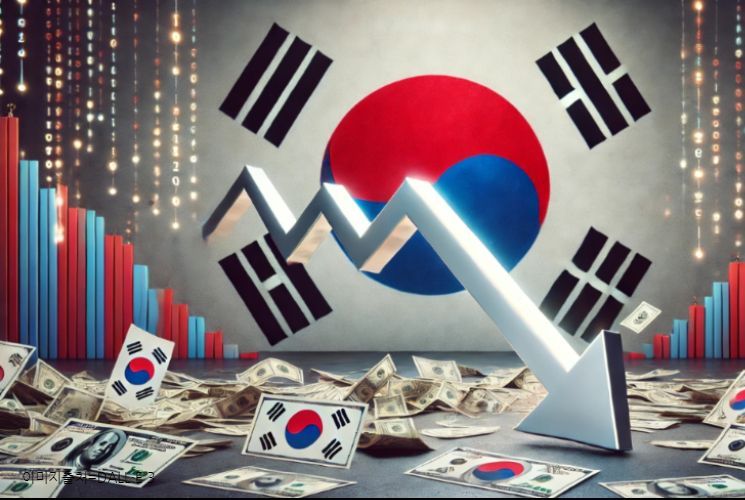
According to the Bank of Korea and financial authorities on the 22nd, South Korea's second-quarter Gross Domestic Product (GDP) growth rate, to be announced on the 25th, is expected to be around 0.1%.
In the economic outlook released in May, the Bank of Korea projected that South Korea's economic growth rate in the first half of this year would increase by 2.9% year-on-year. Based on the first quarter growth rate (1.3% quarter-on-quarter), the second quarter economic growth rate is estimated to be around 0.1 to 0.2%.
Bank of Korea Research Department: "Second Quarter Growth Rate Expected to be Significantly Revised"
The Bank of Korea's Research Department analyzed in its second-quarter economic assessment released on the 16th that the growth rate, which expanded in the first quarter, was significantly adjusted downward in the second quarter. While exports showed clear improvement, the recovery of domestic demand such as consumption and investment was slower than expected. A Bank of Korea Research Department official explained, "Domestic demand, which had increased significantly in the first quarter due to temporary factors such as mild weather and early smartphone releases, was adjusted in the second quarter as the effects of high inflation and high interest rates continued," adding, "Since domestic demand showed a slower recovery compared to exports, the growth gap between exports and domestic demand remained."
Government statistics also indicate domestic demand weakness. According to Statistics Korea, industrial production in May decreased by 0.7% compared to the previous month. Retail sales, which reflect consumption trends, also fell by 0.2% month-on-month, and facility investment dropped by 4.1%. The so-called 'triple decline' in overall industrial production, retail sales, and facility investment continued, indicating persistent domestic demand weakness.
The slowdown in the second quarter growth rate is also influenced by the base effect from the surprise growth in the first quarter. The first quarter growth rate was 1.3% quarter-on-quarter, far exceeding the market expectation of 0.6%. Since the first quarter showed a surprise growth beyond expectations, the second quarter growth rate is inevitably lower in comparison.
The private sector forecasted an even lower second quarter growth rate than the Bank of Korea. Woori Financial Management Research Institute projected the second quarter economic growth rate at 0% quarter-on-quarter. IBK Investment & Securities also forecasted a level of 0.1 to 0.2%.
There are also forecasts of negative growth. Korea Investment & Securities predicted a -0.1% growth rate for the second quarter due to weaker-than-expected industrial production in May. Namgang Lee, a researcher at Korea Investment & Securities, explained, "May industrial production was minus 0.7%, significantly below the forecast of plus 0.2%. With manufacturing and service production both weak, the second quarter growth forecast was lowered."
Major overseas investment banks (IBs) also viewed South Korea's second quarter economic growth rate to be around 0%. According to Bloomberg's aggregation, major foreign IBs expected South Korea's second quarter economic growth rate to average about 0.1% quarter-on-quarter. Citibank and Standard Chartered (SC) projected -0.1% for the second quarter, while HSBC forecasted -0.2%.
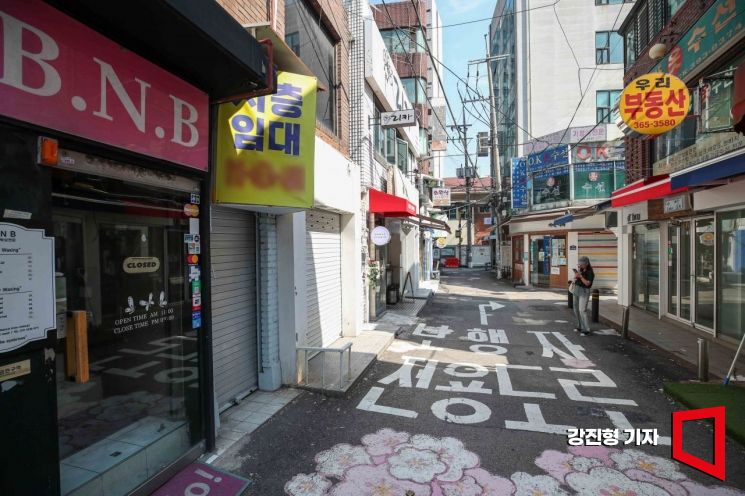 Empty storefronts are located throughout the commercial area near Ewha Womans University in Seodaemun-gu, Seoul. Photo by Jinhyung Kang aymsdream@
If Negative Growth Occurs in Q2, Pressure for Base Rate Cut Likely to Increase
If the second quarter economic growth rate comes in lower than the Bank of Korea's forecast, pressure for a base interest rate cut on the Bank of Korea is expected to intensify. The need for a rate cut to stimulate the economy, including boosting domestic demand, will grow. There is also a higher possibility that minority opinions favoring a rate cut will emerge at the Bank of Korea's Monetary Policy Committee meeting next month.
Moonjong Heo, head of Woori Financial Management Research Institute, explained, "Recent industrial activity trends show a differentiation between domestic demand and exports," adding, "While net export contribution was large in the first quarter GDP, it is expected to be relatively lower in the second quarter, and construction investment and private consumption are likely to continue sluggish trends due to high interest rates and inflation." He continued, "If the decline in the second quarter growth rate is larger than expected, concerns over domestic demand weakness will increase, leading to minority opinions for a rate cut in August," but added, "Considering household debt, the housing market, and exchange rates, an August rate cut would be premature."
Yongtaek Jung, economist at IBK Investment & Securities, said, "Since the Bank of Korea also expects growth to gradually slow, the impact of the second quarter GDP will not be significant," but added, "There is a high possibility that minority opinions will be presented in August due to domestic demand weakness and other reasons." He further assessed, "However, an actual rate cut is more likely to occur after the U.S. Federal Reserve (Fed) cuts its rates."
Even if the second quarter growth rate is better than expected, there is a possibility of a sluggish economic trend going forward. Economist Jung said, "Considering the weak domestic demand, growth rates will decline in the future," and added, "Even if the second quarter growth rate turns out better than initially expected, economic momentum will retreat starting from the second quarter."
© The Asia Business Daily(www.asiae.co.kr). All rights reserved.
![Clutching a Stolen Dior Bag, Saying "I Hate Being Poor but Real"... The Grotesque Con of a "Human Knockoff" [Slate]](https://cwcontent.asiae.co.kr/asiaresize/183/2026021902243444107_1771435474.jpg)

















