Increasing Sexual Violence, Stalking, and Abuse...
Perpetrators Receive Legal Counsel
While Victims Are Marginalized in Criminal Proceedings
There are growing calls to expand the range of crimes for which victims can receive assistance from court-appointed victim attorneys, who help victims of crimes such as sexual violence and abuse of persons with disabilities. This is to prevent the marginalization of crime victims during criminal proceedings and to address legal blind spots.
Crime victims are often marginalized in trial procedures because they are not parties to criminal lawsuits. With the recent increase in human rights violations against crime victims and the growing awareness that anyone can become a victim?such as in the Sicheong Station traffic accident or the death of an army trainee?there is a rising demand to expand the scope of victim protection and strengthen support systems.
Currently, court-appointed victim attorneys provide free legal assistance only to victims of sexual violence, child abuse, abuse of persons with disabilities, human trafficking, and stalking. They play a role in legally supporting victims throughout the entire process from investigation to trial, standing against the defendant’s counsel.
Victim court-appointed attorneys are divided into dedicated attorneys managed by the Korea Legal Aid Corporation and non-dedicated attorneys who handle individual cases alongside other work. Since the introduction of dedicated victim court-appointed attorneys in 2013, 45 have been active nationwide, while about 600 non-dedicated court-appointed attorneys have been active since their introduction in 2012. According to the Ministry of Justice, a total of 260,251 cases have been supported from 2012 to September 2023.
The Ministry of Justice also agrees on expanding the scope of court-appointed victim attorneys and last December announced a legislative amendment to the Act on Special Cases Concerning the Punishment of Specific Violent Crimes to include major violent crimes such as murder, robbery, and organized crime in the support scope. However, this was discarded due to the expiration of the 21st National Assembly’s term.
A former high court judge who presided over a sexual violence-dedicated criminal division said, “Rather than providing assistance only for specific crimes, it is necessary to designate court-appointed victim attorneys upon the victim’s request through the prosecutor’s review. For example, in murder cases, if the victim’s family does not personally hire an attorney, they cannot even apply for a court-appointed attorney, and in cases of bodily injury or violent crimes, many victims find it difficult to voice their concerns.”
Kang Sang-taek (36, 6th Bar Exam), a dedicated victim court-appointed attorney, also said, “Even minor sexual crimes can cause secondary harm, so victims can receive assistance from court-appointed attorneys. Similarly, specific violent crimes also have the potential for secondary harm, so if the state’s conditions allow, support should be discussed.”
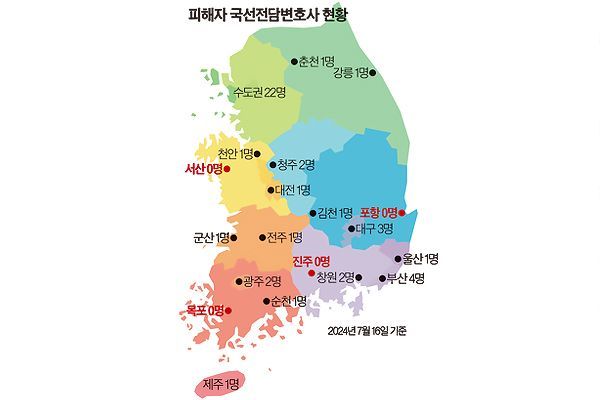
There are a total of 45 attorneys dedicated solely to victim court-appointed cases (as of July 16, 2024), with 22 stationed only in Seoul and the metropolitan area. It has been confirmed that there is not a single attorney in four cities: Pohang, Jinju, Seosan, and Mokpo.
According to the Korea Legal Aid Corporation (Chairman Lee Jong-yeop), recruitment was conducted in 10 locations this February (Seoul East, Bucheon, Yeoju, Seosan, Gimcheon, Pohang, Ulsan, Jinju, Mokpo, Jeju), but no one was hired in six locations (Seosan, Gimcheon, Pohang, Ulsan, Jinju, Mokpo). Accordingly, on the 15th, the corporation posted additional recruitment notices for regions including Pohang, Jinju, Seosan, Mokpo, as well as Seoul Central, Seoul West, Daejeon, Ulsan, and Pyeongtaek.
Prosecutorial support for victims is also lacking in effectiveness. Although a “victim-dedicated prosecutor system” is in operation, these prosecutors mainly coordinate with related agencies and handle victim support tasks when violent crimes occur. The prosecutors who actually assist victims during trials are the “trial prosecutors.” Trial prosecutors can request the court to allow “victim opinion statements” to protect victims’ right to testify.
Trial prosecutors identify detailed aspects of the victim’s psychological, physical, social, and economic damages and assist with testimony related to “secondary harm,” including threats of retaliation. However, according to 2023 Ministry of Justice data, each trial prosecutor is assigned to about 1.68 courts, and the number of old trial cases is increasing, making it difficult for trial prosecutors to thoroughly examine victims in each case.
The Ministry of Justice promotes support for court-appointed victim attorneys under the victim protection and support system with the explanation, “It’s frustrating to be a victim and not be able to find a lawyer!”
However, the legal community points out that improvements in treatment and systems are urgently needed to select court-appointed attorneys. For dedicated victim court-appointed attorneys, there is also the problem that they cannot provide assistance to victims in jurisdictions outside their own.
Shin Jin-hee (54, Judicial Research and Training Institute 40th class), a dedicated victim court-appointed attorney, said, “The biggest reason for reluctance to apply for positions as dedicated court-appointed attorneys in provincial areas is housing issues. If one has to work in an area without personal ties, housing must be arranged, and providing jeonse loans or official residences could increase applicants.”
Treatment improvements are also urgent. The salary of dedicated victim court-appointed attorneys has been frozen at around 5 million KRW per month for the past 10 years. In 2013, the monthly salary was about 5.3 million KRW for handling 15 cases per month, but this year’s recruitment notice shows a decrease to 5 million KRW for about 16 cases per month.
The same applies to non-dedicated court-appointed attorneys. Even when performing duties, they must submit supporting documents for each task during the payment claim process, which is cumbersome and time-consuming. One attorney lamented, “For defendant court-appointed attorneys, the court pays fees and only requires documents when an increase is needed. But for victim court-appointed attorneys, they must attach investigator confirmation letters when accompanying investigations, victim-signed confirmation letters during consultations, and internet-based distance proof for travel expenses, making the time spent per case excessive.”
There are also calls for procedural improvements. Unlike defendants, victims’ attorneys are not notified of related information by investigative agencies, so they must inquire individually with the police during the investigation stage and with the prosecution after transfer to track case numbers.
Lee Jin-young, Park Soo-yeon, Legal Times reporters
※This article is based on content supplied by Law Times.
© The Asia Business Daily(www.asiae.co.kr). All rights reserved.
![Clutching a Stolen Dior Bag, Saying "I Hate Being Poor but Real"... The Grotesque Con of a "Human Knockoff" [Slate]](https://cwcontent.asiae.co.kr/asiaresize/183/2026021902243444107_1771435474.jpg)















