Osangrok KIST Director's 100-Day Inauguration Press Conference
Announces New Management Policy Including Establishment of Three Mission-Focused Research Institutes
"Contributing to the Nation Through Research and Development Challenges"
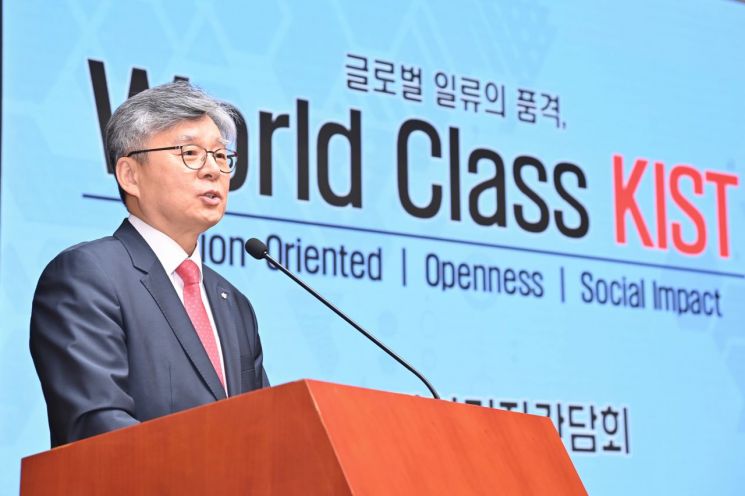 Osangrok, Director of KIST, is speaking at the 100-day inauguration commemorative meeting held at the KIST headquarters on the 17th. Photo by KIST
Oh Sang-rok, President of the Korea Institute of Science and Technology (KIST), presented a goal to directly overcome the 'Korean Paradox,' which refers to the low performance relative to R&D investment, through a reorganization of research organizations centered on missions.
On the 17th, Oh held a press briefing at the KIST Science Convention Hall to commemorate his 100 days in office, explaining the organizational restructuring and future tasks to promote future-oriented research and development (R&D) through bold challenges.
Oh was inaugurated as the 26th president of KIST on March 1, after nearly a year of delay. From the moment he took office, he focused on preparing KIST’s development strategy reflecting his management philosophy over 100 days, as well as plans for the leap forward of Korean science and technology.
Oh emphasized, "The launch of three mission-oriented research institutes as of July 1 is the starting point of change." Unlike the existing research institutes within KIST, the new mission-oriented research institutes are expected to bring a fresh breeze to government-funded research through the enlargement of research projects and the introduction of project managers (PMs), according to Oh.
KIST’s mission-oriented research institutes initially launched three areas: next-generation semiconductors AI·robotics, clean hydrogen convergence, and others. These mission-oriented research institutes focus on fields where only KIST can address national and social issues. The Next-Generation Semiconductor Research Institute aims to develop and commercialize a new type of ultra-large-scale computing semiconductor (RPU) that increases computing power while reducing power consumption, as well as realize large-scale quantum computers through the development of optical-based quantum processors (QPU) and distributed quantum computing. The AI·Robotics Research Institute aims to build and demonstrate a social safety platform for risk detection and response to realize a safe society for the public. The Clean Hydrogen Research Institute targets revitalizing the hydrogen industry by reducing the introduction cost of clean hydrogen production.
These mission-oriented research institutes are granted authority over team formation and budget allocation centered on PMs, deployment of dedicated support organizations, recruitment of outstanding external personnel, and collaboration with various stakeholders.
Oh expects that existing specialized research institutes or research headquarters, such as those in brain science and climate environment, may also join the mission-oriented research institutes.
Oh particularly stressed the urgent need to introduce PMs in mission research institutes. He said it was not easy even to decide on PMs because he set a principle that PMs would not be assigned research projects. This measure reflects Oh’s experience acting as a PM in many projects so far. Although researchers who do not take on research projects may face disadvantages, Oh said, "You cannot expect a supervisor to also play." Rather, through his experience as a PM within the institute, he encouraged seeking opportunities to challenge PM roles promoted by the Ministry of Science and ICT and appointed PMs. Oh believes that these appointed PMs must make bold decisions at turning points of long-term challenging research projects. In this process, PMs will also be fairly evaluated and rewarded based on responsibility and performance.
Oh also stated that he will support technology commercialization, expand cooperation with leading overseas partner institutions, and redefine the role of KIST’s overseas bases. VKIST in Vietnam, promoted as an Official Development Assistance (ODA) project, has completed phase one and plans to transform into a platform for domestic companies entering ASEAN and Vietnam in phase two. The Boston Research Center will shift from a local office in the bio field to a hub for personnel and corporate cooperation in bio, AI semiconductors, and quantum fields. In Europe, KIST plans to revise its role through activities such as acting as an intermediary for participation in Horizon Europe as an associate member country.
Oh said, "The reality is that the spirit of challenge among KIST and domestic researchers has decreased compared to the past. Although KIST has been regarded as the eldest and number one among government-funded research institutes, it is time to reflect on whether its current role is sufficient. I promise to awaken the lost research instinct and dormant wild spirit of researchers again."
© The Asia Business Daily(www.asiae.co.kr). All rights reserved.
![Clutching a Stolen Dior Bag, Saying "I Hate Being Poor but Real"... The Grotesque Con of a "Human Knockoff" [Slate]](https://cwcontent.asiae.co.kr/asiaresize/183/2026021902243444107_1771435474.jpg)















