Ajou University, Highest Proportion of High-Income Earners... 85%
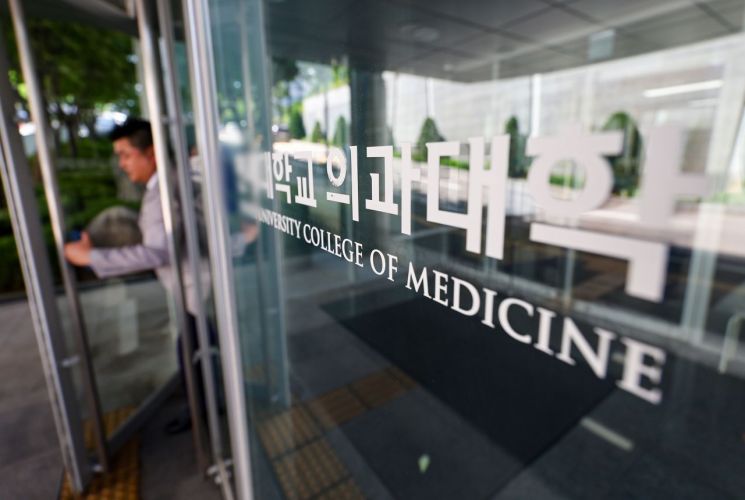
Among the medical school freshmen who applied for the national scholarship this year, 6 out of 10 were children from high-income families earning over 100 million KRW annually.
On the 16th, according to data submitted by the Korea Student Aid Foundation to Kang Deuk-gu, a member of the Democratic Party of Korea, titled "Application Status of National Scholarship by Tuition Support Bracket for Freshmen at 39 Medical Schools Nationwide in the First Semester of This Year," out of 1,821 freshmen, 1,124 students (61.7%) belonged to the highest tuition support brackets 9 and 10.
The national scholarship is a system that provides differential university tuition support from the national treasury based on household income. The foundation calculates the monthly recognized income by assessing the household's monthly income and property such as real estate, then categorizes applicants into basic, near-poverty, and brackets 1 through 10. Students in brackets 9 and 10 are not eligible for scholarships, which are only given to those in bracket 8 or below.
This year, the monthly recognized income threshold for bracket 9 exceeds 11,459,826 KRW. When annualized, this amounts to over 137.51 million KRW. However, this is a converted amount including all assets such as real estate and vehicles, so it differs from actual monthly income.
By university, the medical school with the highest proportion of freshmen in brackets 9 and 10 was Ajou University at 85.0%. This was followed by Ewha Womans University (77.4%), Sungkyunkwan University and Ulsan University (each 75.0%), and Seoul National University (74.3%). Chungbuk National University had the lowest proportion at 37.0%.
The basic and near-poverty classes accounted for only 73 students (4.0%) in total. Soonchunhyang University had the highest number with 6 students, but nine universities?Catholic University, Kyung Hee University, Dankook University, Sungkyunkwan University, Ewha Womans University, Inha University, Jeonbuk National University, Chung-Ang University, and Hanyang University?had none (23.0%). Some medical schools, including Catholic University, had no freshmen from the basic or near-poverty classes applying for the national scholarship for five consecutive years.
Each year, the proportion of medical school freshmen applicants in brackets 9 and 10 has increased from 58.9% in 2020, 59.2% in 2021, 62.3% in 2022, to 67.2% in 2023, but it decreased to 61.7% this year.
© The Asia Business Daily(www.asiae.co.kr). All rights reserved.
![Clutching a Stolen Dior Bag, Saying "I Hate Being Poor but Real"... The Grotesque Con of a "Human Knockoff" [Slate]](https://cwcontent.asiae.co.kr/asiaresize/183/2026021902243444107_1771435474.jpg)















