Isolated on Moksom near Seonjaedo, Incheon
Accessed via tidal sea path during low tide
A middle school student who was stranded by the rising tide after entering an uninhabited island where a sea path opened due to tidal differences was safely rescued.
On the 8th, Yonhap News reported, citing the Incheon Coast Guard, that "at around 3:26 p.m. on the 6th, a report was received that a middle school student, A, was stranded on Moksom near Seonjaedo, Ongjin-gun, Incheon." The Coast Guard dispatched officers from the nearby Yeongheung Police Substation and rescued A using a motorized rescue board about 40 minutes after the report was received.
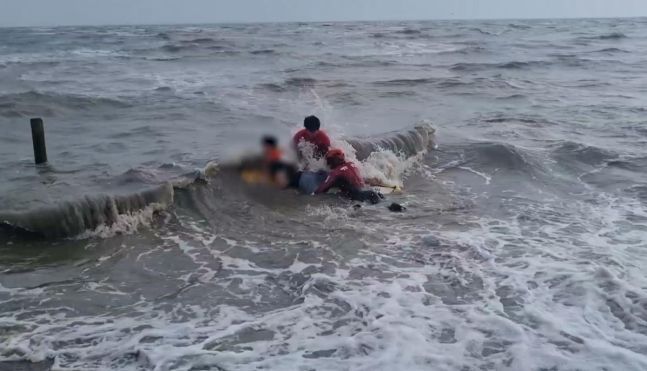
It was investigated that A had come to Seonjaedo for sightseeing with family and entered Moksom alone during low tide. Moksom is an uninhabited island about 500 meters away from Seonjaedo, where a sandy path connecting it to Seonjaedo opens when the tide goes out and disappears during high tide, a phenomenon that repeats twice a day. A, who entered Moksom, did not check the tide and was stranded by the rising tide. At that time, the waves were reported to be 1.5 to 2 meters high.
The Coast Guard confirmed that A was in good health and safely handed him over to his family. A Coast Guard official urged, "You must check the tide in advance before entering Moksom."
Meanwhile, on the west coast including Incheon, accidents of being stranded frequently occur due to large tidal differences and shallow waters when people go to experience mudflats. In April, a woman in her 50s who was stranded by seawater while digging clams in the mudflats on Muui-do, Incheon, was rescued by the Coast Guard. In the same month, a man in his 50s was stranded in waist-deep water while clam digging near the Dobido Port dock in Dangjin, Chungnam, and was rescued. Twelve people died in mudflat accidents last year alone, with about 10 deaths occurring annually.
The speed at which water rushes in during high tide at sea is known to be 7 to 15 km/h, which is 2 to 3 times faster than an average adult walking speed. Since it is impossible to walk normally on mudflats, moving to land 1 to 2 hours before high tide can prevent accidents. Also, even in shallow mudflats, it is necessary to wear life jackets and to engage in activities in groups of 2 to 3 rather than alone to prepare for emergencies.
© The Asia Business Daily(www.asiae.co.kr). All rights reserved.
![Clutching a Stolen Dior Bag, Saying "I Hate Being Poor but Real"... The Grotesque Con of a "Human Knockoff" [Slate]](https://cwcontent.asiae.co.kr/asiaresize/183/2026021902243444107_1771435474.jpg)















