Agreement on 'Safety Mechanism' for Ukraine Support Underway
Concerns Over Distraction by 'Biden Resignation Theory'
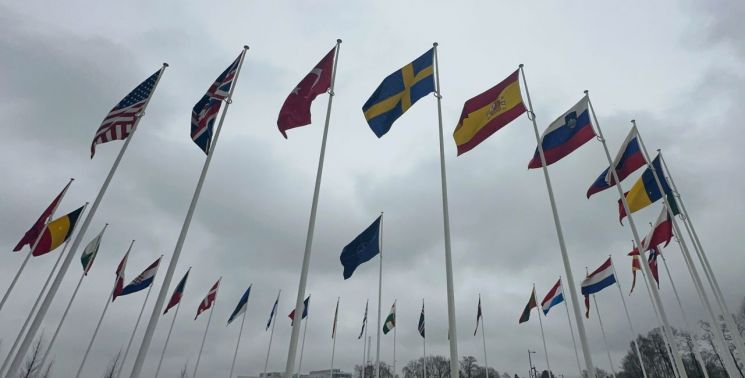
The 32 member countries of the North Atlantic Treaty Organization (NATO) will hold their annual summit from the 9th to the 11th (local time) in Washington DC, USA. Taking place amid heightened uncertainty due to the possibility of former U.S. President Donald Trump's return to power and the surge of far-right movements in major European countries, this summit is expected to serve as a platform to assess the cohesion of NATO allies.
Jens Stoltenberg, NATO Secretary General, held a pre-summit press conference on the 5th in Brussels, Belgium, emphasizing that "the most urgent task of this summit is support for Ukraine." NATO plans to establish so-called "safeguards" to continue supporting Ukraine regardless of political changes both inside and outside the alliance.
Secretary General Stoltenberg said he expects member countries to agree on a "commitment" to maintain annual military support at around 40 billion euros (approximately 60 trillion won). This 40 billion euros represents the total annual military support from NATO member countries since Russia's invasion of Ukraine in February 2022. NATO proposes setting this amount as a "minimum baseline" and calls for military support to be "fairly" shared according to each member country's Gross Domestic Product (GDP). After reaching an agreement at this year's summit, the overall support amount will be reviewed at next year's annual summit.
However, Hungary, which is friendly to Russia, declared early on that it would opt out of this plan, and even if an agreement is reached among the other 31 countries, it will not be binding, making its effectiveness uncertain. Additionally, since the military support expenditures for next year already announced or planned by individual countries are included, it is difficult to view this as "new money."
The summit is also expected to officially approve the NATO-led Ukraine security support and training coordination mission, which has already been agreed upon at the ministerial level. Under this mission, NATO will coordinate each country's donation plans for Ukraine and handle the delivery of weapons and military equipment donated by member countries. NATO will also oversee the training of Ukrainian forces conducted at military facilities within NATO member countries. This means NATO will take over some of the practical work from the U.S.-led informal consultative body, the Ukraine Defense Contact Group (UDCG), in preparation for a possible "Trump return."
Secretary General Stoltenberg also announced that additional support from member countries for air defense systems and ammunition to expand short-term support for Ukraine, as well as the signing of bilateral security agreements, will be announced. The Associated Press noted the possibility of Trump's return and the far-right surge in Germany and France, explaining that "NATO wants to demonstrate renewed unity and resolve even as many major member countries face increased uncertainty due to domestic elections."
Some express concern that renewed calls for U.S. President Joe Biden's withdrawal from the race, sparked by recent TV debates, could divert attention from the summit. Secretary General Stoltenberg seemed aware of this, avoiding direct answers to repeated questions about President Biden's health during the pre-summit press conference. Instead, he said, "We welcome President Biden's strong leadership on support for Ukraine," adding, "If I start commenting on political debates within the alliance, it could weaken the alliance itself."
This year's summit also invited four Asia-Pacific partners (AP4: South Korea, Japan, New Zealand, and Australia) for the third consecutive year. However, instead of Australian Prime Minister Anthony Albanese, Deputy Prime Minister and Defense Minister Richard Marles will attend. Secretary General Stoltenberg highlighted that "South Korean President Yoon Suk-yeol's attendance at the NATO summit reflects our deepening and strengthened partnership." He also said plans are in place to discuss building practical cooperation with Asia-Pacific partner countries, including South Korea, in areas such as Ukraine, cyber, new technologies, and defense industry production cooperation.
The summit is also expected to send a political message about strengthening solidarity between the four Asia-Pacific countries and NATO in response to North Korea-Russia military cooperation and the "rise of China," which NATO is wary of. The U.S. daily The Wall Street Journal (WSJ) reported on the 6th that the China issue will be discussed at this year's NATO summit. According to sources, the leaders plan to include criticism of China's support for Russia, which invaded Ukraine, in the joint declaration.
© The Asia Business Daily(www.asiae.co.kr). All rights reserved.
![Clutching a Stolen Dior Bag, Saying "I Hate Being Poor but Real"... The Grotesque Con of a "Human Knockoff" [Slate]](https://cwcontent.asiae.co.kr/asiaresize/183/2026021902243444107_1771435474.jpg)
















