Terror Attack and Brazen Attitude Instead of Apology
Talks Proposed to 'Shift the Narrative'... Only Repeated Clashes
North Korea Flooded with Insults Like Gaebaekjeong, Jeongsinbyeongja, and Execution
Historical records revealing North Korea's brazen attitude during the first inter-Korean meeting held immediately after the Aung San bombing?an assassination attempt on Chun Doo-hwan?have been disclosed. After facing international condemnation for the terrorist act, North Korea proposed talks to shift the situation, but during the hard-won meeting, they resorted to throwing leaflets and hurling unimaginable insults such as calling the other side "mentally ill" in the negotiation hall.
The Ministry of Unification released volumes 10 and 11 of the inter-Korean talks archives to the public on the 2nd. This is the fifth release following four rounds of document disclosures between 2022 and 2023. The newly unveiled documents cover the progress of events including ▲the announcement of the Plan for Democratic Unification and National Reconciliation (January 1982) ▲the Aung San mausoleum bombing, an assassination attempt on Chun Doo-hwan (October 1983), and North Korea’s proposal for a tripartite meeting (January 1984) ▲inter-Korean sports talks (April?May 1984) ▲delivery and receipt of flood relief supplies (September?October 1984) ▲the 8th to 10th inter-Korean Red Cross talks (May?December 1985) ▲visits to hometowns by separated families and exchange of artistic performance groups (September 1985).
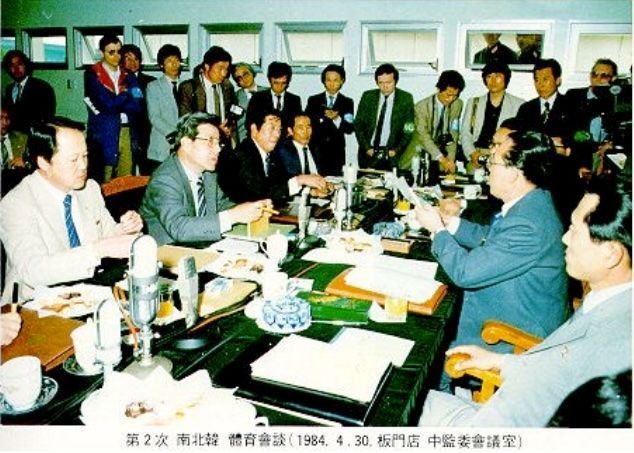 The 2nd Inter-Korean Sports Meeting is taking place in April 1984 at the Neutral Nations Supervisory Commission conference room in Panmunjom. [Photo provided by the Ministry of Unification]
According to the records, after the 1980 working-level representative contacts for a prime ministerial meeting ended without results, North Korea consistently rejected South Korea’s proposals for dialogue. Then, in 1983, the Aung San mausoleum bombing occurred in Burma (now Myanmar), and three months later, North Korea proposed a tripartite meeting involving South Korea and the United States. They extended a hand to discuss forming a unified team for the upcoming LA Olympics, with only two months remaining, as a means to change the situation.
Although dialogue was painstakingly restored in April 1984, the meeting hall saw loud arguments and insults exchanged instead of discussions aimed at restoring relations. Both sides clashed fiercely over sensitive issues such as the Aung San bombing and the abduction of filmmakers Shin Sang-ok and Choi Eun-hee.
The South Korean delegation, in their opening remarks, pointed out that 17 people lost their lives in North Korea’s bombing in Burma targeting then-President Chun Doo-hwan and his entourage, demanding that North Korea first admit to the terrorist act and apologize. However, North Korea countered brazenly, claiming the incident was merely a "South Korean staged act." When the South declared they would discuss the perpetrators arrested in connection with the Aung San bombing, the North retorted with harsh words, saying, "Who are these people bringing a one-act play here, knowing nothing?" and "What explosion in Burma? What did we do?"
North Korea instead accused the South of being the "source of terrorism," to which the South responded by asking, "Is there freedom to hold any ideology other than communism in North Korean territory?" They questioned point by point whether there was freedom of thought, religion, publication, and residence.
North Korean officials, struck at their core, reacted with agitation. The subsequent remarks from the North Korean delegation were recorded as "A place where all freedoms are guaranteed (commotion)... where did the democratization movement occur... (shouting)." The South further mentioned North Korea’s "political prison camps," stating "Your hereditary dynastic regime and idolization have become a laughingstock not only in the free world but even within communist countries that share your system."
During the confrontation, North Korea also tried to divert attention by accusing the South of distributing leaflets from the morning of the meeting day. At the time, the North Korean representative claimed, "Early this morning, your (South Korean) relevant agencies distributed a large number of propaganda leaflets defaming and slandering us in the area of our side in the Joint Security Area at Panmunjom," adding, "This unprecedented leaflet distribution incident, occurring just hours before today’s first sports talks, is a very malicious provocation aimed at insulting us and artificially creating obstacles before the talks." They even shouted, "What is this? Look at this!" while throwing the leaflets around.
Lee Ho-ryeong, head of the Security Strategy Center at the Korea Defense Research Institute and a preliminary reviewer of the document release, commented, "The 1980s were a time when both North and South Korea distributed leaflets," adding, "From the document alone, it is unclear whether North Korea brought accumulated leaflets or those actually distributed just before the talks."
North Korea created chaos in the meeting hall by shouting and cursing even at the press. The meeting documents recorded that "North Korean representatives threw matchboxes while South Korean representatives were speaking, and North Korean journalists joined in, continuously banging on desks and hurling insults."
Three weeks later, another meeting was held, but the two sides failed to reach an agreement. The record of the meeting held on April 30 of that year shows that when the South criticized North Korea’s system as a "hereditary regime" and "dictatorship," the North responded with insults. North Korea unleashed remarks such as "What, aren’t you mentally ill?" "You dog butcher," "You yourself are a traitor," and "Remember clearly that traitors like you will not escape bullets in front of the people."
Although three rounds of sports talks were held, North Korea refused to participate from the fourth round onward. North Korea, along with the Soviet-led communist bloc, boycotted the LA Olympics.
© The Asia Business Daily(www.asiae.co.kr). All rights reserved.
![Clutching a Stolen Dior Bag, Saying "I Hate Being Poor but Real"... The Grotesque Con of a "Human Knockoff" [Slate]](https://cwcontent.asiae.co.kr/asiaresize/183/2026021902243444107_1771435474.jpg)















