Payment Amounts in Childcare Sector Higher Than Average
Support for Tuition Fees and Childcare Product Purchases
Household Income Increase Strengthens Economic Power
Next Generation Shows Deepening Economic Dependence
Kim Mo-shi (66), who retired from a private university professorship, canceled his savings plan last month to coincide with his grandchild's expected birth date. This was to pay 4 million won for the postpartum care center expenses of his eldest son's wife. He also gave his daughter-in-law 1 million won in cash as a congratulatory gift for the birth. For his grandchild, he prepared children's insurance. Kim plans to pay a monthly premium of 25,000 won until his grandchild turns 20.
Recently, a phenomenon has emerged where the baby boomer generation (born 1946?1964), who have become grandparents, share the costs of raising their grandchildren. This is analyzed as a result of their strong economic power surpassing that of their children’s generation, leading them to open their wallets for grandchild care.
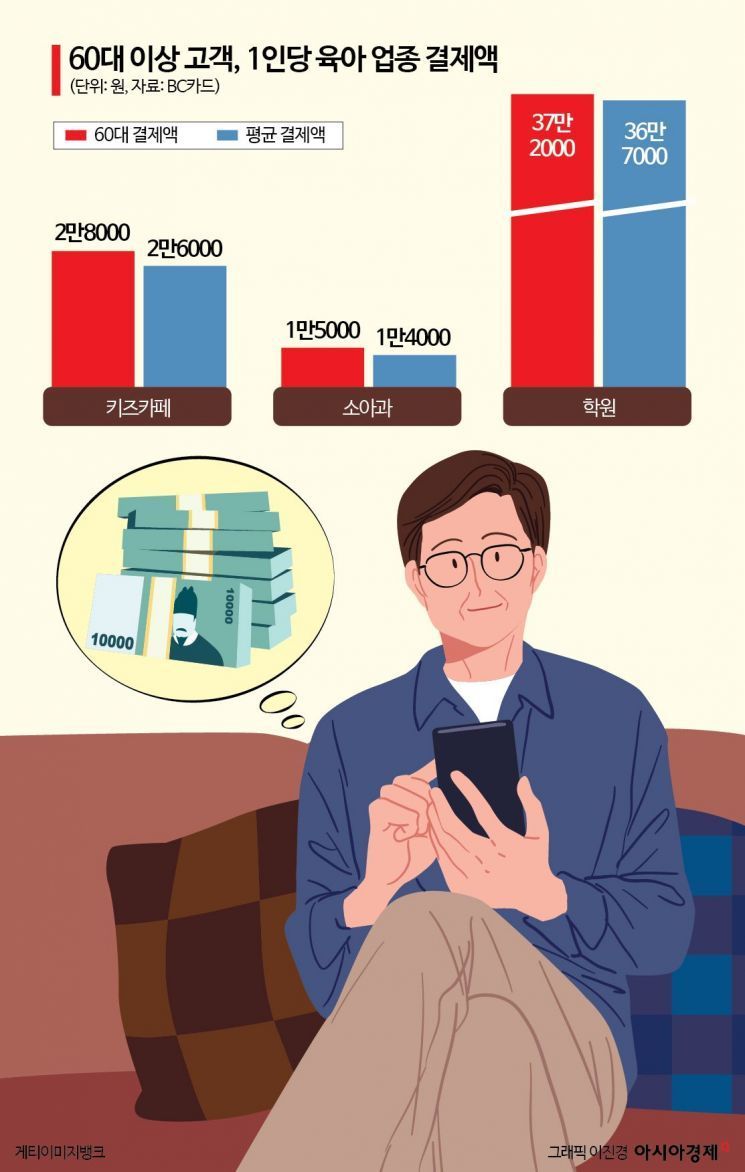
The burden of childcare costs on the baby boomer generation is also evident in statistics. According to BC Card’s 'Twilight Parenting Payment Trends' released last year, customers aged 60 and over paid 28,000 won at kids' cafes in August last year. This exceeds the average spending across all age groups (26,000 won). Additionally, payments for academy fees (372,000 won vs. 367,000 won) and pediatric clinics (15,000 won vs. 14,000 won) also surpassed the average spending of all age groups.
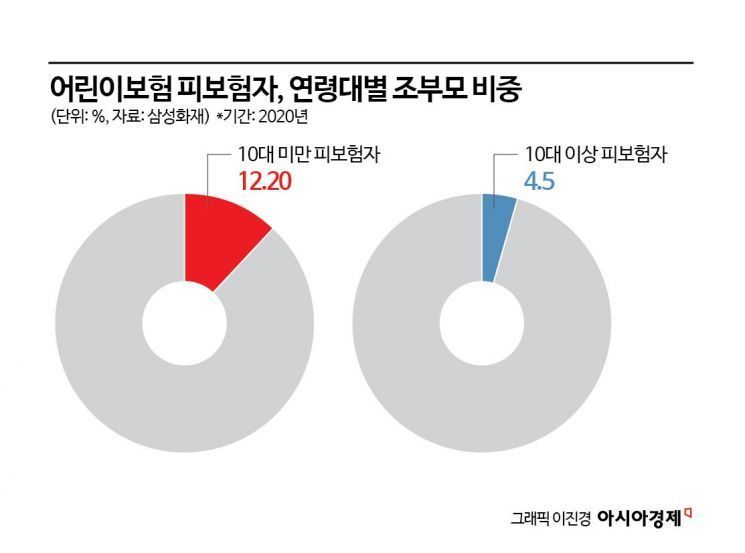
The baby boomer generation has also established itself as major players in the children's insurance industry. Cases of them directly subscribing to children's insurance for their grandchildren are increasing. According to Samsung Fire & Marine Insurance's 2020 children's insurance statistics, grandparents accounted for 12.20% of all policyholders under the age of 10. In contrast, for insured persons aged 10 and above, the rate of grandparents subscribing on their behalf was only 4.5%.
Recently, giving cash gifts to daughters-in-law expecting childbirth has also become somewhat of a trend. On mom cafes, cash gifts from in-laws are categorized by purpose, such as 'morning sickness allowance' or 'birth congratulatory money.' Posts about what kind of support was received from the in-laws after childbirth are a main topic on these mom cafes. One mom cafe member said, "My friend’s in-laws are well-off, so she received 1 million won as an allowance for morning sickness during pregnancy," adding, "I know it’s not something to be taken for granted, but I felt a bit disappointed as I couldn’t help but compare."
The increase in grandparents’ childcare spending is largely due to the baby boomer generation’s economic power surpassing that of their children’s generation. In fact, households in their 60s have shown the highest income growth among all age groups. According to Statistics Korea’s 'Social Trends in Korea 2023,' household income for those in their 60s increased by 22.5% in 2021 compared to 2018. Meanwhile, households in their 30s and 40s saw increases of only 11.5% and 10.8%, respectively. Households in their 20s experienced a 7.4% decrease in income.
Experts explain that due to the economic downturn, the disposable income of the children’s generation has decreased, leading to a tendency to rely on parents for childcare expenses. Professor Eunhee Lee of Inha University’s Department of Consumer Studies said, "The current baby boomer generation has accumulated much more wealth compared to the previous silver generation," adding, "On the other hand, the children’s generation faces increased survival expenses due to housing costs and high inflation, which has strengthened their tendency to depend on their parents for large expenditures." She further noted, "The 'eight-pocket' phenomenon, where eight adults including aunts and grandparents open their wallets for one child, is also one of the outcomes of the children’s generation’s reduced income."
© The Asia Business Daily(www.asiae.co.kr). All rights reserved.
![Clutching a Stolen Dior Bag, Saying "I Hate Being Poor but Real"... The Grotesque Con of a "Human Knockoff" [Slate]](https://cwcontent.asiae.co.kr/asiaresize/183/2026021902243444107_1771435474.jpg)
















