As the vote counting for the Iranian presidential by-election begins, a nail-biting race is unfolding with the lead changing hands at one point.
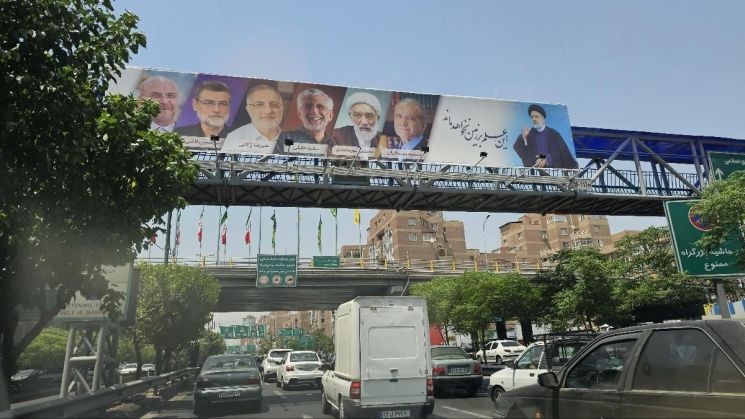 Campaign billboard of Iranian presidential election candidates posted in downtown Tehran. / Photo by Yonhap News
According to the Iranian Ministry of Interior and state broadcaster on the 29th, with about 12.05 million votes counted so far, reformist candidate Masoud Pezeshkian is leading with around 5 million votes. Conservative candidate Saeed Jalili follows closely with approximately 4.87 million votes. Hardline conservative candidate Mohammad Bagher Ghalibaf, who was initially predicted to have the highest chance of winning, is underperforming with about 1.62 million votes.
Looking at the vote percentages, the first and second place candidates have 41.5% and 40.4% respectively, making it a very close race. The total number of votes cast has not been disclosed, but with about 61 million eligible voters in this election and a turnout in the high 40% range, the current counting rate is estimated to be around 40%.
In the Iranian presidential election, if no candidate wins a majority in the first round, a runoff is held between the top two candidates on the first Friday (July 5) after the official announcement of the results. Considering the current vote counting trend, it is highly likely that Pezeshkian and Jalili, both with vote shares in the 40% range, will advance to the runoff. The last time a runoff occurred in an Iranian presidential election was in 2005.
Four candidates are running in this election. Except for Representative Pezeshkian, the other three are all classified as conservatives. Pezeshkian’s unexpected strong performance is analyzed as a reflection of the Iranian public’s disillusionment with the conservative camp following the hardline rule of former President Ebrahim Raisi, who died suddenly in a helicopter crash. The Raisi administration had suppressed the 2022 'hijab protests' with force and subsequently prosecuted many protesters, quelling anti-government sentiment.
Amid increasing Western sanctions, the economic crisis has deepened, and the Iranian public’s criticism that the government has failed to properly address their hardships seems to be reflected in the election results. Although the Raisi administration’s regional presence and influence grew following the outbreak of the Gaza conflict last year, it has been criticized for repeated domestic failures such as soaring prices and tightened controls.
© The Asia Business Daily(www.asiae.co.kr). All rights reserved.
![Clutching a Stolen Dior Bag, Saying "I Hate Being Poor but Real"... The Grotesque Con of a "Human Knockoff" [Slate]](https://cwcontent.asiae.co.kr/asiaresize/183/2026021902243444107_1771435474.jpg)















