Last Major City to Ease Policies
"Positive Signal... Effect of Reducing Purchase Burden"
Beijing, the capital of China, has announced the last real estate optimization measures among first-tier cities. Despite the central government's New Deal policy released last month, the sluggish trend continued, leading to a reduction in the deposit ratio and the lower limit of interest rates, thereby humbling the 'capital's' pride.
On the 26th, the Beijing Municipal Commission of Housing and Urban-Rural Development, the Beijing Branch of the People's Bank of China, the Beijing Branch of the National Financial Regulatory Administration, and the Beijing Housing Provident Fund Management Center jointly issued the "Notice on Optimizing Policy Measures for the Stabilization and Healthy Development of Beijing's Real Estate Market." The related notice mainly includes lowering the deposit ratio for commercial housing and the lower limit of loan interest rates, as well as increasing support for multi-child families. The implementation starts from the next day, the 27th.
Through this measure, the deposit ratio for the first purchase of commercial individual housing has been lowered from the previous 30% to 20%. For the second house, it has been adjusted to 35% within 5 rings and 30% outside.
The measures also include lowering loan interest rates to reduce the burden of purchase. The lower limit of loan interest rates for the first house, which was calculated by adding 0.1 percentage points to the Loan Prime Rate (LPR), has been relaxed to subtracting 0.45 percentage points from the LPR. As of the 20th, the 5-year LPR is 3.95%, so the related interest rate floor is 3.5%.
For the second house purchase, within 5 rings, the rate is calculated by subtracting 0.05 percentage points from the LPR, and outside 5 rings, an additional 0.2 percentage points are deducted. Based on the current LPR, these are adjusted to 3.9% and 3.7%, respectively. The deposit ratios and interest rates related to real estate purchases mentioned this time are the same as the policies announced in Shanghai a month ago.
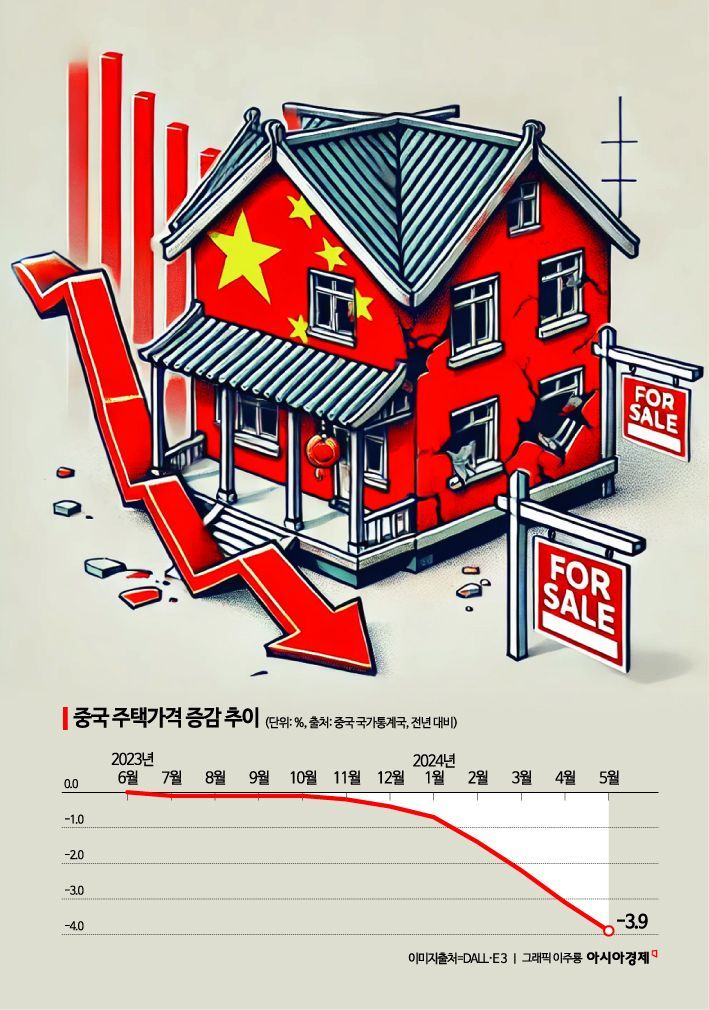
This announcement is interpreted as a follow-up measure after the central government's New Deal policy announced on the 17th of last month, as real estate transactions remained sluggish and prices continued to decline. According to the National Bureau of Statistics of China, the year-on-year decline in housing prices, which was around 0.7% at the beginning of the year, has gradually increased to -1.4% in February, -2.2% in March, -3.1% in April, and -3.9% in May.
Investment has also significantly decreased. From January to May this year, the total real estate investment was 4.06 trillion yuan (approximately 774.9728 trillion won), down 10.1% compared to the same period last year. Recovery of individual investment demand also seems difficult. Guotai Junan Securities recently estimated in a report that the early repayment rate of Chinese mortgage loans reached a record high of 37% in April.
Yan Weijin, head of the research department at Eju Research Institute, told Pengpai News, "This measure has a definite effect of lowering the cost of purchasing a house," explaining, "For example, the deposit for a new house priced at 5 million yuan will be reduced from 1.5 million yuan to 1 million yuan." Yan added, "Beijing's announcement is a significant signal," diagnosing that "As the last first-tier city to adjust deposit and interest rate policies, it is overall positive." He also advised, "It will help create a good purchasing environment and increase market confidence," and emphasized, "Continuous strengthening of market situation monitoring is necessary going forward."
© The Asia Business Daily(www.asiae.co.kr). All rights reserved.
![Clutching a Stolen Dior Bag, Saying "I Hate Being Poor but Real"... The Grotesque Con of a "Human Knockoff" [Slate]](https://cwcontent.asiae.co.kr/asiaresize/183/2026021902243444107_1771435474.jpg)
















