Statistics Korea April Population Trends
The natural population decline, where the number of babies born in April was fewer than the number of deaths, has continued for 54 consecutive months. However, the number of births increased by about 500 compared to last year due to a surprising rise in marriages and other factors.
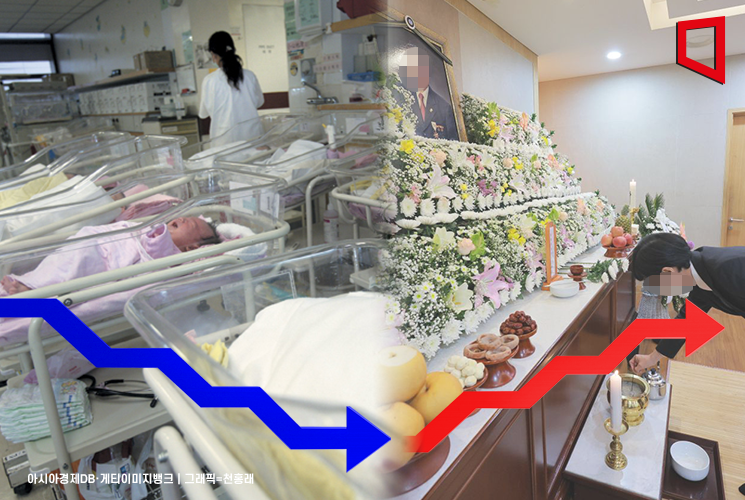
According to the 'April Population Trends' released by Statistics Korea on the 26th, the population naturally decreased by 9,610 in April. The natural population decline has continued for 54 consecutive months since November 2019 (-1,685).
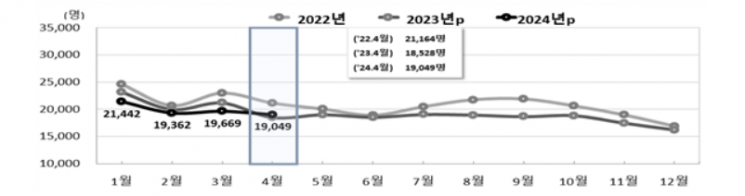
The number of births in April was 19,049, an increase of 521 (2.8%) compared to the same month last year. This is the first time in 1 year and 7 months that the number of births increased compared to the same month of the previous year since September 2022, when it rose by 13 (0.1%).
Regarding the increase in births, Statistics Korea analyzed that "the rise in marriages starting from August 2022 and continuing through the first half of last year is the cause." It explained that it generally takes about two years from marriage to the birth of the first child, so the births of couples who married at that time have begun to be reflected.
There is also a base effect. The number of babies born in April last year was 18,528, a sharp drop of 12.5% compared to the same month the previous year, marking a historic low. The number of births in April was in the 40,000s during 2011-2012, dropped to the 30,000s in 2013, entered the 20,000s in 2018, and fell below 20,000 for the first time last year.
Considering the increase in marriages, the number of births may rise in the second half of this year, but whether the bottom has been reached will need to be observed based on monthly fluctuations. Statistics Korea stated, "Since August 2022, it is highly likely that births will increase around August to October if the average two-year period is considered," adding, "there is room for an increase in the second half."
However, due to the decline from January to March this year, the cumulative number of births up to April was 79,523, marking a historic low. By region, the number of births in April increased in 11 cities and provinces including Seoul and Busan, while it decreased in 6 cities and provinces including Gwangju and Daejeon. The crude birth rate, which indicates the number of births per 1,000 people, was 4.6, slightly higher than last year.
The number of deaths in April was 28,659, an increase of 1,112 (4.0%) compared to one year ago.
Marriages saw a surprising increase due to the base effect from last April’s historic low and the fact that there was one more weekday available for marriage registration.
The number of marriages in April was 18,039, an increase of 3,565 (24.6%) compared to last year. This reversed the decline seen in February (-5.0%) and March (-5.5%) to an increase after three months. The growth rate was the highest since October 2018 (26.0%) and the highest ever for April.
Statistics Korea explained that regions with local government marriage support funds also contributed to the high growth rate.
© The Asia Business Daily(www.asiae.co.kr). All rights reserved.
![Clutching a Stolen Dior Bag, Saying "I Hate Being Poor but Real"... The Grotesque Con of a "Human Knockoff" [Slate]](https://cwcontent.asiae.co.kr/asiaresize/183/2026021902243444107_1771435474.jpg)
















