A method to utilize heat generated from semiconductor devices for computing has been devised in South Korea. Heat generated from semiconductor devices increases energy consumption and interferes with the normal operation of semiconductors. Therefore, minimizing heat generation has been considered a key aspect of existing semiconductor technology. In contrast, the newly devised technology is significant in that it enables the use of heat, which had been a troublesome byproduct, for computing.
KAIST announced on the 25th that a research team led by Professor Kim Kyung-min of the Department of Materials Science and Engineering succeeded in developing thermal computing technology based on the electro-thermal interaction of oxide semiconductors.
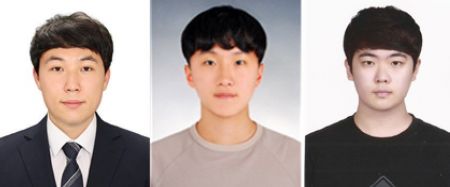
 Professor Kyungmin Kim. KAIST
The research team utilized Mott transition semiconductors, which exhibit strong electro-thermal interactions. They optimized the functions of storing and transferring heat in these semiconductor devices to implement computing using heat.
The developed thermal computing technology has the advantage of solving complex optimization problems such as pathfinding with energy consumption about one-millionth that of conventional digital processors like CPUs and GPUs.
Mott transition semiconductors are semiconductor devices with strong electro-thermal interactions, whose electrical properties change from insulator to conductor depending on temperature.
The research team fabricated Mott transition semiconductor devices on a polyimide substrate?which has low thermal conductivity and high specific heat, and is a polymer material with excellent mechanical strength, flexibility, and heat resistance used in displays, solar cells, and memory?so that heat generated in the Mott transition semiconductor devices could be stored in the polyimide substrate.
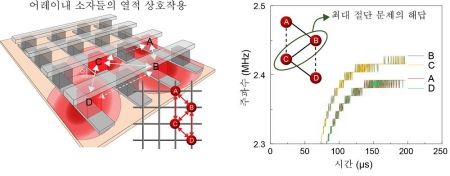 Spatiotemporal heat transfer between Mott transition devices and the process of solving graph optimization problems using this phenomenon. The heat transfer intensity between devices decreases as the distance increases, and this characteristic can be used to construct a graph within an array. When the same voltage is applied to Mott transition devices, they converge to different frequencies according to the heat transfer intensity, enabling the solution of the max-cut problem, according to the research team. Provided by KAIST
As a result, the stored heat was maintained for a certain period, serving as temporal information, and spatially propagated to neighboring devices, serving as spatial information. This enabled the use of heat information both spatially and temporally, allowing computing to be performed using this information.
Professor Kim said, “Heat has characteristics that allow it to be stored and transferred, so if it can be utilized, it can be very useful in computing,” adding, “This research is meaningful in that it is the first to propose the concept of using heat, which was previously discarded, for computing.”
He further emphasized, “By utilizing thermal computing technology, complex signals in neural systems such as neurons can be implemented very simply, and high-dimensional optimization problems can be effectively solved through existing semiconductor technology, making it a practical alternative to ‘quantum computing.’”
Meanwhile, this research was validated through a joint study with the Sandia National Laboratory in the United States. The study involved KAIST’s Department of Materials Science and Engineering doctoral candidates Kim Kwang-min and Lee Young-hyun, and researcher In Jae-hyun as co-first authors. The research results were published in the June 18 issue of the internationally renowned materials science journal Nature Materials (Impact factor: 41.2).
© The Asia Business Daily(www.asiae.co.kr). All rights reserved.
![Clutching a Stolen Dior Bag, Saying "I Hate Being Poor but Real"... The Grotesque Con of a "Human Knockoff" [Slate]](https://cwcontent.asiae.co.kr/asiaresize/183/2026021902243444107_1771435474.jpg)
















