Former Member of People's Solidarity for Participatory Democracy Leading Livelihood Issues
Legal professionals also showed strength in the 22nd general election held on April 10. A total of 61 lawmakers with legal backgrounds were elected, of whom 23 were first-term members. The Legal Times met with these first-term lawmakers from the legal profession to hear about their legislative plans and aspirations.
"During my time as a lawyer, I was mainly involved in legislative reform movements. Together with civic groups, I emphasized the need for legislation to congressional offices and held forums. Although my position has changed to that of a lawmaker, my goal remains steadfast: to represent socioeconomically vulnerable groups and enact laws to eliminate unfair transactions. As a member of the National Assembly, I will listen more attentively to the voices from all sectors of our society and serve as a bridge connecting civil society and the legislature."
Kim Nam-geun (61, Judicial Research and Training Institute class 28, Seongbuk-eul, Seoul), who was elected to the National Assembly in the 22nd general election last April, has led legislative efforts for public welfare while serving as the executive director of the People's Solidarity for Participatory Democracy and vice president of the Lawyers for a Democratic Society. He has promoted dozens of bills, including the "Commercial Building Lease Protection Act" to protect merchants' lease terms, the "Fair Transactions in Franchise Business Act" to protect franchisees' rights, the introduction of the "Sale Price Ceiling System," and the revival of the "Interest Rate Limitation Act."
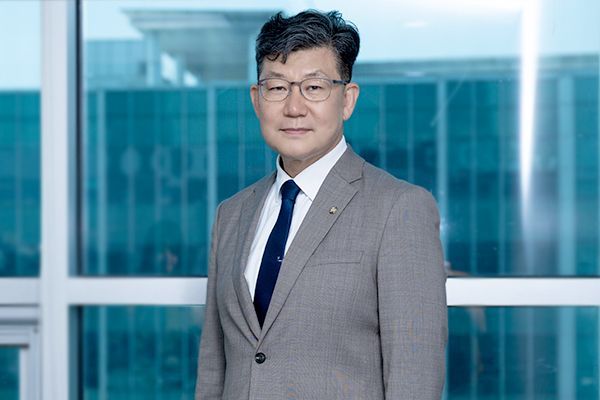
Kim also participated in many high-profile public interest lawsuits that caused significant waves in Korean society. He filed a constitutional lawsuit against the nighttime outdoor assembly ban, leading to the Constitutional Court's ruling of unconstitutionality in 2009. To reform undemocratic party nominations, he secured the country's first injunction suspending nomination validity. He also led a movement to ban forced evictions at redevelopment sites, contributing to the establishment of the National Human Rights Commission's "Forced Eviction Human Rights Guidelines." In 2021, he was the first to raise suspicions of land speculation by employees of the Korea Land and Housing Corporation (LH) related to the 3rd New Town development. His expos? led to the passage of the "Public Officials Conflict of Interest Prevention Act," which regulates public officials engaging in real estate speculation against public ethics.
The following is a Q&A.
Q. What is the top priority bill you plan to promote in the 22nd National Assembly?
A. I will focus on legislation that protects the rights of franchisees, agency owners, small and medium-sized enterprises (SMEs), and small business owners. This includes the "Monopoly Regulation Act" to regulate abuse of monopoly power by online platforms, the "Fair Transactions in Franchise Business Act" to improve unreasonable franchise fees through collective bargaining between large platforms and franchisees, and the "Small and Medium Enterprise Cooperative Act."
Recently, domestic online shopping malls have faced existential threats due to ultra-low price competition from Chinese e-commerce platforms such as AliExpress and Temu. Domestic consumers have suffered from incomplete product sales and inadequate refund and exchange measures on these platforms. To protect domestic consumers from overseas platforms, we are also discussing the proposal of an amendment to the "Electronic Commerce Act." We have invited civic group representatives and experts to the National Assembly for legislative listening sessions and are proceeding with legislative discussions based on the collected opinions.
Q. You mentioned taking the lead in resolving livelihood economy issues. Housing prices and real estate problems cannot be separated from the livelihood economy.
A. The sharp short-term rise in housing prices, including jeonse (key money deposit) prices, is closely linked to financial issues. I view seriously the government's problem of driving up housing prices by providing "excessive loans" at low interest rates.
Early last year, the government released 60 trillion won in policy funds through a special Bogeumjari loan, causing housing prices to suddenly rise and then sharply fall in October when the loans ended. Also, starting this year, the government implemented a 27 trillion won "newborn special loan." As Minister of Land, Infrastructure and Transport Park Sang-woo admitted earlier this month, this has recently stimulated excessive jeonse consumption and led to rising jeonse prices. By leading excessive loans as a policy, the government has ultimately caused housing prices to rise, harming ordinary citizens. I want to thoroughly verify this issue and refer to overseas legislative cases to promote the "Excessive Loan Prevention Act."
Q. You have worked as a lawyer for 25 years. As a legal professional, what legal sector issues are you most interested in?
A. The system and practice for patent-related litigation need improvement. In lawsuits concerning large corporations' theft of SME technologies, SMEs often have to prove the damage, making it difficult for them to win cases. We should introduce the U.S.-style discovery system to ensure both parties transparently disclose evidence.
The "punitive damages system" also needs improvement. There is a need to introduce the U.S.-style system allowing damages up to three times the amount of actual damages. Although punitive damages provisions exist in about 30 laws domestically, judges rarely apply them. Occasionally, courts order damages of 1.2 to 1.5 times the damage amount, but this is far from "punitive." The compensation is unreasonably low compared to the profits gained from infringement. I plan to promote legislation that sets "triple damages" as the principle, allowing courts to reduce damages only in exceptional cases. Additionally, the increasing number of "class action lawsuits" requires system adjustments. Under the "Product Liability Act," consumers must prove product defects and damages, but this principle of civil litigation makes it difficult to realize judicial justice. I aim to contribute to legal amendments in this area.
Hong Yoon-ji, Legal Times Reporter
※This article is based on content supplied by Law Times.
© The Asia Business Daily(www.asiae.co.kr). All rights reserved.
![Clutching a Stolen Dior Bag, Saying "I Hate Being Poor but Real"... The Grotesque Con of a "Human Knockoff" [Slate]](https://cwcontent.asiae.co.kr/asiaresize/183/2026021902243444107_1771435474.jpg)
















