The number of young people classified as 'resting,' who are neither working nor seeking jobs, has increased again after nine months. Despite the government's labor market entry measures announced last year, the number of resting youth remains around 400,000.
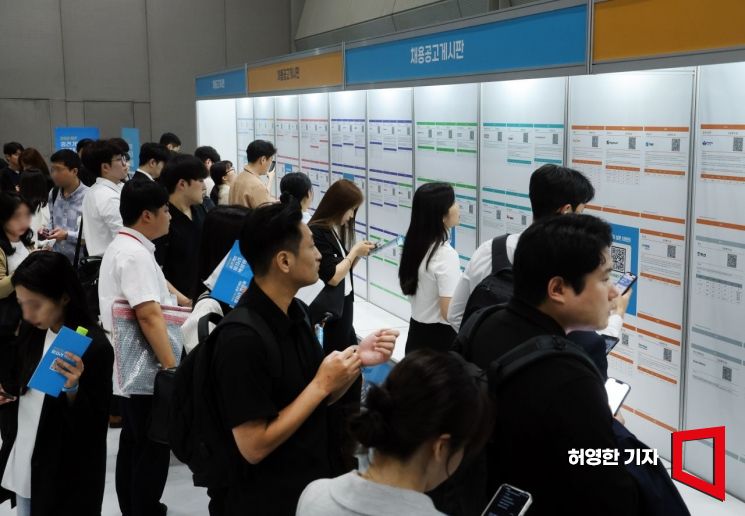 Job seekers are looking at the job posting board at a mid-sized company job fair held last May.
 [Photo by Heo Younghan]
According to the National Statistical Portal of Statistics Korea and microdata from the Economically Active Population Survey on the 23rd, the number of young people aged 15 to 29 classified as 'resting' last month was 398,000, an increase of 13,000 compared to a year ago.
Last month's number of resting youth was the second highest since related statistics began to be compiled in May 2003, following 462,000 in 2020.
'Resting' refers to those who are not employed or unemployed but are part of the economically inactive population who do not have serious illnesses or disabilities and responded in the Economically Active Population Survey that they are "just resting."
The proportion of resting youth within the total youth population also jumped from 4.6% to 4.9% in one year. This is because the number of youth who are "just resting" increased despite the decline in the youth population.
The number of resting youth began to decrease year-on-year from September last year but the rate of decline has been narrowing since March this year.
The number of youth who have given up job seeking, which had decreased last year, has turned to an increasing trend this year. Job seekers who have given up are those in the economically inactive population who want to work and could work but have given up looking for a job because they believe they will not find one that meets conditions such as wage levels.
The average monthly number of youth who gave up job seeking from January to May this year was 120,179, about 11,000 more than the same period last year (108,525). Youth account for 31.1% of the total 387,000 people who have given up job seeking.
The number of youth who gave up job seeking recorded 136,808 from January to May 2022, decreased by about 30,000 last year, but has increased again this year.
The slowdown in the youth employment market appears to have become entrenched through the COVID-19 pandemic. The number of resting youth, which was around 274,000 in 2010, increased by 64% to 448,000 in 2020. It then declined until 2022 (390,000) but exceeded 400,000 again last year, recording 401,000.
Despite the decline in the youth population, the number of resting youth has remained high, fluctuating between 400,000 and 443,000 through April this year.
© The Asia Business Daily(www.asiae.co.kr). All rights reserved.
![Clutching a Stolen Dior Bag, Saying "I Hate Being Poor but Real"... The Grotesque Con of a "Human Knockoff" [Slate]](https://cwcontent.asiae.co.kr/asiaresize/183/2026021902243444107_1771435474.jpg)















