If the departure of residents continues, Seoul Medical Center and Boramae Hospital, both municipal hospitals of Seoul, are expected to incur losses amounting to 90 billion KRW this year.
According to Seoul City on the 23rd, if the group of residents who left collectively on February 20 do not return, the two municipal hospitals are estimated to suffer losses of 89.7 billion KRW by the end of this year. Seoul Medical Center's loss is expected to reach 52.5 billion KRW, and Boramae Hospital's 37.2 billion KRW.
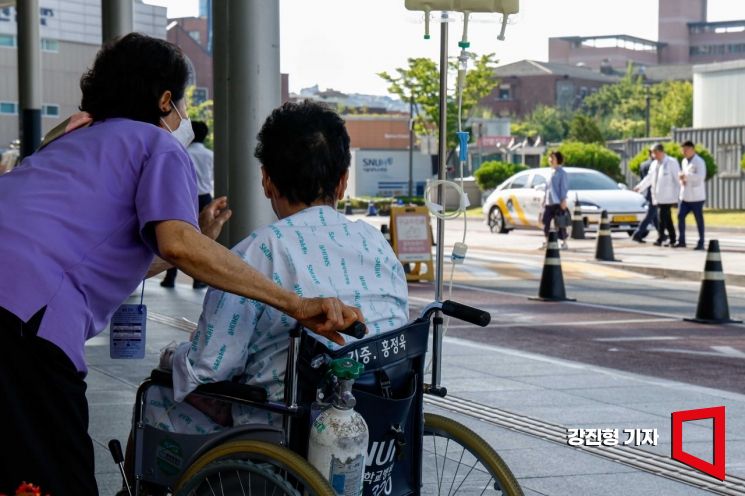 On the 17th, when professors at Seoul National University Hospital began an indefinite strike demanding the resolution of the resident doctor crisis, patients and their families were looking at the medical staff at Seoul National University Hospital in Jongno-gu, Seoul.
 [Photo by Kang Jin-hyung]
Due to the aftermath of conflicts between medical staff and the government, bed occupancy rates have dropped even in public medical institutions with a high proportion of residents. Seoul Medical Center's bed occupancy rate, which was 72% before the residents' departure, fell by 28 percentage points to 44% as of the end of May. Boramae Hospital also saw a decrease from 72% to 52%, a drop of 20 percentage points.
At Seoul Medical Center, residents account for 44 out of 203 doctors, making up 22%, while at Boramae Hospital, residents are 118 out of 348 doctors, or 34%. The proportion of residents at Boramae Hospital is similar to that of Seoul Asan Hospital (34.5%) and Seoul St. Mary's Hospital (33.8%).
Outpatient treatment performance has also deteriorated. Boramae Hospital treated an average of 3,332 outpatients per day last year, but this number decreased to 2,888 in May following the residents' resignation crisis.
Seoul City plans to allocate about 45.6 billion KRW, roughly half of the losses of the two municipal hospitals, from the city budget to support them. The city had previously injected 11.8 billion KRW from the Disaster Management Fund and plans to allocate an additional 33.8 billion KRW through a supplementary budget. Combining the Disaster Management Fund and the supplementary budget, the total support amounts to 45.6 billion KRW.
The hospitals have activated emergency management systems and started various cost-cutting measures. Seoul Medical Center and Boramae Hospital have postponed new hires for non-physician positions and are recommending unpaid leave to all employees except doctors to reduce labor costs. Seoul Medical Center plans to increase medical services such as MRI and CT scans and rehabilitation treatments while reducing expenses for events and promotions.
© The Asia Business Daily(www.asiae.co.kr). All rights reserved.
![Clutching a Stolen Dior Bag, Saying "I Hate Being Poor but Real"... The Grotesque Con of a "Human Knockoff" [Slate]](https://cwcontent.asiae.co.kr/asiaresize/183/2026021902243444107_1771435474.jpg)















