According to Policies and Visas, Foreigners' Responsible Departments Vary
Policy Review Unified under 'Foreigners and Multicultural Policy Committee'
Lowering Private Company Fees and Significantly Reducing Illegal Immigrants
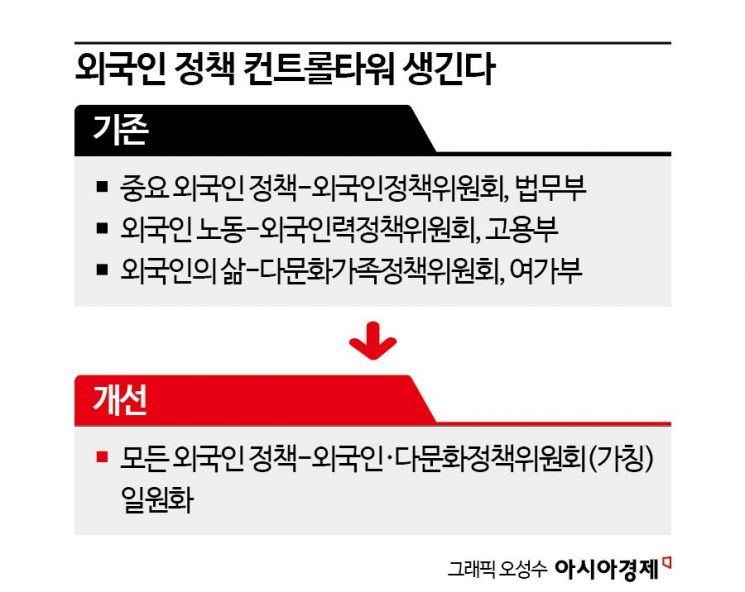
The government is establishing a control tower to manage the 2.6 million foreign residents living in the country. Demand for foreign labor has increased due to low birth rates and job mismatches, but the management entities are scattered according to visas and roles. The government plans to assess the actual need for foreign labor and address various side effects such as remittance costs and illegal residents.
On the 20th, the Office for Government Policy Coordination held a meeting of ministers related to national issues at the Government Complex Sejong, chaired by Prime Minister Han Duck-soo, and announced the ‘Rational Management Plan for Foreign Labor.’ The core of this plan is to unify several foreign policy review bodies into the ‘Foreigners and Multicultural Policy Committee (tentative name).’ The Prime Minister will serve as the chairperson, and the subcommittees will include the Minister of Justice, the head of the Office for Government Policy Coordination, and the Minister of Gender Equality and Family. The government plans to revise the Foreigners Treatment Act and launch the committee in the first half of next year.
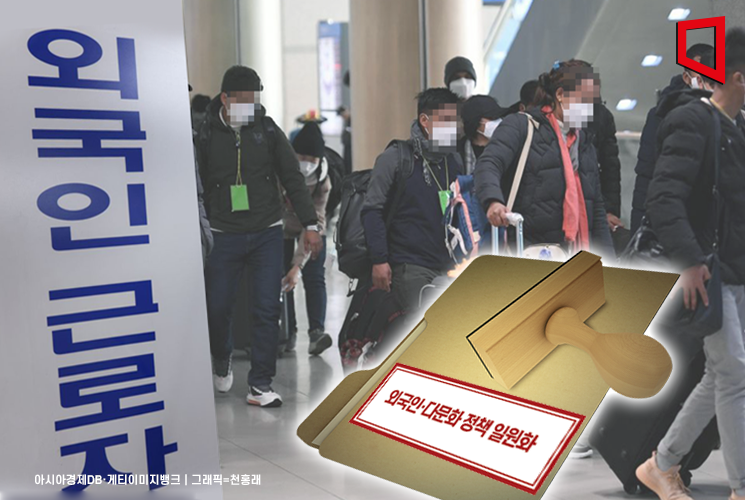
After its launch, the integrated committee will conduct mid- to long-term manpower supply and demand assessments by industry. For example, the supply and demand forecast for seasonal work (E-8) visas has so far been conducted solely by the Ministry of Justice. Going forward, the Ministry of Agriculture, Food and Rural Affairs will assess the outlook for agriculture and livestock industries (E-8·E-9), and the Ministry of Oceans and Fisheries will review manpower supply and demand for related visas in the fisheries sector (E-8·E-9·E-10). Once foreign labor demand by industry is consolidated, the Office for Government Policy Coordination will adjust the total volume of foreign visas.
Different Government Departments Handle Foreigners Depending on Policy and Visa
Foreign labor policies have long been criticized for inefficiency. Currently, the departments responsible for foreigners are divided according to policy. For instance, the overall review of foreigner policies is handled by the ‘Foreign Policy Committee,’ chaired by the Prime Minister, with the Ministry of Justice serving as the secretariat. However, policies related to foreign labor fall under the ‘Foreign Labor Policy Committee,’ chaired by the head of the Office for Government Policy Coordination, with the Ministry of Employment and Labor leading the meetings. Matters concerning the lives and social integration of foreigners in the country are managed by the ‘Multicultural Family Policy Committee’ and the Ministry of Gender Equality and Family.
Management departments also differ depending on the type of visa issued. The introduction and management of visas for skilled workers (E-1 to E-7), short-term employment, and international students are the responsibility of the Ministry of Justice. However, non-skilled worker visas such as non-professional employment (E-9) and visiting employment (H-2) are handled by the Ministry of Employment and Labor. The Ministry of Oceans and Fisheries separately manages seafarer employment (E-10) visas.
Because the responsible departments are fragmented, systematic management has been limited. Without mid- to long-term manpower supply and demand policies, it has been difficult to grasp the overall demand for foreign workers, and visa issuance has been handled in a piecemeal manner. Especially since the scale of foreign worker introduction is decided by visa type, labor shortages have frequently occurred in agriculture and fisheries sectors.
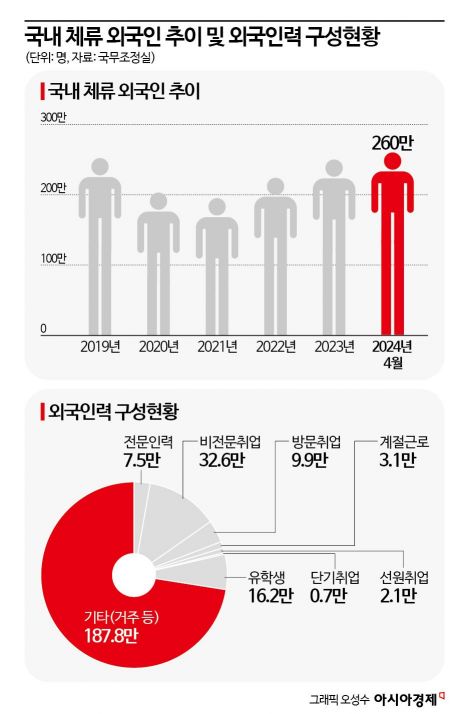
The industrial field expects foreign labor to increase further. This is due to the ongoing low birthrate trend and domestic workers’ avoidance of certain jobs. As of April, the number of foreigners residing in the country was 2,602,669, rapidly increasing from 2,245,912 in 2022 and 2,507,854 last year. In particular, the seasonal worker quota introduced in 2022 increased from 19,000 at that time to 49,000 in the first half of this year, and the non-professional employment quota also grew from 69,000 to 165,000 during the same period.
Lowering Private Company Remittance Costs and “Dramatic Reduction” of Illegal Residents
President Yoon Suk-yeol himself pointed out the absence of a control tower for foreign labor. In June last year, President Yoon met regularly with Prime Minister Han and instructed, “Devise a plan to integrate and manage foreign labor scattered across various ministries so that foreign labor can be operated comprehensively and flexibly in line with market changes.” Prime Minister Han also reported, “We will form a task force (TF) and promptly prepare improvement measures.”
The committee also plans to address the issue of excessive remittance costs charged by private companies. Although local governments formally select seasonal workers and seafarers, their organizational and manpower limitations mean that private companies on-site usually recruit the labor. However, private companies have started demanding excessive fees, increasing local government costs. The government plans to establish standards for private companies’ brokerage methods, qualifications, and sanctions through the committee. Excessive fees and deposits will also be institutionally prohibited.
Regarding the concern over illegal residents due to the increase in foreign labor, the government aims for a “dramatic reduction.” The estimated number of illegal residents in the country exceeded 400,000 in September 2022 and increased to about 424,000 last year. Through a five-year plan to reduce illegal residents implemented since last year, the government plans to reduce the number to the 200,000 range by 2027. Joint government crackdowns will be regularized, and manpower for illegal resident enforcement will be reinforced.
Prime Minister Han said, “Systematic management and utilization of foreign labor is an important task for reestablishing the ecosystem of the domestic labor market,” and urged, “Related ministries should promote systematic management based on close cooperation so that diligent foreign workers can be stably introduced without infringing on jobs for our citizens.”
© The Asia Business Daily(www.asiae.co.kr). All rights reserved.
![Clutching a Stolen Dior Bag, Saying "I Hate Being Poor but Real"... The Grotesque Con of a "Human Knockoff" [Slate]](https://cwcontent.asiae.co.kr/asiaresize/183/2026021902243444107_1771435474.jpg)

















