10,000 Calls Waiting Due to Appointment Changes
Patients and Nurses Say "Healthcare Must Return to Normal"
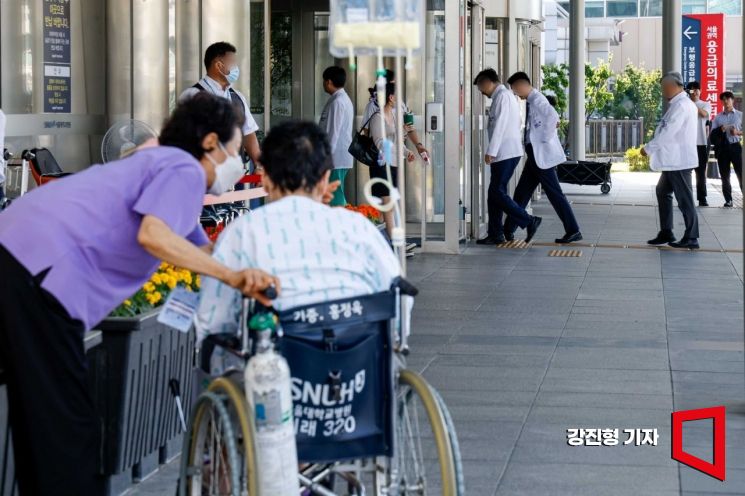 On the 17th, as professors at Seoul National University Hospital began an indefinite strike demanding resolution of the resident doctors' crisis, patients and their families were seen looking at the medical staff at Seoul National University Hospital in Jongno-gu, Seoul. Photo by Jinhyung Kang aymsdream@
As professors at Seoul National University College of Medicine began an indefinite strike on the 17th, Kim Sung-joo, the representative of the Korea Severe Disease Alliance, stated, "This will bring about a tremendous fear and suffering different from the resident doctors' strike."
Kim appeared on CBS Kim Hyun-jung's News Show that day and explained, "Professors play the role of conducting the entire treatment like an orchestra for severe disease patients who require multidisciplinary treatments such as surgery, chemotherapy, and radiation." He warned that the professors' strike would have enormous repercussions. He cited a survey of pancreatic cancer patients showing that only 30% were receiving normal treatment, while 70% were undergoing abnormal care. He added, "This is not about waiting a day or two with fewer prescriptions for a cold; asking cancer patients to wait four months and understand is pushing them to the brink of death."
Kim also mentioned cases of patients who, after hearing suspicious signs of pancreatic cancer, continuously called hospitals to make appointments but experienced delays in treatment. He said, "Even the first chemotherapy session is delayed, chemotherapy schedules change according to the hospital's timetable, and if postponed, patients are left in constant anxiety."
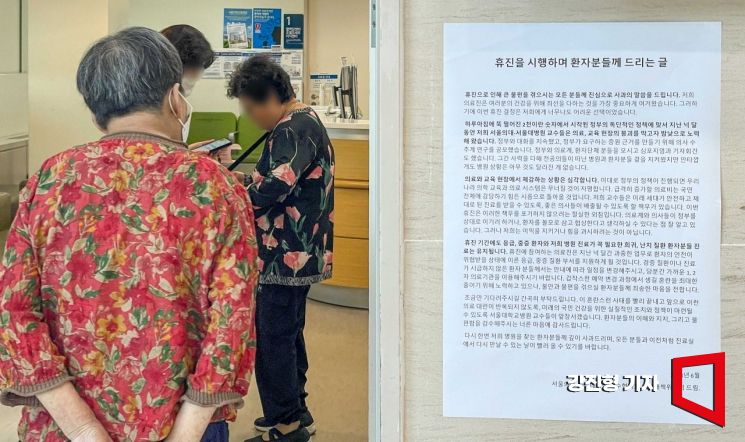 On the 17th, when Seoul National University Hospital professors began an indefinite strike demanding the resolution of the resident doctors' crisis, a notice titled "A Message to Patients During the Strike," written by the Emergency Response Committee of the Seoul National University Hospital Professors' Council, was posted at Seoul National University Hospital in Jongno-gu, Seoul. Photo by Jinhyung Kang aymsdream@
Kim Young-joong, the senior vice chairman of the union at Bundang Seoul National University Hospital, also appeared on the same broadcast, stating, "Due to the strike decision, there is a flood of patient inquiry calls, with over 10,000 calls waiting daily." He explained, "When appointments are changed, everything from outpatient nurses, medical departments, and testing units to prior audits and surgery schedules gets disrupted and must be rescheduled."
Kim emphasized, "If you think hospital staff are opposing doctors, that is a misunderstanding," adding, "Healthcare workers are the ones who rejoice the most when patients improve." He expressed hope that "the medical-government conflict will be resolved quickly so that patients no longer suffer and healthcare workers can return to their respective positions."
Meanwhile, on the same day, professors at four hospitals affiliated with Seoul National University College of Medicine?Seoul National University Hospital, Bundang Seoul National University Hospital, Boramae Hospital, and Seoul National University Hospital Gangnam Center?began their strike. By the 22nd, 54.7% (529 out of 967) of professors had either suspended or reduced outpatient services and postponed regular surgeries, procedures, and examinations. The professors plan to halt regular outpatient care and surgeries, continuing only treatment for severe and rare disease patients.
© The Asia Business Daily(www.asiae.co.kr). All rights reserved.
![Clutching a Stolen Dior Bag, Saying "I Hate Being Poor but Real"... The Grotesque Con of a "Human Knockoff" [Slate]](https://cwcontent.asiae.co.kr/asiaresize/183/2026021902243444107_1771435474.jpg)
















