Xiaomi subsidiary to start sales from Q4
Establishing routes not only for emergency rescue, tourism, and distribution but also for commuting
China's "low-altitude economy" development is gaining momentum. Flying car demonstrations have been conducted from the capital Beijing to nearby areas such as Tianjin, and manufacturers plan to start selling related vehicles from the fourth quarter of this year.
On the 16th, AeroHT, a subsidiary of Chinese electric vehicle startup Xiaopeng, announced through its official social media that its flying car "Voyager X2" completed its first demonstration in the Beijing-Tianjin-Hebei region at the Langfang International Economic and Trade Expo held that day.
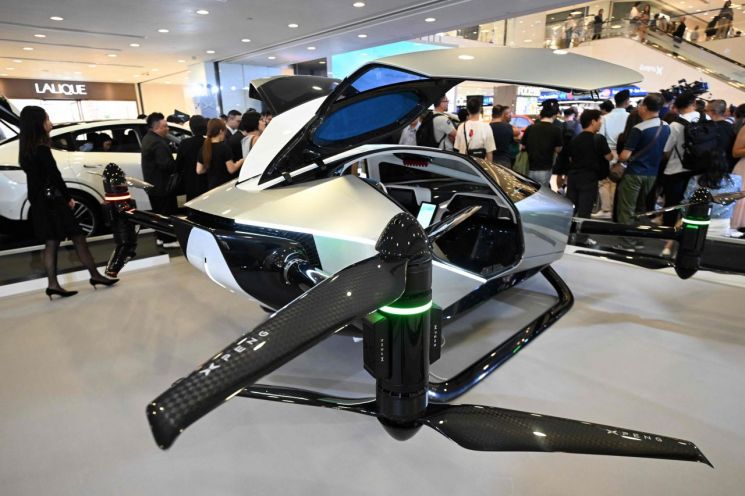
AeroHT explained that the company is preparing for mass production and plans to start pre-sales of the vehicle in the fourth quarter of this year. However, the specific sales price has not yet been disclosed.
AeroHT, a joint venture between Xiaopeng and Guangdong Huitian Aviation Fund Technology, was established in September 2020 and has filed a total of 308 domestic and international patents focusing on key areas such as flying car power systems, safety systems, avionics systems, autonomous driving, flight control, and flying car structure. The X2 completed its first public flight in Dubai in October 2020.
China has recently been paying special attention to the low-altitude economy, which involves flying below 3,000 meters with unmanned drones and flying cars. This year, the central government included the low-altitude economy in its work report for the first time, and according to local government reports in April, a total of 26 local governments have established related economic plans for this year.
Earlier in March, Beijing announced plans to establish three major flying car routes connecting nearby areas by 2027, including purposes such as emergency rescue, logistics and distribution, cultural tourism, and commuting. According to the China Information Industry Development Center, the size of China's low-altitude market is expected to grow from 506 billion yuan (approximately 96.3 trillion KRW) last year to 1 trillion yuan by 2026.
However, there are also opinions that it will be difficult for flying cars to be commercialized in the near future. In April, Wu Siming, Deputy Director of the Science and Technology Committee of China Aviation Industry Corporation, mentioned that although China's low-altitude economy has begun to take shape, infrastructure development is minimal and there is a lack of industry-wide standards, which hinders large-scale commercial launches.
© The Asia Business Daily(www.asiae.co.kr). All rights reserved.
![Clutching a Stolen Dior Bag, Saying "I Hate Being Poor but Real"... The Grotesque Con of a "Human Knockoff" [Slate]](https://cwcontent.asiae.co.kr/asiaresize/183/2026021902243444107_1771435474.jpg)















