Duty-Free Shop Revenue Reinvested in International Free City
"Should Have No Restrictions Like Arrival Duty-Free Shops"
"We are working to improve the system by recommending the transition of the 15 restricted duty-free items to a negative list system (principle-based allowance and exception-based prohibition) and the abolition of the annual purchase limit currently set at six times." (Yang Young-cheol, Chairman of JDC)
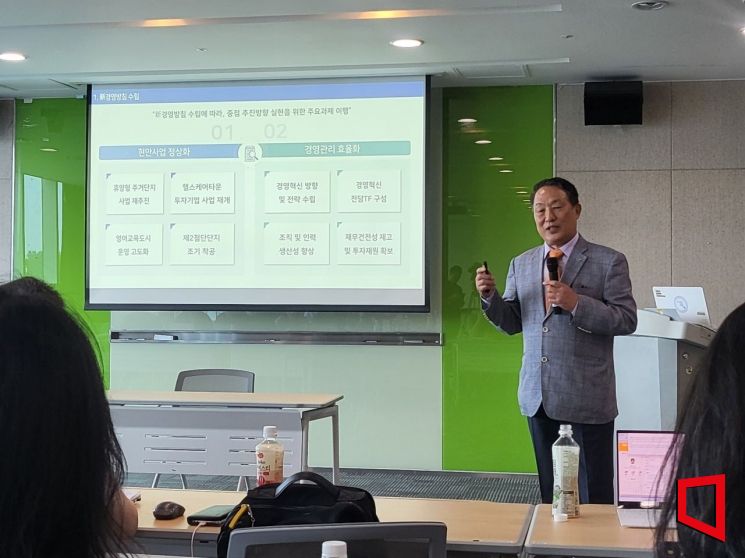 Yang Young-cheol, Chairman of the Jeju Free International City Development Center (JDC), is answering questions from reporters after reporting on the status of the JDC Duty-Free Shop business at the Jeju headquarters on the 14th. / Photo by Noh Kyung-jo
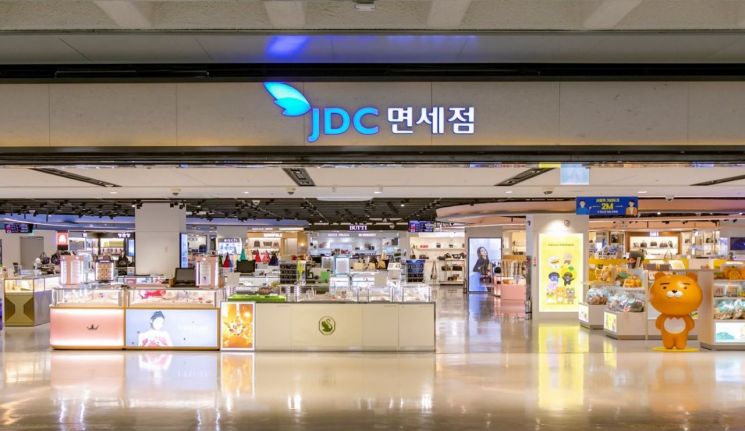
There are duty-free shops available for domestic residents as well. These are the JDC Duty-Free Shops (hereafter referred to as duty-free shops) located at Jeju Airport's domestic terminal and Jeju Port. As the name suggests, they are operated by the Jeju Free International City Development Center (JDC). All profits from the duty-free shops are reinvested in the Jeju Free International City development projects. This is the driving force behind JDC's ability to pursue projects such as the Shinhwa History Park, English Education City, Jeju Advanced Science and Technology Complex, and Jeju Aerospace Museum without government funding.
On the afternoon of the 14th, the domestic departure hall at Jeju Airport was bustling with travelers. There were groups of students, families, friends, and foreigners. The duty-free shops greeting them in front of the boarding gates were offering discounts ranging from 10% to 30%. However, the product categories were limited to items such as liquor, tobacco, and cosmetics.
In terms of size, the duty-free shop at Jeju Airport is the largest at 3,132.3㎡, currently housing 81 partner companies and 284 brands as of May this year. The Jeju Port duty-free shops are smaller, located at Pier 2 and Pier 7, with areas of 281.7㎡ and 234.6㎡ respectively.
Since the number of air travelers exceeds that of ferry passengers, about 98% of total sales come from the duty-free shop at Jeju Airport. Based on last year’s figures, Jeju Airport recorded sales of 528.1 billion KRW, Pier 2 at Jeju Port 4.97 billion KRW, and Pier 7 at Jeju Port 5.33 billion KRW. Since opening in December 2002, cumulative sales and net profits have reached 7.7934 trillion KRW and 1.9218 trillion KRW respectively. However, compared to the duty-free shops in Hainan Province, China, which opened in 2011?about ten years later?the annual sales (approximately 13 trillion KRW) are still far behind.
Chairman Yang said, "Sales increased by about 100 billion KRW compared to the average during the COVID-19 pandemic period of 2021-2022, but since the start of the endemic phase last year, sales have returned to pre-2021 levels. Recently, complex external factors such as high exchange rates and recession-induced consumer sentiment contraction have affected sales decline, so we are conducting various customer-targeted marketing promotions."
However, he mentioned that the fundamental solution lies elsewhere. It is to ease the annual purchase limit of six times and the restriction on 15 types of saleable items. According to JDC, the duty-free shops showed clear growth following regulatory relaxations. After the duty-free limit was increased from $400 to $600 in December 2014, and separate duty-free treatment was applied to liquor and tobacco in April 2020, sales jumped by about 100 to 200 billion KRW within one to two years compared to the previous year.
Chairman Yang emphasized, "Since this is the first duty-free shop targeting domestic residents, the government imposed stricter regulations than on bonded sales shops (duty-free shops used when leaving the country) due to concerns about encouraging overspending and disrupting the distribution market. However, with the emergence of arrival duty-free shops that have no purchase frequency or item restrictions, this government rationale has been broken. There is a need to make the system more flexible."
He particularly noted, "The Hainan Province duty-free shops have no limit on annual purchase frequency, a duty-free range of 100,000 yuan (about 18.8 million KRW), and 45 types of items. To overcome this gap, we have submitted tax expenditure proposals to the Ministry of Economy and Finance. Once the 22nd National Assembly is organized, we will continue to strive for system improvements."
© The Asia Business Daily(www.asiae.co.kr). All rights reserved.
![Clutching a Stolen Dior Bag, Saying "I Hate Being Poor but Real"... The Grotesque Con of a "Human Knockoff" [Slate]](https://cwcontent.asiae.co.kr/asiaresize/183/2026021902243444107_1771435474.jpg)
















