‘HD Hyundai Oilbank + Lotte Chemical’ Side Support
1.9 Trillion Loan Repayment for HPC Investment... Debt Restructuring
Sales Doubled but Borrowings Not Reduced Due to Market Downturn
HD Hyundai Chemical has raised 1.5 trillion KRW in funds to repay loans borrowed from banks for investment in HPC (heavy oil-based petrochemical facilities). Its shareholders, HD Hyundai Oilbank and Lotte Chemical, provided credit support as a form of side assistance, with seven banks including KDB Industrial Bank participating as the lending consortium.
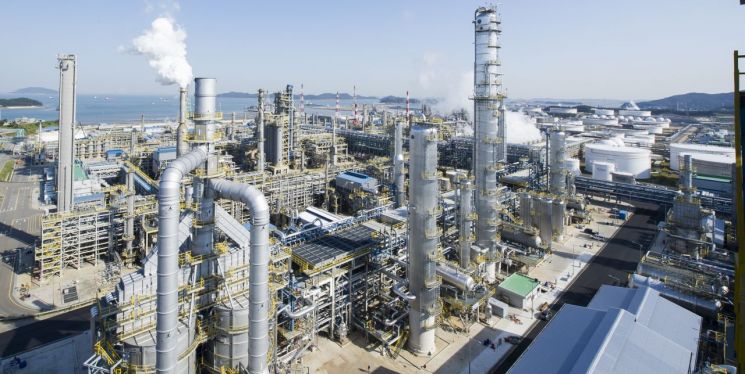
According to the investment banking (IB) industry on the 17th, Hyundai Chemical received a syndicated loan worth 1.5 trillion KRW under the lead of the Industrial Bank of Korea on the same day. The loan maturity is 9 years, with principal repayment or refinancing due in 2033. Seven domestic and foreign banks, including the lead bank Industrial Bank of Korea, Export-Import Bank of Korea (KEXIM), Hana Bank, Kookmin Bank, Woori Bank, Shinhan Bank, NongHyup Bank, and Bank of China, executed loans ranging from several hundred billion to several trillion KRW. Some banks sold the loans to the market through securitization (sell-down).
In this loan, the shareholders Hyundai Oilbank and Lotte Chemical provided liquidity support agreements as side assistance. They promised to support the liquidity needed for repayment if Hyundai Chemical fails to properly repay the principal and interest of the loan. The two companies are shareholders holding 60% and 40% of Hyundai Chemical’s shares, respectively. The liquidity support agreement responsibilities were also divided in a 6:4 ratio. The maximum credit guarantee limits are 900 billion KRW and 600 billion KRW, respectively.
The reason shareholders stepped in to support is that it is difficult for Hyundai Chemical to independently borrow long-term funds of 1.5 trillion KRW at a low interest rate. Hyundai Chemical’s credit rating is rated A. It is estimated that borrowing a 9-year maturity loan at the current credit rating would require paying an interest rate close to 10%. Even if the interest rate is increased, it is difficult to obtain a sufficient loan amount without support from the parent company.
Hyundai Oilbank and Lotte Chemical have credit ratings of AA, which are relatively higher than Hyundai Chemical. A financial industry official said, "If Hyundai Chemical borrows a large-scale loan with its own credit rating, the interest rate difference compared to receiving credit support from shareholders is significant," adding, "It is understood that shareholders provided credit support according to their shareholding ratios to reduce interest expenses."
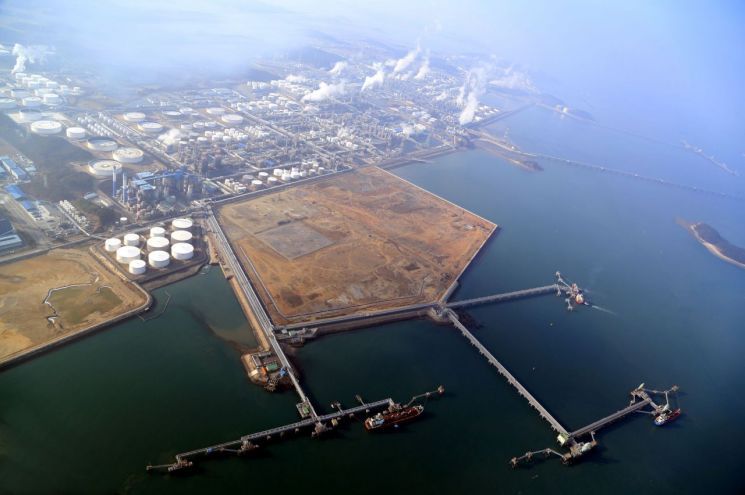
Hyundai Chemical plans to use the raised funds to repay the existing loan of 1.9 trillion KRW borrowed for facility investment. In 2019, Hyundai Chemical invested about 3 trillion KRW to build an HPC plant on a 200,000-pyeong site in Daesan Industrial Complex, Seosan City, Chungcheongnam-do. During this process, it borrowed 1.9 trillion KRW from 15 financial institutions. By repaying all existing borrowings with this syndicated loan, it can reduce borrowings for facility investment by about 400 billion KRW.
An IB industry official explained, "Although the maturity of the existing loan was still long, the need for debt restructuring arose as market interest rates rose," adding, "The existing loan was repaid early before maturity, reducing the overall loan interest burden."
Hyundai Chemical completed the HPC and started operations in 2021. It currently produces polyethylene (PE), polypropylene (PP), ethylene vinyl acetate (EVA) used in solar panel materials, and more. The produced products are supplied to Hyundai Oilbank, Hyundai Cosmo, Lotte Chemical, and others. Compared to naphtha, the main raw material in existing petrochemical processes, products are produced using refinery by-products such as desulfurized heavy oil, by-product gas, and liquefied petroleum gas (LPG), which are cheaper, resulting in high cost competitiveness.
Accordingly, sales have approximately doubled since the HPC started operations. Sales increased from 3 to 4 trillion KRW before HPC operation to an average of about 7 trillion KRW over the past two years. EBITDA also increased from around 100 billion KRW to about 300 billion KRW. However, due to a decline in sales caused by recent market downturns and depreciation expenses from large-scale investments, the company has continued to post operating losses for two consecutive years.
Additionally, combined with interest burdens, operating cash flow (OCF) has decreased, preventing the reduction of increased debt burdens. Net debt, excluding cash equivalents from total borrowings, increased from 1.7 trillion KRW at the end of 2020 to 3.8 trillion KRW at the end of last year and has remained at the same level in the first quarter of this year.
© The Asia Business Daily(www.asiae.co.kr). All rights reserved.
![Clutching a Stolen Dior Bag, Saying "I Hate Being Poor but Real"... The Grotesque Con of a "Human Knockoff" [Slate]](https://cwcontent.asiae.co.kr/asiaresize/183/2026021902243444107_1771435474.jpg)
















